 Français
 English

| ELK.No | ES5961 |
| Product name | ITPK1 rabbit pAb |
| Reactivity | Human;Mouse |
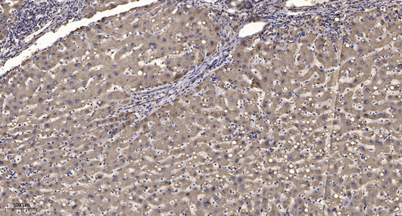
| Applications | WB;ELISA;IHC |
| Other name | ITPK1; Inositol-tetrakisphosphate 1-kinase; Inositol 1; 3,4-trisphosphate 5/6-kinase; Inositol-triphosphate 5/6-kinase; Ins(1,3,4)P(3) 5/6-kinase |
| Size | 100μL |
| Unit price ($) | 248 |
| Human gene ID | 3705 |
| Human Swiss-Prot | Q13572 |
| Source | Rabbit |
| Isotype | IgG |
| Target | ITPK1 |
| Fields | >>Inositol phosphate metabolism;>>Metabolic pathways;>>Phosphatidylinositol signaling system |
| Gene name | ITPK1 |
| Protein name | Inositol-tetrakisphosphate 1-kinase |
| Human gene link | View Human Gene |
| Human Swiss link | View Human Swiss-Prot |
| Mouse gene ID | 217837 |
| Mouse gene link | View Mouse Gene |
| Mouse Swiss-Prot | Q8BYN3 |
| Mouse Swiss link | View Mouse Swiss-Prot |
| Rat gene ID | |
| Rat gene link | |
| Rat Swiss-Prot | |
| Rat Swiss link | |
| Immunogen | The antiserum was produced against synthesized peptide derived from human ITPK1. AA range:81-130 |
| Specificity | ITPK1 Polyclonal Antibody detects endogenous levels of ITPK1 protein. |
| Formulation | Liquid in PBS containing 50% glycerol, 0.5% BSA and 0.02% sodium azide. |
| Clonality | Polyclonal |
| Dilution | WB 1:500-2000;IHC-p 1:50-300; ELISA 2000-20000 |
| Purification | The antibody was affinity-purified from rabbit antiserum by affinity-chromatography using epitope-specific immunogen. |
| Concentration | 1 mg/ml |
| Storage stability | -20°C/1 year |
| Molecular Weight (Da) | |
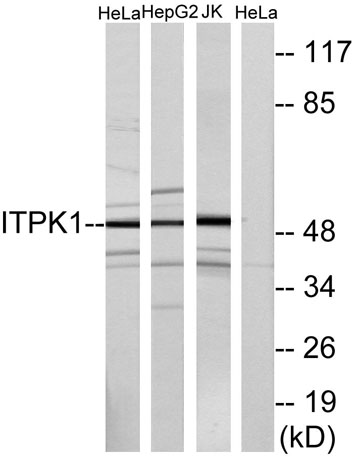
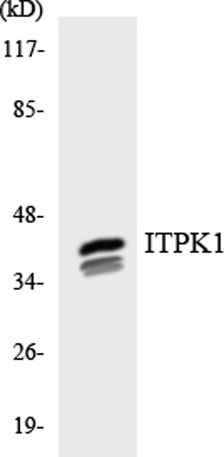
| Observed band (KD) | 50kD |
| Background | This gene encodes an enzyme that belongs to the inositol 1,3,4-trisphosphate 5/6-kinase family. This enzyme regulates the synthesis of inositol tetraphosphate, and downstream products, inositol pentakisphosphate and inositol hexakisphosphate. Inositol metabolism plays a role in the development of the neural tube. Disruptions in this gene are thought to be associated with neural tube defects. A pseudogene of this gene has been identified on chromosome X. [provided by RefSeq, Jul 2016], |
| Function | catalytic activity:ATP + 1D-myo-inositol 1,3,4-trisphosphate = ADP + 1D-myo-inositol 1,3,4,5-tetrakisphosphate.,catalytic activity:ATP + 1D-myo-inositol 1,3,4-trisphosphate = ADP + 1D-myo-inositol 1,3,4,6-tetrakisphosphate.,catalytic activity:ATP + 1D-myo-inositol 3,4,5,6-tetrakisphosphate = ADP + 1D-myo-inositol 1,3,4,5,6-pentakisphosphate.,caution:PubMed:11533064 detected some protein kinase activity and ability to phosphorylate transcription factors c-jun/JUN and ATF2. However, PubMed:15762844 showed that it does not have protein kinase activity.,cofactor:Binds 2 magnesium ions per subunit.,function:Kinase that can phosphorylate various inositol polyphosphate such as Ins(3,4,5,6)P4 or Ins(1,3,4)P3. Phosphorylates Ins(3,4,5,6)P4 at position 1 to form Ins(1,3,4,5,6)P5. This reaction is thought to have regulatory importance, since Ins(3,4,5,6)P4 is an inhibitor of plasma membrane Ca(2+)- |
| Subcellular location | intracellular,cytosol,apical plasma membrane, |
| Expression | Expressed in brain > heart > skeletal muscle = kidney = pancreas = liver = placenta > lung. In brain, it is expressed in cerebellum, cerebral cortex, medulla, spinal cord, occipital lobe, frontal lobe, temporal lobe and putamen. |

Use collapsible tabs for more detailed information that will help customers make a purchasing decision.
Ex: Shipping and return policies, size guides, and other common questions.