 Français
 English
KIR6.2 (phospho Thr224) rabbit pAb
AO-06-ES6009-100

| ELK.No | ES6009 |
| Product name | KIR6.2 (phospho Thr224) rabbit pAb |
| Reactivity | Human;Mouse;Rat |
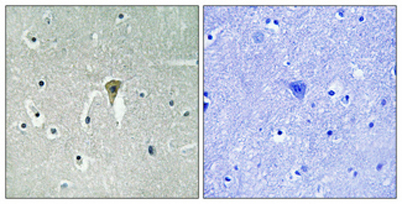
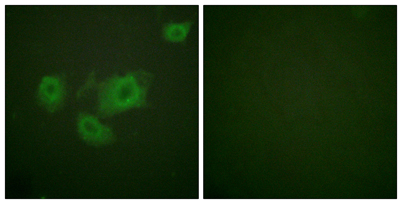
| Applications | WB;IHC;IF;ELISA |
| Other name | KCNJ11; ATP-sensitive inward rectifier potassium channel 11; IKATP; Inward rectifier K(+) channel Kir6.2; Potassium channel; inwardly rectifying subfamily J member 11 |
| Size | 100μL |
| Unit price ($) | 248 |
| Human gene ID | 3767 |
| Human Swiss-Prot | Q14654 |
| Source | Rabbit |
| Isotype | IgG |
| Target | KIR6.2 |
| Fields | >>Insulin secretion;>>GnRH secretion;>>Type II diabetes mellitus |
| Gene name | KCNJ11 |
| Protein name | ATP-sensitive inward rectifier potassium channel 11 |
| Human gene link | View Human Gene |
| Human Swiss link | View Human Swiss-Prot |
| Mouse gene ID | 16514 |
| Mouse gene link | View Mouse Gene |
| Mouse Swiss-Prot | Q61743 |
| Mouse Swiss link | View Mouse Swiss-Prot |
| Rat gene ID | 83535 |
| Rat gene link | View Rat Gene |
| Rat Swiss-Prot | P70673 |
| Rat Swiss link | View Rat Swiss-Prot |
| Immunogen | The antiserum was produced against synthesized peptide derived from human Kir6.2 around the phosphorylation site of Thr224. AA range:190-239 |
| Specificity | Phospho-KIR6.2 (T224) Polyclonal Antibody detects endogenous levels of KIR6.2 protein only when phosphorylated at T224. |
| Formulation | Liquid in PBS containing 50% glycerol, 0.5% BSA and 0.02% sodium azide. |
| Clonality | Polyclonal |
| Dilution | Western Blot: 1/500 - 1/2000. Immunohistochemistry: 1/100 - 1/300. Immunofluorescence: 1/200 - 1/1000. ELISA: 1/5000. Not yet tested in other applications. |
| Purification | The antibody was affinity-purified from rabbit antiserum by affinity-chromatography using epitope-specific immunogen. |
| Concentration | 1 mg/ml |
| Storage stability | -20°C/1 year |
| Molecular Weight (Da) | |
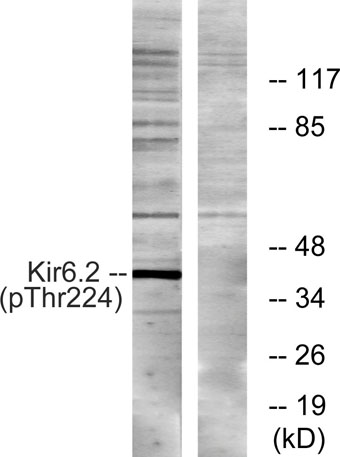
| Observed band (KD) | 40kD |
| Background | Potassium channels are present in most mammalian cells, where they participate in a wide range of physiologic responses. The protein encoded by this gene is an integral membrane protein and inward-rectifier type potassium channel. The encoded protein, which has a greater tendency to allow potassium to flow into a cell rather than out of a cell, is controlled by G-proteins and is found associated with the sulfonylurea receptor SUR. Mutations in this gene are a cause of familial persistent hyperinsulinemic hypoglycemia of infancy (PHHI), an autosomal recessive disorder characterized by unregulated insulin secretion. Defects in this gene may also contribute to autosomal dominant non-insulin-dependent diabetes mellitus type II (NIDDM), transient neonatal diabetes mellitus type 3 (TNDM3), and permanent neonatal diabetes mellitus (PNDM). Multiple alternatively spliced trans |
| Function | disease:Defects in KCNJ11 are a cause of permanent neonatal diabetes mellitus (PNDM) [MIM:606176]. PNDM is a rare form of diabetes characterized by insulin-requiring hyperglycemia that is diagnosed within the first months of life.,disease:Defects in KCNJ11 are the cause of familial hyperinsulinemic hypoglycemia type 2 (HHF2) [MIM:601820]; also known as persistent hyperinsulinemic hypoglycemia of infancy (PPHI) or hyperinsulinism. HHF2 is the most common cause of persistent hypoglycemia in infancy and is due to defective negative feedback regulation of insulin secretion by low glucose levels. It causes nesidioblastosis, a diffuse abnormality of the pancreas in which there is extensive, often disorganized formation of new islets. Unless early and aggressive intervention is undertaken, brain damage from recurrent episodes of hypoglycemia may occur.,disease:Defects in KCNJ11 are the cause of |
| Subcellular location | Membrane; Multi-pass membrane protein. |
| Expression | Brain,Breast,Ovary,Placenta,Spleen, |

Use collapsible tabs for more detailed information that will help customers make a purchasing decision.
Ex: Shipping and return policies, size guides, and other common questions.