 Français
 English

| ELK.No | ES6140 |
| Product name | LSP1 rabbit pAb |
| Reactivity | Human;Rat;Mouse; |
| Applications | WB;ELISA |
| Other name | LSP1; WP34; Lymphocyte-specific protein 1; 47 kDa actin-binding protein; 52 kDa phosphoprotein; pp52; Lymphocyte-specific antigen WP34 |
| Size | 50μL |
| Unit price ($) | 148 |
| Human gene ID | 4046 |
| Human Swiss-Prot | P33241 |
| Source | Rabbit |
| Isotype | IgG |
| Target | LSP1 |
| Fields | >>C-type lectin receptor signaling pathway;>>Tuberculosis |
| Gene name | LSP1 |
| Protein name | Lymphocyte-specific protein 1 |
| Human gene link | View Human Gene |
| Human Swiss link | View Human Swiss-Prot |
| Mouse gene ID | |
| Mouse gene link | |
| Mouse Swiss-Prot | P19973 |
| Mouse Swiss link | View Mouse Swiss-Prot |
| Rat gene ID | |
| Rat gene link | |
| Rat Swiss-Prot | |
| Rat Swiss link | |
| Immunogen | The antiserum was produced against synthesized peptide derived from human LSP1. AA range:104-153 |
| Specificity | LSP1 Polyclonal Antibody detects endogenous levels of LSP1 protein. |
| Formulation | Liquid in PBS containing 50% glycerol, 0.5% BSA and 0.02% sodium azide. |
| Clonality | Polyclonal |
| Dilution | Western Blot: 1/500 - 1/2000. ELISA: 1/5000. Not yet tested in other applications. |
| Purification | The antibody was affinity-purified from rabbit antiserum by affinity-chromatography using epitope-specific immunogen. |
| Concentration | 1 mg/ml |
| Storage stability | -20°C/1 year |
| Molecular Weight (Da) | |
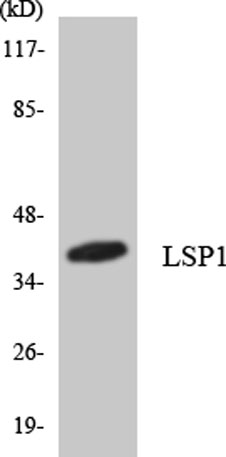
| Observed band (KD) | 37kD |
| Background | This gene encodes an intracellular F-actin binding protein. The protein is expressed in lymphocytes, neutrophils, macrophages, and endothelium and may regulate neutrophil motility, adhesion to fibrinogen matrix proteins, and transendothelial migration. Alternative splicing results in multiple transcript variants encoding different isoforms. [provided by RefSeq, Jul 2008], |
| Function | function:May play a role in mediating neutrophil activation and chemotaxis.,PTM:Phosphorylated by casein kinase II, protein kinase C and MAPKAPK2. Phosphorylation by PKC induces translocation from membrane to cytoplasm. Phosphorylation by MAPKAPK2 may regulate neutrophil chemotaxis.,subunit:Binds actin.,tissue specificity:Activated T-lymphocytes., |
| Subcellular location | Cell membrane; Peripheral membrane protein; Cytoplasmic side. |
| Expression | Activated T-lymphocytes. |

Use collapsible tabs for more detailed information that will help customers make a purchasing decision.
Ex: Shipping and return policies, size guides, and other common questions.