 Français
 English

| ELK.No | ES6201 |
| Product name | MC1-R rabbit pAb |
| Reactivity | Human;Rat;Mouse; |
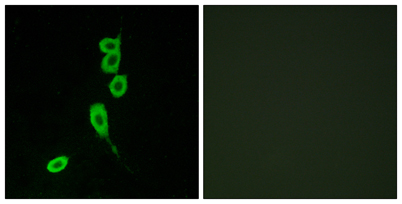
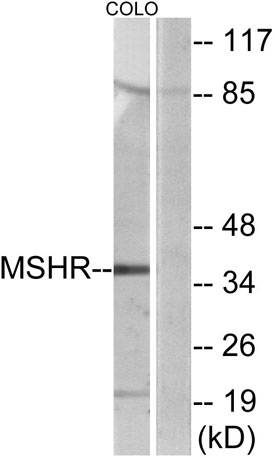
| Applications | WB;ELISA;IHC |
| Other name | MC1R; MSHR; Melanocyte-stimulating hormone receptor; MSH-R; Melanocortin receptor 1; MC1-R |
| Size | 100μL |
| Unit price ($) | 248 |
| Human gene ID | 4157 |
| Human Swiss-Prot | Q01726 |
| Source | Rabbit |
| Isotype | IgG |
| Target | MC1-R |
| Fields | >>Neuroactive ligand-receptor interaction;>>Melanogenesis |
| Gene name | MC1R |
| Protein name | Melanocyte-stimulating hormone receptor |
| Human gene link | View Human Gene |
| Human Swiss link | View Human Swiss-Prot |
| Mouse gene ID | |
| Mouse gene link | |
| Mouse Swiss-Prot | Q01727 |
| Mouse Swiss link | View Mouse Swiss-Prot |
| Rat gene ID | |
| Rat gene link | |
| Rat Swiss-Prot | |
| Rat Swiss link | |
| Immunogen | The antiserum was produced against synthesized peptide derived from human MSHR. AA range:268-317 |
| Specificity | MC1-R Polyclonal Antibody detects endogenous levels of MC1-R protein. |
| Formulation | Liquid in PBS containing 50% glycerol, 0.5% BSA and 0.02% sodium azide. |
| Clonality | Polyclonal |
| Dilution | WB 1:500-2000;IHC-p 1:50-300; ELISA 2000-20000 |
| Purification | The antibody was affinity-purified from rabbit antiserum by affinity-chromatography using epitope-specific immunogen. |
| Concentration | 1 mg/ml |
| Storage stability | -20°C/1 year |
| Molecular Weight (Da) | |
| Observed band (KD) | 35kD |
| Background | This intronless gene encodes the receptor protein for melanocyte-stimulating hormone (MSH). The encoded protein, a seven pass transmembrane G protein coupled receptor, controls melanogenesis. Two types of melanin exist: red pheomelanin and black eumelanin. Gene mutations that lead to a loss in function are associated with increased pheomelanin production, which leads to lighter skin and hair color. Eumelanin is photoprotective but pheomelanin may contribute to UV-induced skin damage by generating free radicals upon UV radiation. Binding of MSH to its receptor activates the receptor and stimulates eumelanin synthesis. This receptor is a major determining factor in sun sensitivity and is a genetic risk factor for melanoma and non-melanoma skin cancer. Over 30 variant alleles have been identified which correlate with skin and hair color, providing evidence that this gene is an important component in de |
| Function | domain:The highly acidic C-terminal region may bind cations such as calcium.,function:Receptor for MSH (alpha, beta and gamma) and ACTH. The activity of this receptor is mediated by G proteins which activate adenylate cyclase.,function:Tubulin is the major constituent of microtubules. It binds two moles of GTP, one at an exchangeable site on the beta chain and one at a non-exchangeable site on the alpha-chain.,polymorphism:Genetic variations in MC1R are associated with variation in skin/hair/eye pigmentation type 2 (SHEP2) [MIM:266300]. Hair, eye and skin pigmentation are among the most visible examples of human phenotypic variation, with a broad normal range that is subject to substantial geographic stratification. In the case of skin, individuals tend to have lighter pigmentation with increasing distance from the equator. By contrast, the majority of variation in human eye and hair col |
| Subcellular location | Cell membrane ; Multi-pass membrane protein . |
| Expression | Expressed in melanocytes (PubMed:1325670, PubMed:31097585). Expressed in corticoadrenal tissue (PubMed:1325670). |


Use collapsible tabs for more detailed information that will help customers make a purchasing decision.
Ex: Shipping and return policies, size guides, and other common questions.