 Français
 English
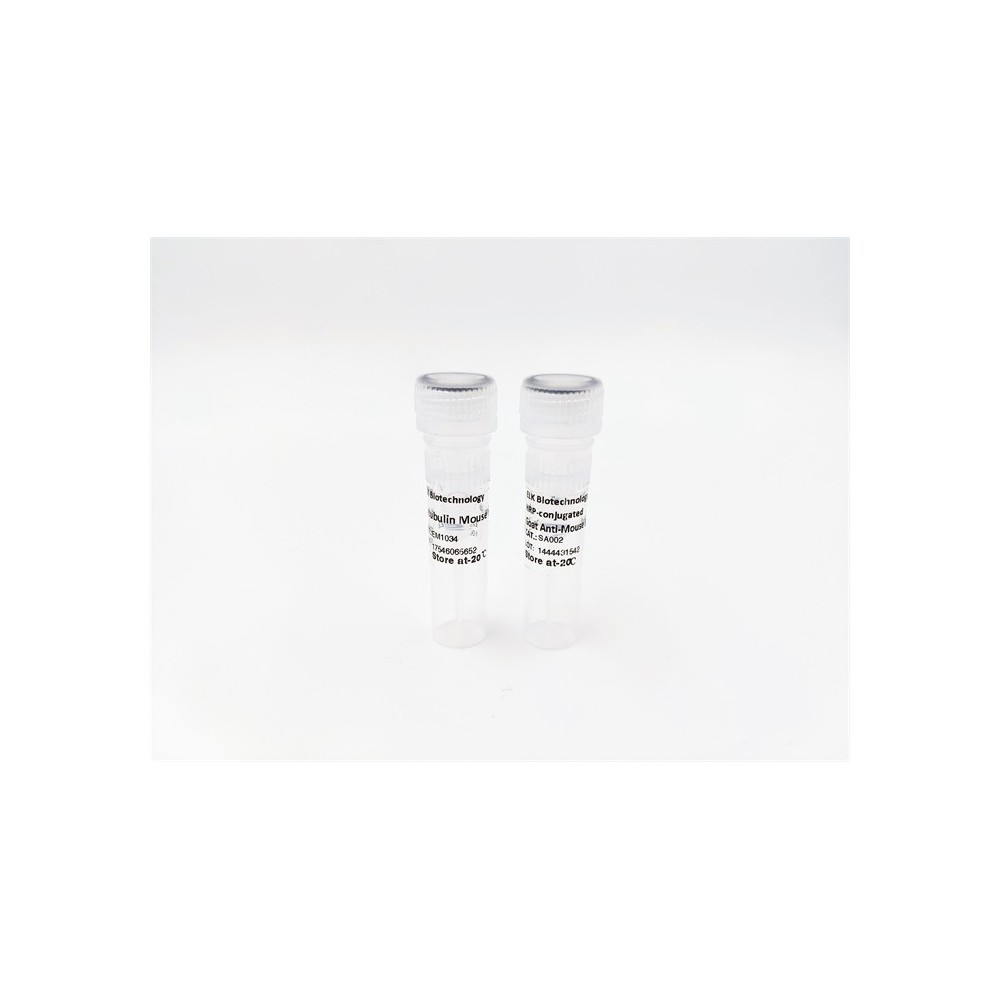

| ELK.No | ES6242 |
| Product name | CIITA rabbit pAb |
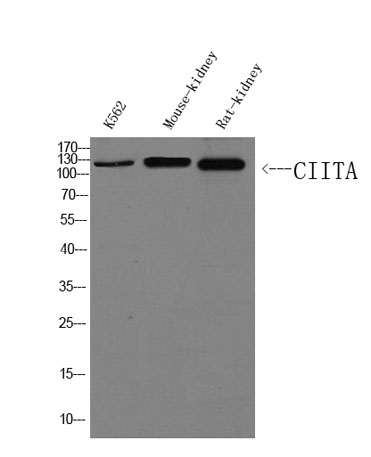
| Reactivity | Human;Mouse;Rat |
| Applications | WB;ELISA |
| Other name | CIITA; MHC2TA; MHC class II transactivator; CIITA |
| Size | 50μL |
| Unit price ($) | 148 |
| Human gene ID | 4261 |
| Human Swiss-Prot | P33076 |
| Source | Rabbit |
| Isotype | IgG |
| Target | CIITA |
| Fields | >>Antigen processing and presentation;>>Toxoplasmosis;>>Tuberculosis;>>Influenza A;>>Primary immunodeficiency |
| Gene name | CIITA |
| Protein name | MHC class II transactivator |
| Human gene link | View Human Gene |
| Human Swiss link | View Human Swiss-Prot |
| Mouse gene ID | 12265 |
| Mouse gene link | View Mouse Gene |
| Mouse Swiss-Prot | P79621 |
| Mouse Swiss link | View Mouse Swiss-Prot |
| Rat gene ID | |
| Rat gene link | |
| Rat Swiss-Prot | |
| Rat Swiss link | |
| Immunogen | The antiserum was produced against synthesized peptide derived from human CIITA. AA range:706-755 |
| Specificity | CIITA Polyclonal Antibody detects endogenous levels of CIITA protein. |
| Formulation | Liquid in PBS containing 50% glycerol, 0.5% BSA and 0.02% sodium azide. |
| Clonality | Polyclonal |
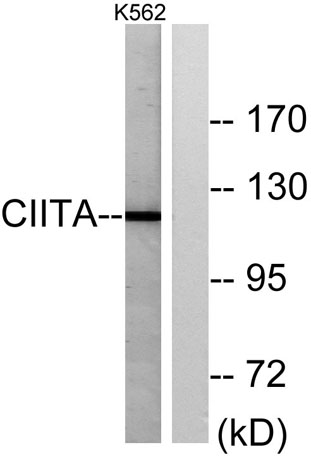
| Dilution | Western Blot: 1/500 - 1/2000. ELISA: 1/10000. Not yet tested in other applications. |
| Purification | The antibody was affinity-purified from rabbit antiserum by affinity-chromatography using epitope-specific immunogen. |
| Concentration | 1 mg/ml |
| Storage stability | -20°C/1 year |
| Molecular Weight (Da) | |
| Observed band (KD) | 123kD |
| Background | class II major histocompatibility complex transactivator(CIITA) Homo sapiens This gene encodes a protein with an acidic transcriptional activation domain, 4 LRRs (leucine-rich repeats) and a GTP binding domain. The protein is located in the nucleus and acts as a positive regulator of class II major histocompatibility complex gene transcription, and is referred to as the "master control factor" for the expression of these genes. The protein also binds GTP and uses GTP binding to facilitate its own transport into the nucleus. Once in the nucleus it does not bind DNA but rather uses an intrinsic acetyltransferase (AT) activity to act in a coactivator-like fashion. Mutations in this gene have been associated with bare lymphocyte syndrome type II (also known as hereditary MHC class II deficiency or HLA class II-deficient combined immunodeficiency), increased susceptibility to rheumatoid arthritis, multiple sclerosis, and possibly myocardi |
| Function | disease:Defects in CIITA are a cause of bare lymphocyte syndrome type 2 (BLS2) [MIM:209920]; also known as hereditary MHC class II deficiency or HLA class II-deficient combined immunodeficiency. BLS2 is a severe combined immunodeficiency disease with early onset. It is characterized by a profound defect in constitutive and interferon-gamma induced MHC II expression, absence of cellular and humoral T-cell response to antigen challenge, hypogammaglobulinemia and impaired antibody production. The consequence include extreme susceptibility to viral, bacterial and fungal infections.,function:Essential for transcriptional activity of the HLA class II promoter; activation is via the proximal promoter. No DNA binding of in vitro translated CIITA was detected. May act in a coactivator-like fashion through protein-protein interactions by contacting factors binding to the proximal MHC class II prom |
| Subcellular location | Nucleus . Nucleus, PML body . Recruited to PML body by PML. |
| Expression |

Use collapsible tabs for more detailed information that will help customers make a purchasing decision.
Ex: Shipping and return policies, size guides, and other common questions.