 Français
 English
Ron (phospho Ser1394) rabbit pAb
AO-06-ES6285-100

| ELK.No | ES6285 |
| Product name | Ron (phospho Ser1394) rabbit pAb |
| Reactivity | Human;Mouse |
| Applications | WB;IHC |
| Other name | MST1R; PTK8; RON; Macrophage-stimulating protein receptor; MSP receptor; CDw136; Protein-tyrosine kinase 8; p185-Ron; CD antigen CD136 |
| Size | 100μL |
| Unit price ($) | 248 |
| Human gene ID | 4486 |
| Human Swiss-Prot | Q04912 |
| Source | Rabbit |
| Isotype | IgG |
| Target | Ron |
| Fields | >>Calcium signaling pathway |
| Gene name | MST1R |
| Protein name | Macrophage-stimulating protein receptor |
| Human gene link | View Human Gene |
| Human Swiss link | View Human Swiss-Prot |
| Mouse gene ID | 19882 |
| Mouse gene link | View Mouse Gene |
| Mouse Swiss-Prot | Q62190 |
| Mouse Swiss link | View Mouse Swiss-Prot |
| Rat gene ID | |
| Rat gene link | |
| Rat Swiss-Prot | |
| Rat Swiss link | |
| Immunogen | The antiserum was produced against synthesized peptide derived from human CD136/RON around the phosphorylation site of Ser1394. AA range:1351-1400 |
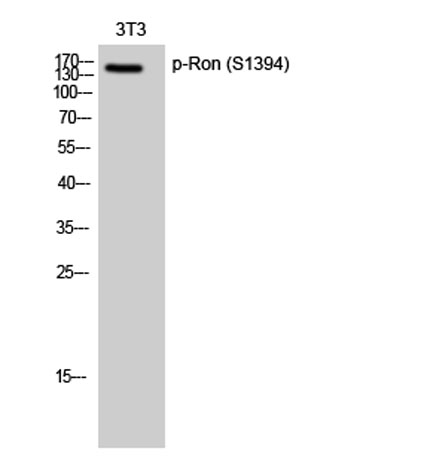
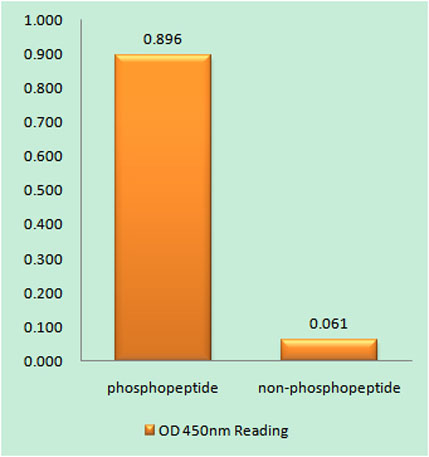
| Specificity | Phospho-Ron (S1394) Polyclonal Antibody detects endogenous levels of Ron protein only when phosphorylated at S1394. |
| Formulation | Liquid in PBS containing 50% glycerol, 0.5% BSA and 0.02% sodium azide. |
| Clonality | Polyclonal |
| Dilution | WB 1:500-2000;IHC-p 1:50-300 |
| Purification | The antibody was affinity-purified from rabbit antiserum by affinity-chromatography using epitope-specific immunogen. |
| Concentration | 1 mg/ml |
| Storage stability | -20°C/1 year |
| Molecular Weight (Da) | |
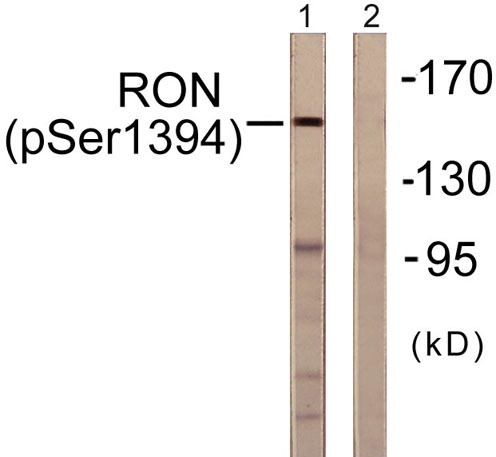
| Observed band (KD) | 152kD |
| Background | This gene encodes a cell surface receptor for macrophage-stimulating protein (MSP) with tyrosine kinase activity. The mature form of this protein is a heterodimer of disulfide-linked alpha and beta subunits, generated by proteolytic cleavage of a single-chain precursor. The beta subunit undergoes tyrosine phosphorylation upon stimulation by MSP. This protein is expressed on the ciliated epithelia of the mucociliary transport apparatus of the lung, and together with MSP, thought to be involved in host defense. Alternative splicing generates multiple transcript variants encoding different isoforms that may undergo similar proteolytic processing. [provided by RefSeq, Jan 2016], |
| Function | catalytic activity:ATP + a [protein]-L-tyrosine = ADP + a [protein]-L-tyrosine phosphate.,function:Receptor for macrophage stimulating protein (MSP). Has a tyrosine-protein kinase activity.,PTM:Phosphorylated in response to ligand binding.,PTM:Proteolytic processing yields the two subunits.,similarity:Belongs to the protein kinase superfamily. Tyr protein kinase family.,similarity:Contains 1 protein kinase domain.,similarity:Contains 1 Sema domain.,similarity:Contains 3 IPT/TIG domains.,subunit:Heterodimer formed of an alpha chain and a beta chain which are disulfide linked. Binds PLXNB1. Associates with and is negatively regulated by HYAL2.,tissue specificity:Keratinocytes and lung., |
| Subcellular location | Membrane; Single-pass type I membrane protein. |
| Expression | Expressed in colon, skin, lung and bone marrow. |

Use collapsible tabs for more detailed information that will help customers make a purchasing decision.
Ex: Shipping and return policies, size guides, and other common questions.