 Français
 English
Neuro D (phospho Ser274) rabbit pAb
AO-06-ES6360-50

| ELK.No | ES6360 |
| Product name | Neuro D (phospho Ser274) rabbit pAb |
| Reactivity | Human;Mouse;Rat |
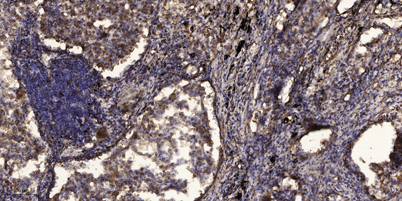
| Applications | WB;IHC |
| Other name | NEUROD1; BHLHA3; NEUROD; Neurogenic differentiation factor 1; NeuroD; NeuroD1; Class A basic helix-loop-helix protein 3; bHLHa3 |
| Size | 50μL |
| Unit price ($) | 148 |
| Human gene ID | 4760 |
| Human Swiss-Prot | Q13562 |
| Source | Rabbit |
| Isotype | IgG |
| Target | Neuro D |
| Fields | >>Maturity onset diabetes of the young |
| Gene name | NEUROD1 |
| Protein name | Neurogenic differentiation factor 1 |
| Human gene link | View Human Gene |
| Human Swiss link | View Human Swiss-Prot |
| Mouse gene ID | 18012 |
| Mouse gene link | View Mouse Gene |
| Mouse Swiss-Prot | Q60867 |
| Mouse Swiss link | View Mouse Swiss-Prot |
| Rat gene ID | 29458 |
| Rat gene link | View Rat Gene |
| Rat Swiss-Prot | Q64289 |
| Rat Swiss link | View Rat Swiss-Prot |
| Immunogen | The antiserum was produced against synthesized peptide derived from human Neuro D around the phosphorylation site of Ser274. AA range:240-289 |
| Specificity | Phospho-Neuro D (S274) Polyclonal Antibody detects endogenous levels of Neuro D protein only when phosphorylated at S274. |
| Formulation | Liquid in PBS containing 50% glycerol, 0.5% BSA and 0.02% sodium azide. |
| Clonality | Polyclonal |
| Dilution | WB 1:500-2000;IHC-p 1:50-300 |
| Purification | The antibody was affinity-purified from rabbit antiserum by affinity-chromatography using epitope-specific immunogen. |
| Concentration | 1 mg/ml |
| Storage stability | -20°C/1 year |
| Molecular Weight (Da) | |
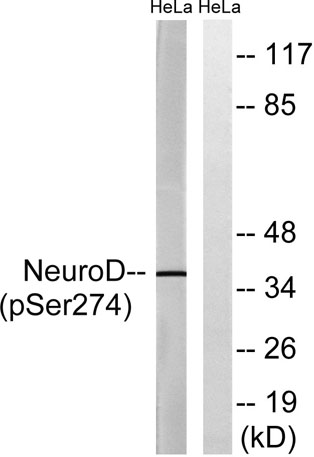
| Observed band (KD) | 36kD |
| Background | This gene encodes a member of the NeuroD family of basic helix-loop-helix (bHLH) transcription factors. The protein forms heterodimers with other bHLH proteins and activates transcription of genes that contain a specific DNA sequence known as the E-box. It regulates expression of the insulin gene, and mutations in this gene result in type II diabetes mellitus. [provided by RefSeq, Jul 2008], |
| Function | disease:Defects in NEUROD1 are the cause of maturity onset diabetes of the young type 6 (MODY6) [MIM:606394]. MODY [MIM:606391] is characterized by an autosomal dominant mode of inheritance, onset during young adulthood and a primary defect in insulin secretion.,function:Differentiation factor required for dendrite morphogenesis and maintenance in the cerebellar cortex. Transcriptional activator. Binds to the insulin gene E-box.,PTM:Phosphorylated. In islet cells, phosphorylated on Ser-274 upon glucose stimulation; which may be required for nuclear localization. In activated neurons, phosphorylated on Ser-335; which promotes dendritic growth.,similarity:Contains 1 basic helix-loop-helix (bHLH) domain.,subunit:Efficient DNA binding requires dimerization with another bHLH protein. Heterodimer with TCF3/E47. Interacts with RREB1., |
| Subcellular location | Cytoplasm . Nucleus . In pancreatic islet cells, shuttles to the nucleus in response to glucose stimulation (By similarity). Colocalizes with NR0B2 in the nucleus. . |
| Expression | Eye,Retina,Rhabdomyosarcoma, |

Use collapsible tabs for more detailed information that will help customers make a purchasing decision.
Ex: Shipping and return policies, size guides, and other common questions.