 Français
 English

| ELK.No | ES6445 |
| Product name | KOR-1 rabbit pAb |
| Reactivity | Human;Mouse;Rat;Monkey |
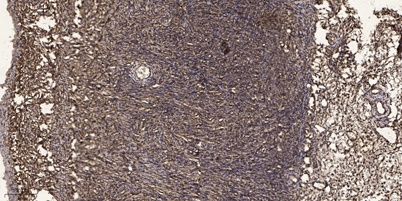
| Applications | WB;ELISA;IHC |
| Other name | OPRK1; OPRK; Kappa-type opioid receptor; K-OR-1; KOR-1 |
| Size | 50μL |
| Unit price ($) | 148 |
| Human gene ID | 4986 |
| Human Swiss-Prot | P41145 |
| Source | Rabbit |
| Isotype | IgG |
| Target | KOR-1 |
| Fields | >>Neuroactive ligand-receptor interaction |
| Gene name | OPRK1 |
| Protein name | Kappa-type opioid receptor |
| Human gene link | View Human Gene |
| Human Swiss link | View Human Swiss-Prot |
| Mouse gene ID | 18387 |
| Mouse gene link | View Mouse Gene |
| Mouse Swiss-Prot | P33534 |
| Mouse Swiss link | View Mouse Swiss-Prot |
| Rat gene ID | 29335 |
| Rat gene link | View Rat Gene |
| Rat Swiss-Prot | P34975 |
| Rat Swiss link | View Rat Swiss-Prot |
| Immunogen | The antiserum was produced against synthesized peptide derived from human OPRK1. AA range:321-370 |
| Specificity | KOR-1 Polyclonal Antibody detects endogenous levels of KOR-1 protein. |
| Formulation | Liquid in PBS containing 50% glycerol, 0.5% BSA and 0.02% sodium azide. |
| Clonality | Polyclonal |
| Dilution | WB 1:500-2000;IHC-p 1:50-300; ELISA 2000-20000 |
| Purification | The antibody was affinity-purified from rabbit antiserum by affinity-chromatography using epitope-specific immunogen. |
| Concentration | 1 mg/ml |
| Storage stability | -20°C/1 year |
| Molecular Weight (Da) | |
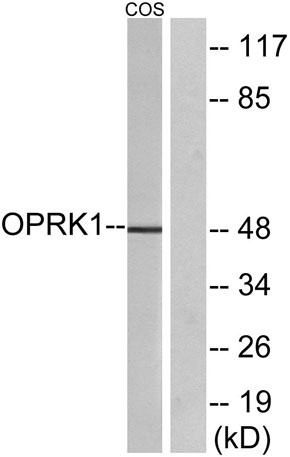
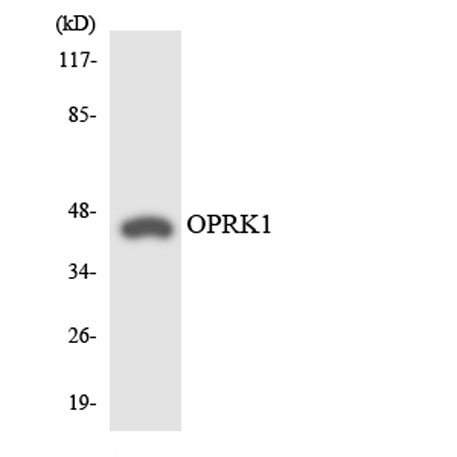
| Observed band (KD) | 48kD |
| Background | This gene encodes an opioid receptor, which is a member of the 7 transmembrane-spanning G protein-coupled receptor family. It functions as a receptor for endogenous ligands, as well as a receptor for various synthetic opioids. Ligand binding results in inhibition of adenylate cyclase activity and neurotransmitter release. This opioid receptor plays a role in the perception of pain and mediating the hypolocomotor, analgesic and aversive actions of synthetic opioids. Variations in this gene have also been associated with alcohol dependence and opiate addiction. Alternatively spliced transcript variants encoding different isoforms have been found for this gene. A recent study provided evidence for translational readthrough in this gene and expression of an additional C-terminally extended isoform via the use of an alternative in-frame translation termination codon. [provided by RefSeq, Jan 2016], |
| Function | function:Inhibits neurotransmitter release by reducing calcium ion currents and increasing potassium ion conductance. Receptor for dynorphins. May play a role in arousal and regulation of autonomic and neuroendocrine functions.,online information:Kappa opioid receptor entry,similarity:Belongs to the G-protein coupled receptor 1 family.,subunit:Interacts with SLC9A3R1. Interacts with GABARAPL1., |
| Subcellular location | Cell membrane ; Multi-pass membrane protein . |
| Expression | Detected in brain and placenta. |

Use collapsible tabs for more detailed information that will help customers make a purchasing decision.
Ex: Shipping and return policies, size guides, and other common questions.