 Français
 English

| ELK.No | ES6491 |
| Product name | Sclerostin rabbit pAb |
| Reactivity | Human;Rat;Mouse; |
| Applications | WB;ELISA;IHC |
| Other name | SOST; Sclerostin |
| Size | 50μL |
| Unit price ($) | 148 |
| Human gene ID | 50964 |
| Human Swiss-Prot | Q9BQB4 |
| Source | Rabbit |
| Isotype | IgG |
| Target | Sclerostin |
| Fields | >>Wnt signaling pathway;>>Parathyroid hormone synthesis, secretion and action |
| Gene name | SOST |
| Protein name | Sclerostin |
| Human gene link | View Human Gene |
| Human Swiss link | View Human Swiss-Prot |
| Mouse gene ID | |
| Mouse gene link | |
| Mouse Swiss-Prot | Q99P68 |
| Mouse Swiss link | View Mouse Swiss-Prot |
| Rat gene ID | |
| Rat gene link | |
| Rat Swiss-Prot | |
| Rat Swiss link | |
| Immunogen | Synthesized peptide derived from Sclerostin . at AA range: 130-210 |
| Specificity | Sclerostin Polyclonal Antibody detects endogenous levels of Sclerostin protein. |
| Formulation | Liquid in PBS containing 50% glycerol, 0.5% BSA and 0.02% sodium azide. |
| Clonality | Polyclonal |
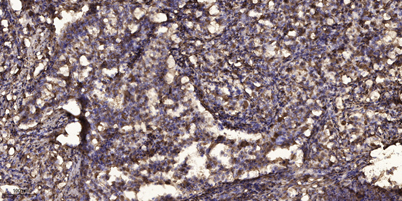
| Dilution | WB 1:500-2000;IHC-p 1:50-300; ELISA 2000-20000 |
| Purification | The antibody was affinity-purified from rabbit antiserum by affinity-chromatography using epitope-specific immunogen. |
| Concentration | 1 mg/ml |
| Storage stability | -20°C/1 year |
| Molecular Weight (Da) | |
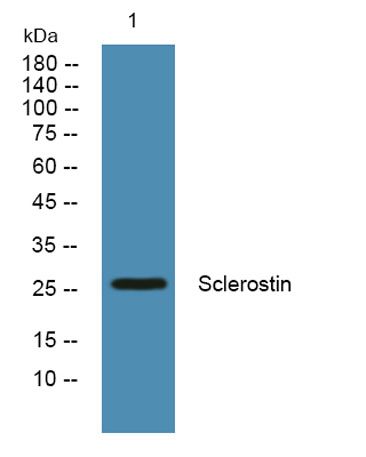
| Observed band (KD) | 26kD |
| Background | Sclerostin is a secreted glycoprotein with a C-terminal cysteine knot-like (CTCK) domain and sequence similarity to the DAN (differential screening-selected gene aberrative in neuroblastoma) family of bone morphogenetic protein (BMP) antagonists. Loss-of-function mutations in this gene are associated with an autosomal-recessive disorder, sclerosteosis, which causes progressive bone overgrowth. A deletion downstream of this gene, which causes reduced sclerostin expression, is associated with a milder form of the disorder called van Buchem disease. [provided by RefSeq, Jul 2008], |
| Function | disease:A 52 kb deletion downstream of SOST results in SOST transcription suppression and is a cause of van Buchem disease (VBCH) [MIM:239100]; also known as hyperostosis corticalis generalisata. VBCH is an autosomal recessive sclerosing bone dysplasia characterized by endosteal hyperostosis of the mandible, skull, ribs, clavicles, and diaphyses of the long bones. Affected patients present a symmetrically increased thickness of bones, most frequently found as an enlarged jawbone, but also an enlargement of the skull, ribs, diaphysis of long bones, as well as tubular bones of hands and feet. The clinical consequence of increased thickness of the skull include facial nerve palsy causing hearing loss, visual problems, neurological pain, and, very rarely, blindness as a consequence of optic atrophy. Serum alkaline phosphatase levels are elevated.,disease:Defects in SOST are the cause of scle |
| Subcellular location | Secreted, extracellular space, extracellular matrix . |
| Expression | Widely expressed at low levels with highest levels in bone, cartilage, kidney, liver, bone marrow and primary osteoblasts differentiated for 21 days. Detected in the subendothelial layer of the aortic intima (at protein level). |

Use collapsible tabs for more detailed information that will help customers make a purchasing decision.
Ex: Shipping and return policies, size guides, and other common questions.