 Français
 English
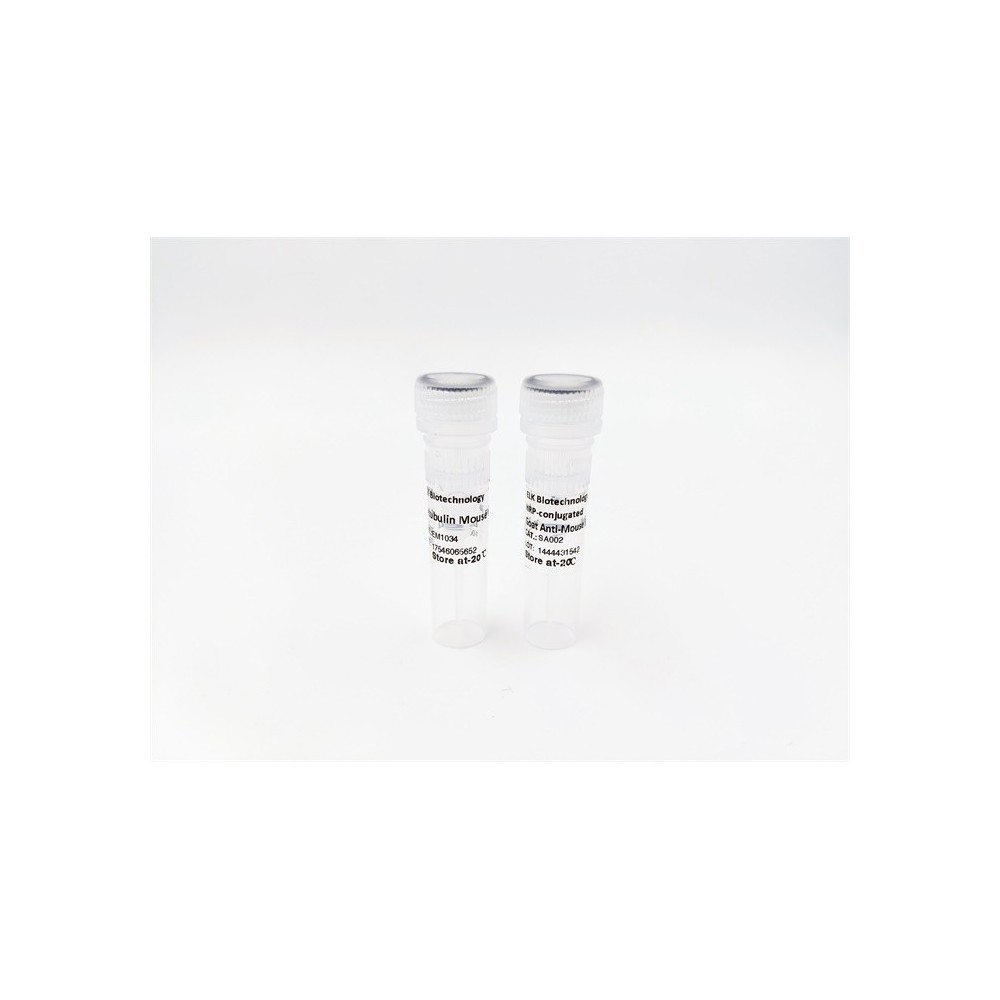

| ELK.No | ES6601 |
| Product name | tPA rabbit pAb |
| Reactivity | Human;Mouse;Rat |
| Applications | WB;ELISA |
| Other name | PLAT; Tissue-type plasminogen activator; t-PA; t-plasminogen activator; tPA; Alteplase; Reteplase |
| Size | 50μL |
| Unit price ($) | 148 |
| Human gene ID | 5327 |
| Human Swiss-Prot | P00750 |
| Source | Rabbit |
| Isotype | IgG |
| Target | tPA |
| Fields | >>Apelin signaling pathway;>>Complement and coagulation cascades;>>Transcriptional misregulation in cancer;>>Prostate cancer;>>Fluid shear stress and atherosclerosis |
| Gene name | PLAT |
| Protein name | Tissue-type plasminogen activator |
| Human gene link | View Human Gene |
| Human Swiss link | View Human Swiss-Prot |
| Mouse gene ID | 18791 |
| Mouse gene link | View Mouse Gene |
| Mouse Swiss-Prot | P11214 |
| Mouse Swiss link | View Mouse Swiss-Prot |
| Rat gene ID | 25692 |
| Rat gene link | View Rat Gene |
| Rat Swiss-Prot | P19637 |
| Rat Swiss link | View Rat Swiss-Prot |
| Immunogen | The antiserum was produced against synthesized peptide derived from human tPA. AA range:38-87 |
| Specificity | tPA Polyclonal Antibody detects endogenous levels of tPA protein. |
| Formulation | Liquid in PBS containing 50% glycerol, 0.5% BSA and 0.02% sodium azide. |
| Clonality | Polyclonal |
| Dilution | Western Blot: 1/500 - 1/2000. ELISA: 1/10000. Not yet tested in other applications. |
| Purification | The antibody was affinity-purified from rabbit antiserum by affinity-chromatography using epitope-specific immunogen. |
| Concentration | 1 mg/ml |
| Storage stability | -20°C/1 year |
| Molecular Weight (Da) | |
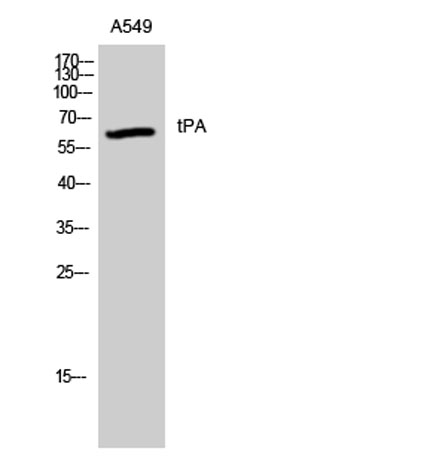
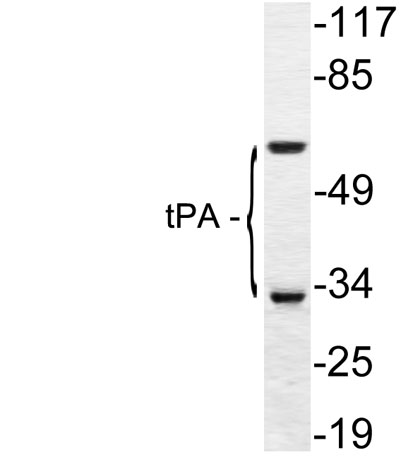
| Observed band (KD) | 63kD |
| Background | This gene encodes tissue-type plasminogen activator, a secreted serine protease that converts the proenzyme plasminogen to plasmin, a fibrinolytic enzyme. The encoded preproprotein is proteolytically processed by plasmin or trypsin to generate heavy and light chains. These chains associate via disulfide linkages to form the heterodimeric enzyme. This enzyme plays a role in cell migration and tissue remodeling. Increased enzymatic activity causes hyperfibrinolysis, which manifests as excessive bleeding, while decreased activity leads to hypofibrinolysis, which can result in thrombosis or embolism. Alternative splicing of this gene results in multiple transcript variants, at least one of which encodes an isoform that is proteolytically processed. [provided by RefSeq, Jan 2016], |
| Function | catalytic activity:Specific cleavage of Arg-|-Val bond in plasminogen to form plasmin.,disease:Increased activity of TPA is the cause of hyperfibrinolysis [MIM:173370]. Hyperfibrinolysis leads to excessive bleeding. Defective release of TPA causes hypofibrinolysis, leading to thrombosis or embolism.,domain:Both FN1 and EGF-like domains are important for binding to LRP1.,domain:Both FN1 and one of the kringle domains are required for binding to fibrin.,domain:The FN1 domain mediates binding to annexin A2.,domain:The second kringle domain is implicated in binding to cytokeratin-8 and to the endothelial cell surface binding site.,function:Converts the abundant, but inactive, zymogen plasminogen to plasmin by hydrolyzing a single Arg-Val bond in plasminogen. By controlling plasmin-mediated proteolysis, it plays an important role in tissue remodeling and degradation, in cell migration and man |
| Subcellular location | Secreted, extracellular space. |
| Expression | Synthesized in numerous tissues (including tumors) and secreted into most extracellular body fluids, such as plasma, uterine fluid, saliva, gingival crevicular fluid, tears, seminal fluid, and milk. |

Use collapsible tabs for more detailed information that will help customers make a purchasing decision.
Ex: Shipping and return policies, size guides, and other common questions.