 Français
 English
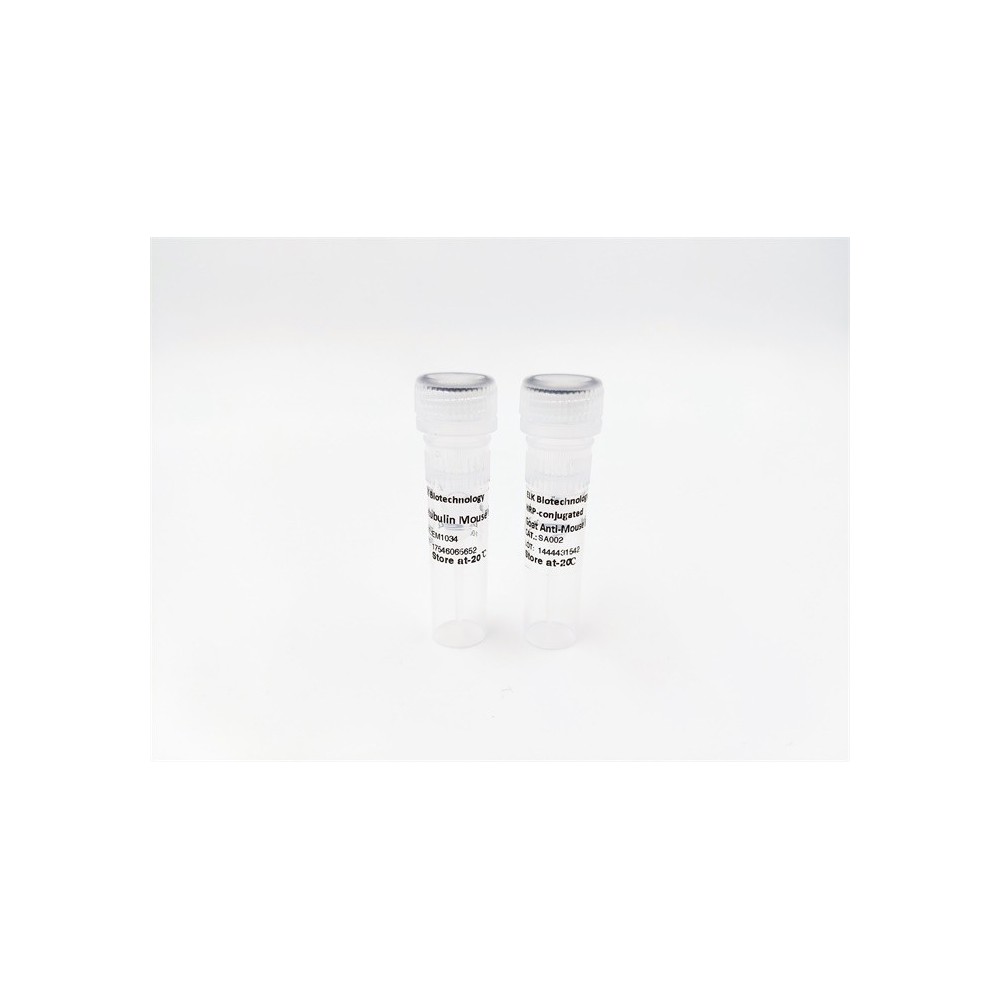

| ELK.No | ES6677 |
| Product name | BCAS3 rabbit pAb |
| Reactivity | Human;Mouse |
| Applications | WB;ELISA |
| Other name | BCAS3; Breast carcinoma-amplified sequence 3; GAOB1 |
| Size | 100μL |
| Unit price ($) | 248 |
| Human gene ID | 54828 |
| Human Swiss-Prot | Q9H6U6 |
| Source | Rabbit |
| Isotype | IgG |
| Target | BCAS3 |
| Fields | |
| Gene name | BCAS3 |
| Protein name | Breast carcinoma-amplified sequence 3 |
| Human gene link | View Human Gene |
| Human Swiss link | View Human Swiss-Prot |
| Mouse gene ID | 192197 |
| Mouse gene link | View Mouse Gene |
| Mouse Swiss-Prot | Q8CCN5 |
| Mouse Swiss link | View Mouse Swiss-Prot |
| Rat gene ID | |
| Rat gene link | |
| Rat Swiss-Prot | |
| Rat Swiss link | |
| Immunogen | Synthesized peptide derived from BCAS3 . at AA range: 660-740 |
| Specificity | BCAS3 Polyclonal Antibody detects endogenous levels of BCAS3 protein. |
| Formulation | Liquid in PBS containing 50% glycerol, 0.5% BSA and 0.02% sodium azide. |
| Clonality | Polyclonal |
| Dilution | Western Blot: 1/500 - 1/2000. ELISA: 1/5000. Not yet tested in other applications. |
| Purification | The antibody was affinity-purified from rabbit antiserum by affinity-chromatography using epitope-specific immunogen. |
| Concentration | 1 mg/ml |
| Storage stability | -20°C/1 year |
| Molecular Weight (Da) | |
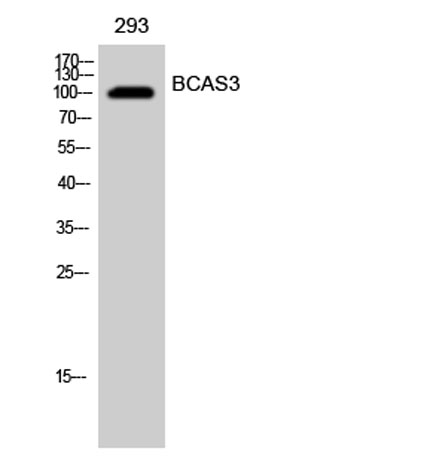
| Observed band (KD) | 100kD |
| Background | developmental stage:Fetal.,disease:A chromosomal aberration involving BCAS3 may be a cause of breast cancer. Translocation t(17;20)(q23;q13) with BCAS4.,similarity:Belongs to the WD repeat BCAS3 family.,similarity:Contains 3 WD repeats.,tissue specificity:Stomach, liver, lung, kidney, prostate, testis, thyroid gland, adrenal gland, brain, heart, skeletal muscle, colon, spleen, small intestine, placenta, blood leucocyte and mammary epithelial cells. Overexpressed in most breast cancer cell lines., |
| Function | developmental stage:Fetal.,disease:A chromosomal aberration involving BCAS3 may be a cause of breast cancer. Translocation t(17;20)(q23;q13) with BCAS4.,similarity:Belongs to the WD repeat BCAS3 family.,similarity:Contains 3 WD repeats.,tissue specificity:Stomach, liver, lung, kidney, prostate, testis, thyroid gland, adrenal gland, brain, heart, skeletal muscle, colon, spleen, small intestine, placenta, blood leucocyte and mammary epithelial cells. Overexpressed in most breast cancer cell lines., |
| Subcellular location | Nucleus . Cytoplasm . Cytoplasm, cytoskeleton . Preautophagosomal structure . Localizes in the cytoplasm in stationary cells. Translocates from the cytoplasm to the leading edge in motile cells. Colocalizes with microtubules and intermediate filaments in both stationary and motile cells (By similarity). Associates with chromatin. Recruited to estrogen receptor-induced promoters in a PELP1-dependent manner. The BCAS3:PHAF1 complex is recruited to the preautophagosomal structures adjacent to the damaged mitochondria upon mitophagy in a PRKN-PINK1 dependent manner (PubMed:33499712). . |
| Expression | Expressed in stomach, liver, lung, kidney, prostate, testis, thyroid gland, adrenal gland, brain, heart, skeletal muscle, colon, spleen, small intestine, placenta, blood leukocyte and mammary epithelial cells. Expressed in undifferentiated ES cells. Expressed in blood islands and nascent blood vessels derived from differentiated ES cells into embryoid bodies (BD). Expressed in endothelial cells. Not detected in brain. Expressed in brain tumors (at protein level). Expressed in brain. Highly expressed in breast cancers and in glioma cell lines. |

Use collapsible tabs for more detailed information that will help customers make a purchasing decision.
Ex: Shipping and return policies, size guides, and other common questions.