 Français
 English

| ELK.No | ES6701 |
| Product name | PPP1R3A rabbit pAb |
| Reactivity | Human;Rat;Mouse; |
| Applications | WB;IHC |
| Other name | PPP1R3A; PP1G; Protein phosphatase 1 regulatory subunit 3A; Protein phosphatase 1 glycogen-associated regulatory subunit; Protein phosphatase type-1 glycogen targeting subunit; RG1 |
| Size | 50μL |
| Unit price ($) | 148 |
| Human gene ID | 5506 |
| Human Swiss-Prot | Q16821 |
| Source | Rabbit |
| Isotype | IgG |
| Target | PPP1R3A |
| Fields | >>Insulin signaling pathway;>>Insulin resistance |
| Gene name | PPP1R3A |
| Protein name | Protein phosphatase 1 regulatory subunit 3A |
| Human gene link | View Human Gene |
| Human Swiss link | View Human Swiss-Prot |
| Mouse gene ID | |
| Mouse gene link | |
| Mouse Swiss-Prot | Q99MR9 |
| Mouse Swiss link | View Mouse Swiss-Prot |
| Rat gene ID | |
| Rat gene link | |
| Rat Swiss-Prot | |
| Rat Swiss link | |
| Immunogen | The antiserum was produced against synthesized peptide derived from human PPP1R3A. AA range:647-696 |
| Specificity | PPP1R3A Polyclonal Antibody detects endogenous levels of PPP1R3A protein. |
| Formulation | Liquid in PBS containing 50% glycerol, 0.5% BSA and 0.02% sodium azide. |
| Clonality | Polyclonal |
| Dilution | WB 1:500-2000;IHC-p 1:50-300 |
| Purification | The antibody was affinity-purified from rabbit antiserum by affinity-chromatography using epitope-specific immunogen. |
| Concentration | 1 mg/ml |
| Storage stability | -20°C/1 year |
| Molecular Weight (Da) | |
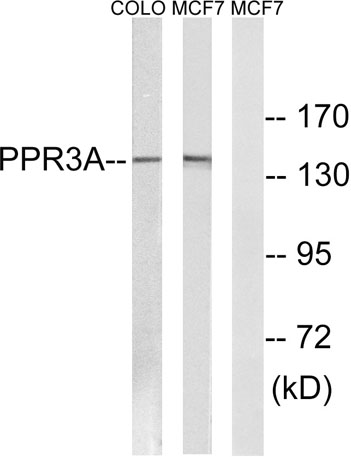
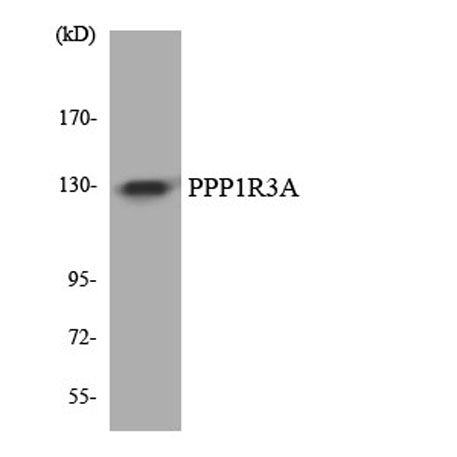
| Observed band (KD) | 140kD |
| Background | The glycogen-associated form of protein phosphatase-1 (PP1) derived from skeletal muscle is a heterodimer composed of a 37-kD catalytic subunit and a 124-kD targeting and regulatory subunit. This gene encodes the regulatory subunit which binds to muscle glycogen with high affinity, thereby enhancing dephosphorylation of glycogen-bound substrates for PP1 such as glycogen synthase and glycogen phosphorylase kinase. [provided by RefSeq, Jul 2008], |
| Function | disease:Defects in PPP1R3A are a cause of insulin resistance (Ins resistance).,disease:Defects in PPP1R3A are a cause of susceptibility to noninsulin-dependent diabetes mellitus (NIDDM) [MIM:125853]; also known as diabetes mellitus type II. NIDDM is characterized by an autosomal dominant mode of inheritance, onset during adulthood and insulin resistance.,domain:The CBM21 domain is known to be involved in the localization to glycogen and is characteristic of some regulatory subunit of phosphatase complexes.,function:Seems to act as a glycogen-targeting subunit for PP1. PP1 is essential for cell division, and participates in the regulation of glycogen metabolism, muscle contractility and protein synthesis. Plays an important role in glycogen synthesis but is not essential for insulin activation of glycogen synthase.,PTM:Phosphorylation at Ser-46 by ISPK stimulates the dephosphorylation of |
| Subcellular location | Membrane ; Single-pass membrane protein . |
| Expression | Skeletal muscle and heart. |

Use collapsible tabs for more detailed information that will help customers make a purchasing decision.
Ex: Shipping and return policies, size guides, and other common questions.