 Français
 English

| ELK.No | ES6753 |
| Product name | ARF GAP1 rabbit pAb |
| Reactivity | Human;Mouse;Rat;Monkey;Bovine |
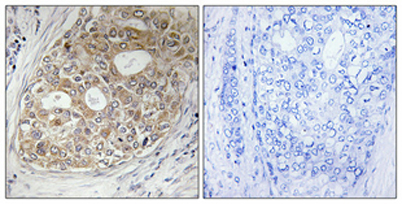
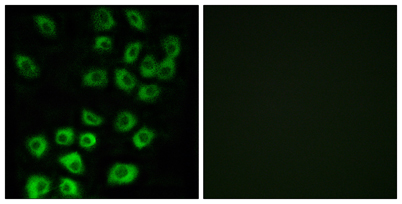
| Applications | WB;IHC;IF;ELISA |
| Other name | ARFGAP1; ARF1GAP; ADP-ribosylation factor GTPase-activating protein 1; ARF GAP 1; ADP-ribosylation factor 1 GTPase-activating protein; ARF1 GAP; ARF1-directed GTPase-activating protein |
| Size | 50μL |
| Unit price ($) | 148 |
| Human gene ID | 55738 |
| Human Swiss-Prot | Q8N6T3 |
| Source | Rabbit |
| Isotype | IgG |
| Target | ARF GAP1 |
| Fields | >>Endocytosis |
| Gene name | ARFGAP1 |
| Protein name | ADP-ribosylation factor GTPase-activating protein 1 |
| Human gene link | View Human Gene |
| Human Swiss link | View Human Swiss-Prot |
| Mouse gene ID | 228998 |
| Mouse gene link | View Mouse Gene |
| Mouse Swiss-Prot | Q9EPJ9 |
| Mouse Swiss link | View Mouse Swiss-Prot |
| Rat gene ID | 246310 |
| Rat gene link | View Rat Gene |
| Rat Swiss-Prot | Q62848 |
| Rat Swiss link | View Rat Swiss-Prot |
| Immunogen | The antiserum was produced against synthesized peptide derived from human ARFGAP1. AA range:171-220 |
| Specificity | ARF GAP1 Polyclonal Antibody detects endogenous levels of ARF GAP1 protein. |
| Formulation | Liquid in PBS containing 50% glycerol, 0.5% BSA and 0.02% sodium azide. |
| Clonality | Polyclonal |
| Dilution | Western Blot: 1/500 - 1/2000. Immunohistochemistry: 1/100 - 1/300. Immunofluorescence: 1/200 - 1/1000. ELISA: 1/20000. Not yet tested in other applications. |
| Purification | The antibody was affinity-purified from rabbit antiserum by affinity-chromatography using epitope-specific immunogen. |
| Concentration | 1 mg/ml |
| Storage stability | -20°C/1 year |
| Molecular Weight (Da) | |
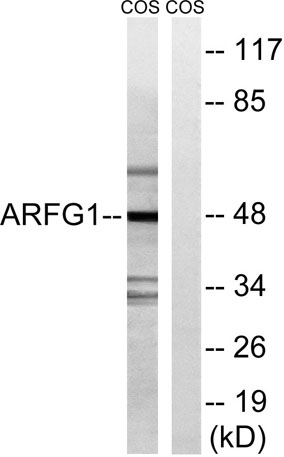
| Observed band (KD) | 48kD |
| Background | The protein encoded by this gene is a GTPase-activating protein, which associates with the Golgi apparatus and which interacts with ADP-ribosylation factor 1. The encoded protein promotes hydrolysis of ADP-ribosylation factor 1-bound GTP and is required for the dissociation of coat proteins from Golgi-derived membranes and vesicles. Dissociation of the coat proteins is required for the fusion of these vesicles with target compartments. The activity of this protein is stimulated by phosphoinosides and inhibited by phosphatidylcholine. Alternative splicing results in multiple transcript variants. [provided by RefSeq, Jul 2013], |
| Function | domain:The region downstream of Arf-GAP domain is essential to GAP activity in vivo. This region may be required for its targeting to Golgi membranes.,function:GTPase-activating protein (GAP) for the ADP ribosylation factor 1 (ARF1). Involved in membrane trafficking and /or vesicle transport. Promotes hydrolysis of the ARF1-bound GTP and thus, is required for the dissociation of coat proteins from Golgi-derived membranes and vesicles, a prerequisite for vesicle's fusion with target compartment. Probably regulates ARF1-mediated transport via its interaction with the KDELR proteins and RNP24. Overexpression induces the redistribution of the entire Golgi complex to the endoplasmic reticulum, as when ARF1 is deactivated. Its activity is stimulated by phosphoinosides and inhibited by phosphatidylcholine.,sequence caution:Intron retention.,similarity:Contains 1 Arf-GAP domain.,subcellular loca |
| Subcellular location | Cytoplasm . Golgi apparatus . Associates with the Golgi complex. . |
| Expression | Brain,Epithelium,Fetal brain,Testis, |

Use collapsible tabs for more detailed information that will help customers make a purchasing decision.
Ex: Shipping and return policies, size guides, and other common questions.