 Français
 English

| ELK.No | ES6782 |
| Product name | Dok-5 rabbit pAb |
| Reactivity | Human;Mouse |
| Applications | WB;ELISA |
| Other name | DOK5; C20orf180; Docking protein 5; Downstream of tyrosine kinase 5; Insulin receptor substrate 6; IRS-6; IRS6 |
| Size | 50μL |
| Unit price ($) | 148 |
| Human gene ID | 55816 |
| Human Swiss-Prot | Q9P104 |
| Source | Rabbit |
| Isotype | IgG |
| Target | Dok-5 |
| Fields | |
| Gene name | DOK5 |
| Protein name | Docking protein 5 |
| Human gene link | View Human Gene |
| Human Swiss link | View Human Swiss-Prot |
| Mouse gene ID | 76829 |
| Mouse gene link | View Mouse Gene |
| Mouse Swiss-Prot | Q91ZM9 |
| Mouse Swiss link | View Mouse Swiss-Prot |
| Rat gene ID | |
| Rat gene link | |
| Rat Swiss-Prot | |
| Rat Swiss link | |
| Immunogen | The antiserum was produced against synthesized peptide derived from human DOK5. AA range:101-150 |
| Specificity | Dok-5 Polyclonal Antibody detects endogenous levels of Dok-5 protein. |
| Formulation | Liquid in PBS containing 50% glycerol, 0.5% BSA and 0.02% sodium azide. |
| Clonality | Polyclonal |
| Dilution | Western Blot: 1/500 - 1/2000. ELISA: 1/20000. Not yet tested in other applications. |
| Purification | The antibody was affinity-purified from rabbit antiserum by affinity-chromatography using epitope-specific immunogen. |
| Concentration | 1 mg/ml |
| Storage stability | -20°C/1 year |
| Molecular Weight (Da) | |
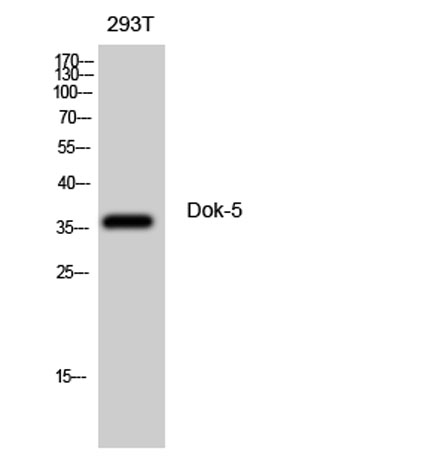
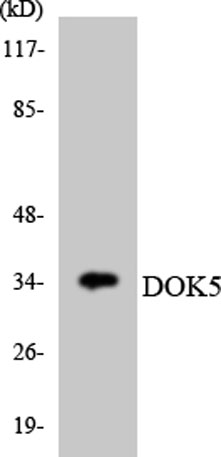
| Observed band (KD) | 36kD |
| Background | docking protein 5(DOK5) Homo sapiens The protein encoded by this gene is a member of the DOK family of membrane proteins, which are adapter proteins involved in signal transduction. The encoded protein interacts with phosphorylated receptor tyrosine kinases to mediate neurite outgrowth and activation of the MAP kinase pathway. Unlike other DOK family proteins, this protein does not interact with RASGAP. This protein is up-regulated in patients with systemic sclerosis and is associated with fibrosis induced by insulin-like growth factor binding protein 5. Alternative splicing of this gene results in multiple transcript variants. [provided by RefSeq, Jun 2014], |
| Function | domain:PTB domain mediates receptor interaction.,function:DOK proteins are enzymatically inert adaptor or scaffolding proteins. They provide a docking platform for the assembly of multimolecular signaling complexes. DOK5 functions in RET-mediated neurite outgrowth and plays a positive role in activation of the MAP kinase pathway. Putative link with downstream effectors of RET in neuronal differentiation.,PTM:Phosphorylated on tyrosine residues in response to insulin, IGF1 and GDNF.,similarity:Belongs to the DOK family. Type B subfamily.,similarity:Contains 1 IRS-type PTB domain.,similarity:Contains 1 PH domain.,subunit:Interacts with phosphorylated RET. In contrast to other DOK proteins, it does not interact with RASGAP.,tissue specificity:Highest expression in skeletal muscle, lower in brain, heart and kidney. Also detected in activated peripheral blood T-lymphocytes., |
| Subcellular location | intracellular, |
| Expression | Highest expression in skeletal muscle, lower in brain, heart and kidney. Also detected in activated peripheral blood T-lymphocytes. |

Use collapsible tabs for more detailed information that will help customers make a purchasing decision.
Ex: Shipping and return policies, size guides, and other common questions.