 Français
 English
PTP1B (phospho Ser50) rabbit pAb
AO-06-ES6929-100

| ELK.No | ES6929 |
| Product name | PTP1B (phospho Ser50) rabbit pAb |
| Reactivity | Human;Mouse;Rat;Monkey |
| Applications | WB;IHC;IF;ELISA |
| Other name | PTPN1; PTP1B; Tyrosine-protein phosphatase non-receptor type 1; Protein-tyrosine phosphatase 1B; PTP-1B |
| Size | 100μL |
| Unit price ($) | 248 |
| Human gene ID | 5770 |
| Human Swiss-Prot | P18031 |
| Source | Rabbit |
| Isotype | IgG |
| Target | PTP1B |
| Fields | >>Adherens junction;>>Insulin signaling pathway;>>Insulin resistance;>>Chemical carcinogenesis - reactive oxygen species |
| Gene name | PTPN1 |
| Protein name | Tyrosine-protein phosphatase non-receptor type 1 |
| Human gene link | View Human Gene |
| Human Swiss link | View Human Swiss-Prot |
| Mouse gene ID | 19246 |
| Mouse gene link | View Mouse Gene |
| Mouse Swiss-Prot | P35821 |
| Mouse Swiss link | View Mouse Swiss-Prot |
| Rat gene ID | 24697 |
| Rat gene link | View Rat Gene |
| Rat Swiss-Prot | P20417 |
| Rat Swiss link | View Rat Swiss-Prot |
| Immunogen | The antiserum was produced against synthesized peptide derived from human PTP1B around the phosphorylation site of Ser50. AA range:16-65 |
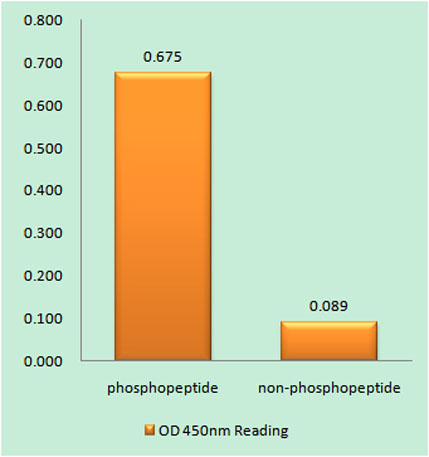
| Specificity | Phospho-PTP1B (S50) Polyclonal Antibody detects endogenous levels of PTP1B protein only when phosphorylated at S50. |
| Formulation | Liquid in PBS containing 50% glycerol, 0.5% BSA and 0.02% sodium azide. |
| Clonality | Polyclonal |
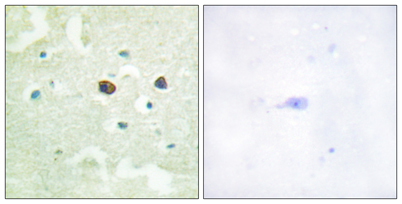
| Dilution | Western Blot: 1/500 - 1/2000. Immunohistochemistry: 1/100 - 1/300. ELISA: 1/40000. Not yet tested in other applications. |
| Purification | The antibody was affinity-purified from rabbit antiserum by affinity-chromatography using epitope-specific immunogen. |
| Concentration | 1 mg/ml |
| Storage stability | -20°C/1 year |
| Molecular Weight (Da) | |
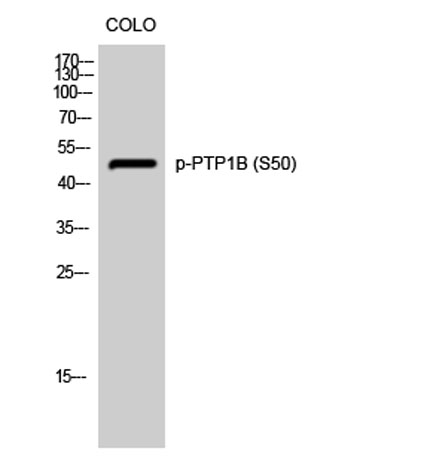
| Observed band (KD) | 49kD |
| Background | The protein encoded by this gene is the founding member of the protein tyrosine phosphatase (PTP) family, which was isolated and identified based on its enzymatic activity and amino acid sequence. PTPs catalyze the hydrolysis of the phosphate monoesters specifically on tyrosine residues. Members of the PTP family share a highly conserved catalytic motif, which is essential for the catalytic activity. PTPs are known to be signaling molecules that regulate a variety of cellular processes including cell growth, differentiation, mitotic cycle, and oncogenic transformation. This PTP has been shown to act as a negative regulator of insulin signaling by dephosphorylating the phosphotryosine residues of insulin receptor kinase. This PTP was also reported to dephosphorylate epidermal growth factor receptor kinase, as well as JAK2 and TYK2 kinases, which implicated the role of |
| Function | catalytic activity:Protein tyrosine phosphate + H(2)O = protein tyrosine + phosphate.,function:May play an important role in CKII- and p60c-src-induced signal transduction cascades.,PTM:Oxidized on Cys-215; the Cys-SOH formed in response to redox signaling reacts with the alpha-amido of the following residue to form a 4-amino-3-isothiazolidinone serine cross-link, triggering a conformational change that inhibits substrate binding and activity. The active site can be restored by reduction.,similarity:Belongs to the protein-tyrosine phosphatase family. Non-receptor class 1 subfamily.,similarity:Contains 1 tyrosine-protein phosphatase domain., |
| Subcellular location | Endoplasmic reticulum membrane ; Peripheral membrane protein ; Cytoplasmic side . Interacts with EPHA3 at the cell membrane. |
| Expression | Expressed in keratinocytes (at protein level). |

Use collapsible tabs for more detailed information that will help customers make a purchasing decision.
Ex: Shipping and return policies, size guides, and other common questions.