 Français
 English
PTPα (phospho Tyr798) rabbit pAb
AO-06-ES6938-50

| ELK.No | ES6938 |
| Product name | PTPα (phospho Tyr798) rabbit pAb |
| Reactivity | Human;Mouse;Rat;Monkey |
| Applications | WB;ELISA;IHC |
| Other name | PTPRA; PTPA; PTPRL2; Receptor-type tyrosine-protein phosphatase alpha; Protein-tyrosine phosphatase alpha; R-PTP-alpha |
| Size | 50μL |
| Unit price ($) | 148 |
| Human gene ID | 5786 |
| Human Swiss-Prot | P18433 |
| Source | Rabbit |
| Isotype | IgG |
| Target | PTPα |
| Fields | |
| Gene name | PTPRA |
| Protein name | Receptor-type tyrosine-protein phosphatase alpha |
| Human gene link | View Human Gene |
| Human Swiss link | View Human Swiss-Prot |
| Mouse gene ID | 19262 |
| Mouse gene link | View Mouse Gene |
| Mouse Swiss-Prot | P18052 |
| Mouse Swiss link | View Mouse Swiss-Prot |
| Rat gene ID | |
| Rat gene link | |
| Rat Swiss-Prot | Q03348 |
| Rat Swiss link | View Rat Swiss-Prot |
| Immunogen | The antiserum was produced against synthesized peptide derived from human PTPRA around the phosphorylation site of Tyr798. AA range:753-802 |
| Specificity | Phospho-PTPα (Y798) Polyclonal Antibody detects endogenous levels of PTPα protein only when phosphorylated at Y798. |
| Formulation | Liquid in PBS containing 50% glycerol, 0.5% BSA and 0.02% sodium azide. |
| Clonality | Polyclonal |
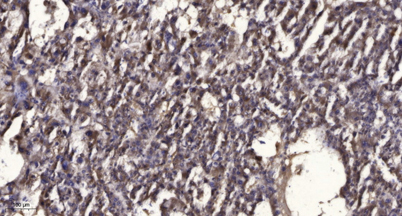
| Dilution | WB 1:500-2000;IHC-p 1:50-300; ELISA 2000-20000 |
| Purification | The antibody was affinity-purified from rabbit antiserum by affinity-chromatography using epitope-specific immunogen. |
| Concentration | 1 mg/ml |
| Storage stability | -20°C/1 year |
| Molecular Weight (Da) | |
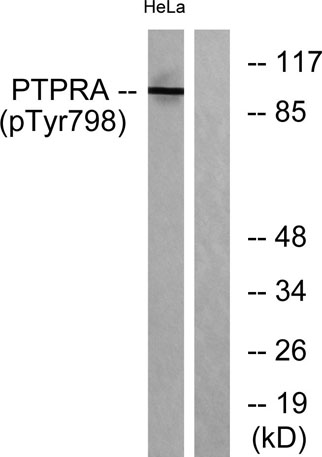
| Observed band (KD) | 100 90kD |
| Background | The protein encoded by this gene is a member of the protein tyrosine phosphatase (PTP) family. PTPs are known to be signaling molecules that regulate a variety of cellular processes including cell growth, differentiation, mitotic cycle, and oncogenic transformation. This PTP contains an extracellular domain, a single transmembrane segment and two tandem intracytoplasmic catalytic domains, and thus represents a receptor-type PTP. This PTP has been shown to dephosphorylate and activate Src family tyrosine kinases, and is implicated in the regulation of integrin signaling, cell adhesion and proliferation. Three alternatively spliced variants of this gene, which encode two distinct isoforms, have been reported. [provided by RefSeq, Jul 2008], |
| Function | catalytic activity:Protein tyrosine phosphate + H(2)O = protein tyrosine + phosphate.,similarity:Belongs to the protein-tyrosine phosphatase family. Receptor class 4 subfamily.,similarity:Contains 2 tyrosine-protein phosphatase domains., |
| Subcellular location | Cell membrane ; Single-pass type I membrane protein . Cell junction, focal adhesion . Localizes to focal adhesion sites following integrin engagement. . |
| Expression | Brain,Epithelium,Kidney,Lymph node,Skin, |

Use collapsible tabs for more detailed information that will help customers make a purchasing decision.
Ex: Shipping and return policies, size guides, and other common questions.