 Français
 English

| ELK.No | ES7012 |
| Product name | p107 rabbit pAb |
| Reactivity | Human;Mouse |
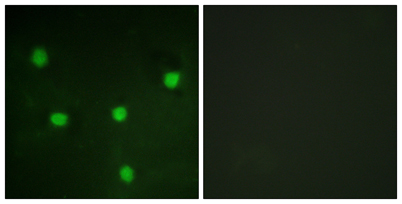
| Applications | IF;ELISA |
| Other name | RBL1; Retinoblastoma-like protein 1; 107 kDa retinoblastoma-associated protein; p107; pRb1 |
| Size | 100μL |
| Unit price ($) | 248 |
| Human gene ID | 5933 |
| Human Swiss-Prot | P28749 |
| Source | Rabbit |
| Isotype | IgG |
| Target | p107 |
| Fields | >>Cell cycle;>>Cellular senescence;>>TGF-beta signaling pathway;>>Human papillomavirus infection;>>Viral carcinogenesis |
| Gene name | RBL1 |
| Protein name | Retinoblastoma-like protein 1 |
| Human gene link | View Human Gene |
| Human Swiss link | View Human Swiss-Prot |
| Mouse gene ID | 19650 |
| Mouse gene link | View Mouse Gene |
| Mouse Swiss-Prot | Q64701 |
| Mouse Swiss link | View Mouse Swiss-Prot |
| Rat gene ID | |
| Rat gene link | |
| Rat Swiss-Prot | |
| Rat Swiss link | |
| Immunogen | The antiserum was produced against synthesized peptide derived from human RBL1. AA range:335-384 |
| Specificity | p107 Polyclonal Antibody detects endogenous levels of p107 protein. |
| Formulation | Liquid in PBS containing 50% glycerol, 0.5% BSA and 0.02% sodium azide. |
| Clonality | Polyclonal |
| Dilution | Immunofluorescence: 1/200 - 1/1000. ELISA: 1/5000. Not yet tested in other applications. |
| Purification | The antibody was affinity-purified from rabbit antiserum by affinity-chromatography using epitope-specific immunogen. |
| Concentration | 1 mg/ml |
| Storage stability | -20°C/1 year |
| Molecular Weight (Da) | 121kD |
| Observed band (KD) | |
| Background | The protein encoded by this gene is similar in sequence and possibly function to the product of the retinoblastoma 1 (RB1) gene. The RB1 gene product is a tumor suppressor protein that appears to be involved in cell cycle regulation, as it is phosphorylated in the S to M phase transition and is dephosphorylated in the G1 phase of the cell cycle. Both the RB1 protein and the product of this gene can form a complex with adenovirus E1A protein and SV40 large T-antigen, with the SV40 large T-antigen binding only to the unphosphorylated form of each protein. In addition, both proteins can inhibit the transcription of cell cycle genes containing E2F binding sites in their promoters. Due to the sequence and biochemical similarities with the RB1 protein, it is thought that the protein encoded by this gene may also be a tumor suppressor. Two transcript variants encoding different isoforms hav |
| Function | function:Key regulator of entry into cell division. Directly involved in heterochromatin formation by maintaining overall chromatin structure and, in particular, that of constitutive heterochromatin by stabilizing histone methylation. Recruits and targets histone methyltransferases SUV420H1 and SUV420H2, leading to epigenetic transcriptional repression. Controls histone H4 'Lys-20' trimethylation. Probably acts as a transcription repressor by recruiting chromatin-modifying enzymes to promoters. Potent inhibitor of E2F-mediated trans-activation. Forms a complex with adenovirus E1A and with SV40 large T antigen. May bind and modulate functionally certain cellular proteins with which T and E1A compete for pocket binding. May act as a tumor suppressor.,PTM:Exists in both phosphorylated and unphosphorylated forms, and T, but not E1A, binds only to the unphosphorylated form. Cell-cycle arrest |
| Subcellular location | Nucleus . |
| Expression | Testis, |

Use collapsible tabs for more detailed information that will help customers make a purchasing decision.
Ex: Shipping and return policies, size guides, and other common questions.