 Français
 English
Synuclein-α (phospho Tyr136) rabbit pAb
AO-06-ES7249-50

| ELK.No | ES7249 |
| Product name | Synuclein-α (phospho Tyr136) rabbit pAb |
| Reactivity | Human;Mouse;Rat |
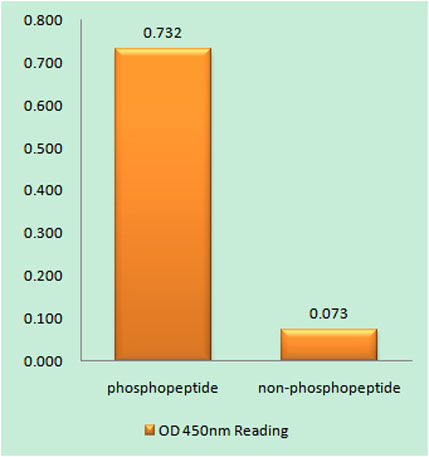
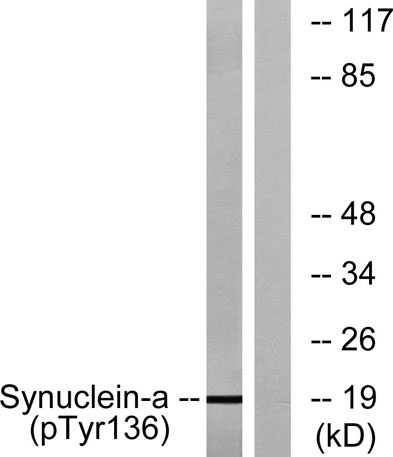
| Applications | WB;ELISA |
| Other name | SNCA; NACP; PARK1; Alpha-synuclein; Non-A beta component of AD amyloid; Non-A4 component of amyloid precursor; NACP |
| Size | 50μL |
| Unit price ($) | 148 |
| Human gene ID | 6622 |
| Human Swiss-Prot | P37840 |
| Source | Rabbit |
| Isotype | IgG |
| Target | Synuclein-α |
| Fields | >>Alzheimer disease;>>Parkinson disease;>>Pathways of neurodegeneration - multiple diseases |
| Gene name | SNCA |
| Protein name | Alpha-synuclein |
| Human gene link | View Human Gene |
| Human Swiss link | View Human Swiss-Prot |
| Mouse gene ID | 20617 |
| Mouse gene link | View Mouse Gene |
| Mouse Swiss-Prot | O55042 |
| Mouse Swiss link | View Mouse Swiss-Prot |
| Rat gene ID | 29219 |
| Rat gene link | View Rat Gene |
| Rat Swiss-Prot | P37377 |
| Rat Swiss link | View Rat Swiss-Prot |
| Immunogen | The antiserum was produced against synthesized peptide derived from human Synuclein-alpha around the phosphorylation site of Tyr136. AA range:91-140 |
| Specificity | Phospho-Synuclein-α (Y136) Polyclonal Antibody detects endogenous levels of Synuclein-α protein only when phosphorylated at Y136. |
| Formulation | Liquid in PBS containing 50% glycerol, 0.5% BSA and 0.02% sodium azide. |
| Clonality | Polyclonal |
| Dilution | Western Blot: 1/500 - 1/2000. ELISA: 1/5000. Not yet tested in other applications. |
| Purification | The antibody was affinity-purified from rabbit antiserum by affinity-chromatography using epitope-specific immunogen. |
| Concentration | 1 mg/ml |
| Storage stability | -20°C/1 year |
| Molecular Weight (Da) | |
| Observed band (KD) | 15kD |
| Background | Alpha-synuclein is a member of the synuclein family, which also includes beta- and gamma-synuclein. Synucleins are abundantly expressed in the brain and alpha- and beta-synuclein inhibit phospholipase D2 selectively. SNCA may serve to integrate presynaptic signaling and membrane trafficking. Defects in SNCA have been implicated in the pathogenesis of Parkinson disease. SNCA peptides are a major component of amyloid plaques in the brains of patients with Alzheimer's disease. Alternatively spliced transcripts encoding different isoforms have been identified for this gene. [provided by RefSeq, Feb 2016], |
| Function | alternative products:Additional isoforms seem to exist,disease:Brain iron accumulation type 1 (NBIA1, also called Hallervorden-Spatz syndrome), a rare neuroaxonal dystrophy, is histologically characterized by axonal spheroids, iron deposition, Lewy body (LB)-like intraneuronal inclusions, glial inclusions and neurofibrillary tangles. SNCA is found in LB-like inclusions, glial inclusions and spheroids.,disease:Defects in SNCA are a cause of autosomal dominant Parkinson disease 1 (PARK1) [MIM:168601, 168600]. Parkinson disease (PD) is a complex, multifactorial disorder that typically manifests after the age of 50 years, although early-onset cases (before 50 years) are known. PD generally arises as a sporadic condition but is occasionally inherited as a simple mendelian trait. Although sporadic and familial PD are very similar, inherited forms of the disease usually begin at earlier ages an |
| Subcellular location | Cytoplasm . Membrane . Nucleus . Cell junction, synapse . Secreted . Cell projection, axon . Membrane-bound in dopaminergic neurons (PubMed:15282274). Expressed and colocalized with SEPTIN4 in dopaminergic axon terminals, especially at the varicosities (By similarity). . |
| Expression | Highly expressed in presynaptic terminals in the central nervous system. Expressed principally in brain. |

Use collapsible tabs for more detailed information that will help customers make a purchasing decision.
Ex: Shipping and return policies, size guides, and other common questions.