 Français
 English

| ELK.No | ES7312 |
| Product name | LKB1 rabbit pAb |
| Reactivity | Human;Mouse |
| Applications | WB;IHC;IF;ELISA |
| Other name | STK11; LKB1; PJS; Serine/threonine-protein kinase STK11; Liver kinase B1; LKB1; hLKB1; Renal carcinoma antigen NY-REN-19 |
| Size | 50μL |
| Unit price ($) | 148 |
| Human gene ID | 6794 |
| Human Swiss-Prot | Q15831 |
| Source | Rabbit |
| Isotype | IgG |
| Target | LKB1 |
| Fields | >>FoxO signaling pathway;>>Autophagy - animal;>>mTOR signaling pathway;>>PI3K-Akt signaling pathway;>>AMPK signaling pathway;>>Longevity regulating pathway;>>Tight junction;>>Adipocytokine signaling pathway |
| Gene name | STK11 |
| Protein name | Serine/threonine-protein kinase STK11 |
| Human gene link | View Human Gene |
| Human Swiss link | View Human Swiss-Prot |
| Mouse gene ID | 20869 |
| Mouse gene link | View Mouse Gene |
| Mouse Swiss-Prot | Q9WTK7 |
| Mouse Swiss link | View Mouse Swiss-Prot |
| Rat gene ID | |
| Rat gene link | |
| Rat Swiss-Prot | |
| Rat Swiss link | |
| Immunogen | The antiserum was produced against synthesized peptide derived from human LKB1. AA range:384-433 |
| Specificity | LKB1 Polyclonal Antibody detects endogenous levels of LKB1 protein. |
| Formulation | Liquid in PBS containing 50% glycerol, 0.5% BSA and 0.02% sodium azide. |
| Clonality | Polyclonal |
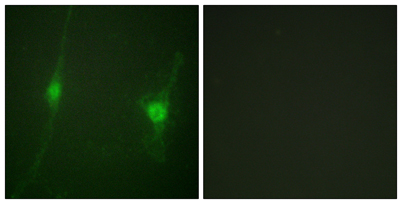
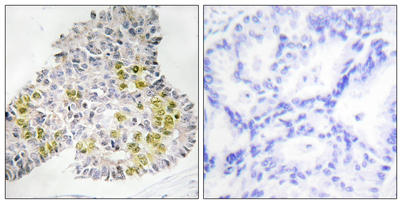
| Dilution | Immunohistochemistry: 1/100 - 1/300. Immunofluorescence: 1/200 - 1/1000. ELISA: 1/20000. Not yet tested in other applications. |
| Purification | The antibody was affinity-purified from rabbit antiserum by affinity-chromatography using epitope-specific immunogen. |
| Concentration | 1 mg/ml |
| Storage stability | -20°C/1 year |
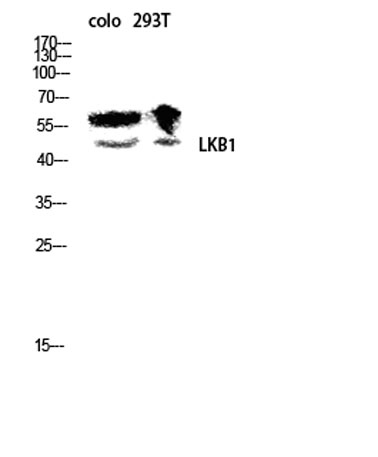
| Molecular Weight (Da) | 49kD |
| Observed band (KD) | |
| Background | This gene, which encodes a member of the serine/threonine kinase family, regulates cell polarity and functions as a tumor suppressor. Mutations in this gene have been associated with Peutz-Jeghers syndrome, an autosomal dominant disorder characterized by the growth of polyps in the gastrointestinal tract, pigmented macules on the skin and mouth, and other neoplasms. Alternate transcriptional splice variants of this gene have been observed but have not been thoroughly characterized. [provided by RefSeq, Jul 2008], |
| Function | catalytic activity:ATP + a protein = ADP + a phosphoprotein.,cofactor:Magnesium or manganese.,disease:Defects in STK11 are a cause of Peutz-Jeghers syndrome (PJS) [MIM:175200]. PJS is a rare hereditary disease in which there is predisposition to benign and malignant tumors of many organ systems. PJS is an autosomal dominant disorder characterized by melanocytic macules of the lips, multiple gastrointestinal hamartomatous polyps and an increased risk for various neoplasms, including gastrointestinal cancer.,disease:Defects in STK11 have been associated with testicular tumors [MIM:273300]. It includes germ cell tumor (GCT) or testicular germ cell tumor (TGCT).,enzyme regulation:Activated by binding of a complex consisting of CAB39 and STRAD or CAB39 and ALS2CR2.,function:Essential role in G1 cell cycle arrest. Phosphorylates and activates members of the AMPK-related subfamily of protein ki |
| Subcellular location | Nucleus. Cytoplasm. Membrane . Mitochondrion. A small fraction localizes at membranes (By similarity). Relocates to the cytoplasm when bound to STRAD (STRADA or STRADB) and CAB39/MO25 (CAB39/MO25alpha or CAB39L/MO25beta). Translocates to the mitochondrion during apoptosis. PTEN promotes cytoplasmic localization. .; [Isoform 2]: Nucleus . Cytoplasm . Predominantly nuclear, but translocates to the cytoplasm in response to metformin or peroxynitrite treatment. |
| Expression | Ubiquitously expressed. Strongest expression in testis and fetal liver. |

Use collapsible tabs for more detailed information that will help customers make a purchasing decision.
Ex: Shipping and return policies, size guides, and other common questions.