 Français
 English
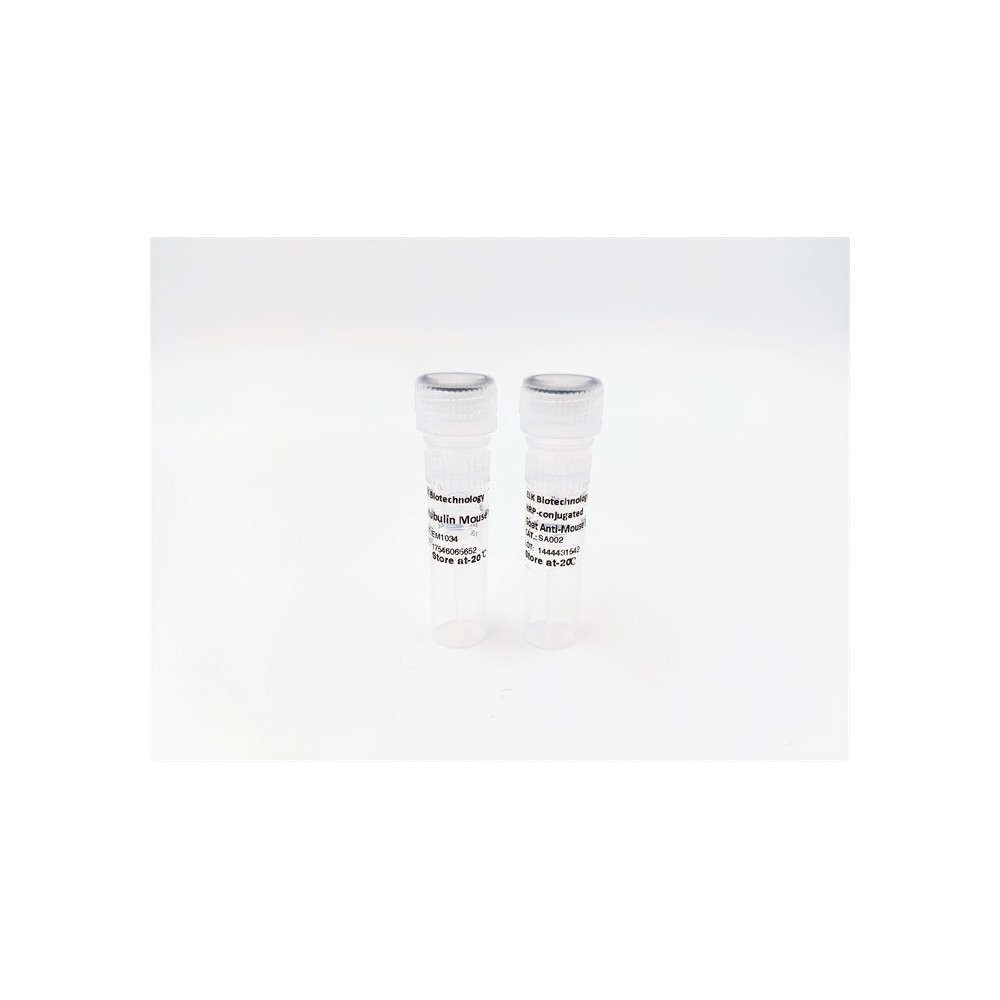

| ELK.No | ES7377 |
| Product name | Hic-5 rabbit pAb |
| Reactivity | Human;Mouse;Rat |
| Applications | WB;IHC;IF;ELISA |
| Other name | TGFB1I1; ARA55; Transforming growth factor beta-1-induced transcript 1 protein; Androgen receptor coactivator 55 kDa protein; Androgen receptor-associated protein of 55 kDa; Hydrogen peroxide-inducible clone 5 protein; Hic-5 |
| Size | 50μL |
| Unit price ($) | 148 |
| Human gene ID | 7041 |
| Human Swiss-Prot | O43294 |
| Source | Rabbit |
| Isotype | IgG |
| Target | Hic-5 |
| Fields | |
| Gene name | TGFB1I1 |
| Protein name | Transforming growth factor beta-1-induced transcript 1 protein |
| Human gene link | View Human Gene |
| Human Swiss link | View Human Swiss-Prot |
| Mouse gene ID | 21804 |
| Mouse gene link | View Mouse Gene |
| Mouse Swiss-Prot | Q62219 |
| Mouse Swiss link | View Mouse Swiss-Prot |
| Rat gene ID | 84574 |
| Rat gene link | View Rat Gene |
| Rat Swiss-Prot | Q99PD6 |
| Rat Swiss link | View Rat Swiss-Prot |
| Immunogen | The antiserum was produced against synthesized peptide derived from human Hic-5. AA range:31-80 |
| Specificity | Hic-5 Polyclonal Antibody detects endogenous levels of Hic-5 protein. |
| Formulation | Liquid in PBS containing 50% glycerol, 0.5% BSA and 0.02% sodium azide. |
| Clonality | Polyclonal |
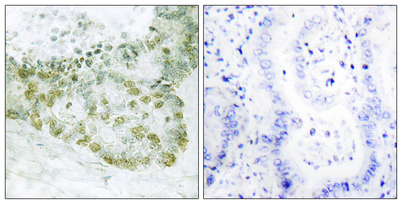
| Dilution | Immunohistochemistry: 1/100 - 1/300. Immunofluorescence: 1/200 - 1/1000. ELISA: 1/10000. Not yet tested in other applications. |
| Purification | The antibody was affinity-purified from rabbit antiserum by affinity-chromatography using epitope-specific immunogen. |
| Concentration | 1 mg/ml |
| Storage stability | -20°C/1 year |
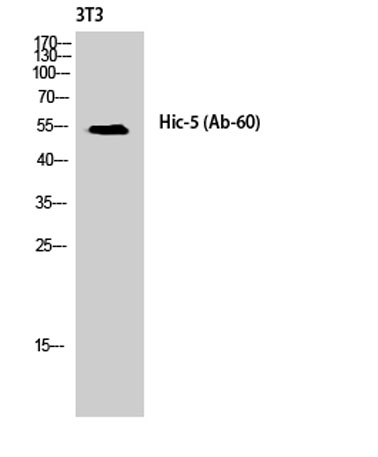
| Molecular Weight (Da) | 50kD |
| Observed band (KD) | |
| Background | transforming growth factor beta 1 induced transcript 1(TGFB1I1) Homo sapiens This gene encodes a coactivator of the androgen receptor, a transcription factor which is activated by androgen and has a key role in male sexual differentiation. The encoded protein is thought to regulate androgen receptor activity and may have a role to play in the treatment of prostate cancer. Multiple transcript variants encoding different isoforms have been found for this gene. [provided by RefSeq, Sep 2009], |
| Function | domain:The LD (leucine and aspartate-rich) motif 3 mediates interaction with GIT1 and functions as a nuclear export signal.,domain:The LIM zinc-binding domains mediate glucocorticoid receptor coactivation and interaction with AR, CRIP2, ILK, LIMS1, NR3C1, PPARG, TCF3, TCF7L2, SLC6A3 and SMAD3. The LIM zinc-binding 2 and LIM zinc-binding 3 domains mediate targeting to focal adhesions and actin stress fibers. The LIM zinc-binding 3 and LIM zinc-binding 4 domains mediate interaction with TRAF4 and MAPK15. The LIM zinc-binding 4 domain mediates interaction with HSPB1, homooligomerization and targeting to the nuclear matrix. The LIM zinc-binding 3 domain mediates interaction with PTPN12.,function:Functions as a molecular adapter coordinating multiple protein-protein interactions at the focal adhesion complex and in the nucleus. Links various intracellular signaling modules to plasma membrane |
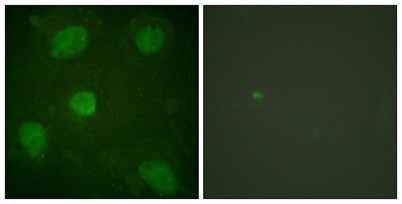
| Subcellular location | Cell junction, focal adhesion. Nucleus matrix. Cytoplasm, cytoskeleton. Associated with the actin cytoskeleton; colocalizes with stress fibers. |
| Expression | Expressed in platelets, smooth muscle and prostate stromal cells (at protein level). |

Use collapsible tabs for more detailed information that will help customers make a purchasing decision.
Ex: Shipping and return policies, size guides, and other common questions.