 Français
 English
TRβ1 (phospho Ser142) rabbit pAb
AO-06-ES7390-100

| ELK.No | ES7390 |
| Product name | TRβ1 (phospho Ser142) rabbit pAb |
| Reactivity | Human;Mouse;Rat |
| Applications | WB;ELISA |
| Other name | THRB; ERBA2; NR1A2; THR1; Thyroid hormone receptor beta; Nuclear receptor subfamily 1 group A member 2; c-erbA-2; c-erbA-beta |
| Size | 100μL |
| Unit price ($) | 248 |
| Human gene ID | 7068 |
| Human Swiss-Prot | P10828 |
| Source | Rabbit |
| Isotype | IgG |
| Target | TRβ1 |
| Fields | >>Neuroactive ligand-receptor interaction;>>Thyroid hormone signaling pathway |
| Gene name | THRB |
| Protein name | Thyroid hormone receptor beta |
| Human gene link | View Human Gene |
| Human Swiss link | View Human Swiss-Prot |
| Mouse gene ID | 21834 |
| Mouse gene link | View Mouse Gene |
| Mouse Swiss-Prot | P37242 |
| Mouse Swiss link | View Mouse Swiss-Prot |
| Rat gene ID | |
| Rat gene link | |
| Rat Swiss-Prot | P18113 |
| Rat Swiss link | View Rat Swiss-Prot |
| Immunogen | The antiserum was produced against synthesized peptide derived from human TR-beta1 around the phosphorylation site of Ser142. AA range:116-165 |
| Specificity | Phospho-TRβ1 (S142) Polyclonal Antibody detects endogenous levels of TRβ1 protein only when phosphorylated at S142. |
| Formulation | Liquid in PBS containing 50% glycerol, 0.5% BSA and 0.02% sodium azide. |
| Clonality | Polyclonal |
| Dilution | Western Blot: 1/500 - 1/2000. ELISA: 1/5000. Not yet tested in other applications. |
| Purification | The antibody was affinity-purified from rabbit antiserum by affinity-chromatography using epitope-specific immunogen. |
| Concentration | 1 mg/ml |
| Storage stability | -20°C/1 year |
| Molecular Weight (Da) | |
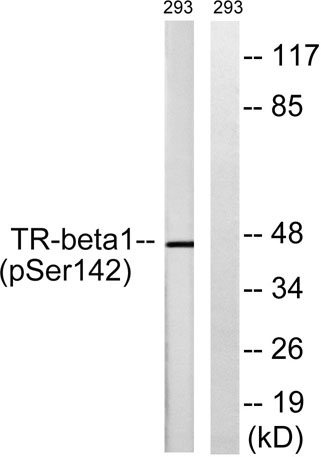
| Observed band (KD) | 45kD |
| Background | The protein encoded by this gene is a nuclear hormone receptor for triiodothyronine. It is one of the several receptors for thyroid hormone, and has been shown to mediate the biological activities of thyroid hormone. Knockout studies in mice suggest that the different receptors, while having certain extent of redundancy, may mediate different functions of thyroid hormone. Mutations in this gene are known to be a cause of generalized thyroid hormone resistance (GTHR), a syndrome characterized by goiter and high levels of circulating thyroid hormone (T3-T4), with normal or slightly elevated thyroid stimulating hormone (TSH). Several alternatively spliced transcript variants encoding the same protein have been observed for this gene. [provided by RefSeq, Jul 2008], |
| Function | disease:Defects in THRB are the cause of generalized thyroid hormone resistance (GTHR) [MIM:188570, 274300]. GTHR is transmitted as an autosomal dominant trait, but an autosomal recessive form also exists. The disease is characterized by goiter, abnormal mental functions, increased susceptibility to infections, abnormal growth and bone maturation, tachycardia and deafness. Affected individuals may also have attention deficit-hyperactivity disorders (ADHD) and language difficulties. GTHR patients also have high levels of circulating thyroid hormones (T3-T4), with normal or slightly elevated thyroid stimulating hormone (TSH).,disease:Defects in THRB are the cause of selective pituitary thyroid hormone resistance (PRTH) [MIM:145650]; also called familial hyperthyroidism due to inappropriate thyrotropin secretion. PRTH is a variant form of thyroid hormone resistance and is characterized by c |
| Subcellular location | Nucleus. |
| Expression | Brain,Kidney,Pituitary,Placenta,Testis, |

Use collapsible tabs for more detailed information that will help customers make a purchasing decision.
Ex: Shipping and return policies, size guides, and other common questions.