 Français
 English
Zyxin (phospho Ser142) rabbit pAb
AO-06-ES7554-50

| ELK.No | ES7554 |
| Product name | Zyxin (phospho Ser142) rabbit pAb |
| Reactivity | Human;Rat;Mouse; |
| Applications | WB;ELISA |
| Other name | ZYX; Zyxin; Zyxin-2 |
| Size | 50μL |
| Unit price ($) | 148 |
| Human gene ID | 7791 |
| Human Swiss-Prot | Q15942 |
| Source | Rabbit |
| Isotype | IgG |
| Target | Zyxin |
| Fields | >>Focal adhesion |
| Gene name | ZYX |
| Protein name | Zyxin |
| Human gene link | View Human Gene |
| Human Swiss link | View Human Swiss-Prot |
| Mouse gene ID | |
| Mouse gene link | |
| Mouse Swiss-Prot | Q62523 |
| Mouse Swiss link | View Mouse Swiss-Prot |
| Rat gene ID | |
| Rat gene link | |
| Rat Swiss-Prot | |
| Rat Swiss link | |
| Immunogen | The antiserum was produced against synthesized peptide derived from human Zyxin around the phosphorylation site of Ser142. AA range:108-157 |
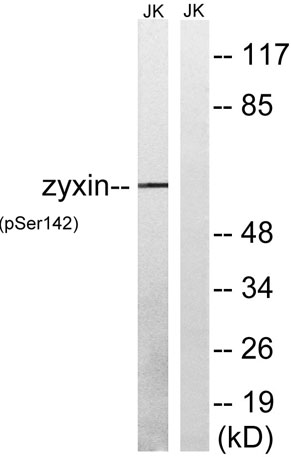
| Specificity | Phospho-Zyxin (S142) Polyclonal Antibody detects endogenous levels of Zyxin protein only when phosphorylated at S142. |
| Formulation | Liquid in PBS containing 50% glycerol, 0.5% BSA and 0.02% sodium azide. |
| Clonality | Polyclonal |
| Dilution | Western Blot: 1/500 - 1/2000. ELISA: 1/5000. Not yet tested in other applications. |
| Purification | The antibody was affinity-purified from rabbit antiserum by affinity-chromatography using epitope-specific immunogen. |
| Concentration | 1 mg/ml |
| Storage stability | -20°C/1 year |
| Molecular Weight (Da) | |
| Observed band (KD) | 61kD |
| Background | Focal adhesions are actin-rich structures that enable cells to adhere to the extracellular matrix and at which protein complexes involved in signal transduction assemble. Zyxin is a zinc-binding phosphoprotein that concentrates at focal adhesions and along the actin cytoskeleton. Zyxin has an N-terminal proline-rich domain and three LIM domains in its C-terminal half. The proline-rich domain may interact with SH3 domains of proteins involved in signal transduction pathways while the LIM domains are likely involved in protein-protein binding. Zyxin may function as a messenger in the signal transduction pathway that mediates adhesion-stimulated changes in gene expression and may modulate the cytoskeletal organization of actin bundles. Alternative splicing results in multiple transcript variants that encode the same isoform. [provided by RefSeq, Jul 2008], |
| Function | function:Adhesion plaque protein. Binds alpha-actinin and the CRP protein. May be a component of a signal transduction pathway that mediates adhesion-stimulated changes in gene expression.,similarity:Belongs to the zyxin/ajuba family.,similarity:Contains 3 LIM zinc-binding domains.,subcellular location:Associates with the actin cytoskeleton near the adhesion plaques. Enters the nucleus in the presence of HESX1.,subunit:Interacts with HPV type 6 protein E6. Does not interact significantly with E6 proteins from HPV types 11, 16, or 18. Interacts, via the Pro-rich regions, with the EVH1 domains of ENAH and VASP. Interaction with ENA/VASP family members is important for their targeting to focal adhesions and the formation of actin-rich structures., |
| Subcellular location | Cytoplasm. Cytoplasm, cytoskeleton. Nucleus. Cell junction, focal adhesion. Associates with the actin cytoskeleton near the adhesion plaques. Enters the nucleus in the presence of HESX1. |
| Expression | Cervix carcinoma,Epididymis,Epithelium,Kidney,Placenta,Platelet,Skin,Umbilical vein,Uterus, |

Use collapsible tabs for more detailed information that will help customers make a purchasing decision.
Ex: Shipping and return policies, size guides, and other common questions.