 Français
 English
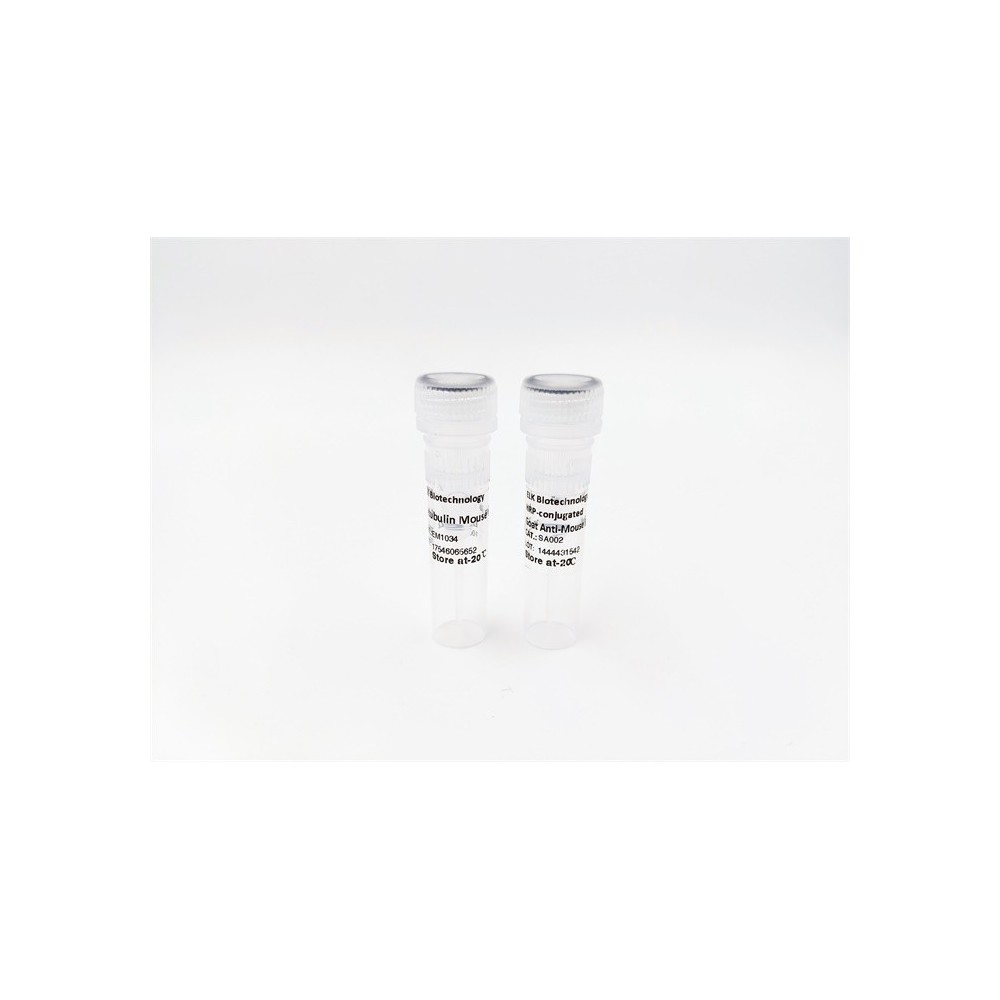

| ELK.No | ES7647 |
| Product name | Nectin 4 rabbit pAb |
| Reactivity | Human;Rat;Mouse; |
| Applications | WB;ELISA |
| Other name | PVRL4; LNIR; PRR4; Poliovirus receptor-related protein 4; Ig superfamily receptor LNIR; Nectin-4 |
| Size | 100μL |
| Unit price ($) | 248 |
| Human gene ID | 81607 |
| Human Swiss-Prot | Q96NY8 |
| Source | Rabbit |
| Isotype | IgG |
| Target | Nectin 4 |
| Fields | >>Adherens junction |
| Gene name | PVRL4 |
| Protein name | Poliovirus receptor-related protein 4 |
| Human gene link | View Human Gene |
| Human Swiss link | View Human Swiss-Prot |
| Mouse gene ID | |
| Mouse gene link | |
| Mouse Swiss-Prot | Q8R007 |
| Mouse Swiss link | View Mouse Swiss-Prot |
| Rat gene ID | |
| Rat gene link | |
| Rat Swiss-Prot | |
| Rat Swiss link | |
| Immunogen | The antiserum was produced against synthesized peptide derived from human PVRL4. AA range:312-361 |
| Specificity | Nectin 4 Polyclonal Antibody detects endogenous levels of Nectin 4 protein. |
| Formulation | Liquid in PBS containing 50% glycerol, 0.5% BSA and 0.02% sodium azide. |
| Clonality | Polyclonal |
| Dilution | Western Blot: 1/500 - 1/2000. ELISA: 1/5000. Not yet tested in other applications. |
| Purification | The antibody was affinity-purified from rabbit antiserum by affinity-chromatography using epitope-specific immunogen. |
| Concentration | 1 mg/ml |
| Storage stability | -20°C/1 year |
| Molecular Weight (Da) | |
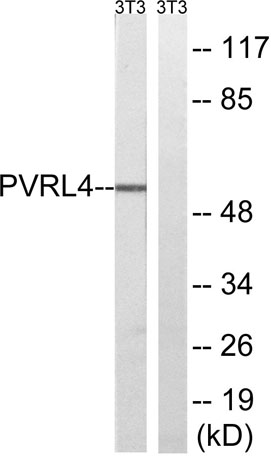
| Observed band (KD) | 55kD |
| Background | This gene encodes a member of the nectin family. The encoded protein contains two immunoglobulin-like (Ig-like) C2-type domains and one Ig-like V-type domain. It is involved in cell adhesion through trans-homophilic and -heterophilic interactions. It is a single-pass type I membrane protein. The soluble form is produced by proteolytic cleavage at the cell surface by the metalloproteinase ADAM17/TACE. The secreted form is found in both breast tumor cell lines and breast tumor patients. Mutations in this gene are the cause of ectodermal dysplasia-syndactyly syndrome type 1, an autosomal recessive disorder. Alternatively spliced transcript variants have been found but the full-length nature of the variant has not been determined.[provided by RefSeq, Jan 2011], |
| Function | function:Seems to be involved in cell adhesion through trans-homophilic and -heterophilic interactions, the latter including specifically interactions with PVRL2/nectin-1. Does not act as receptor for alpha-herpesvirus entry into cells.,PTM:The soluble form is produced by proteolytic cleavage at the cell surface (shedding), probably by ADAM17/TACE.,similarity:Belongs to the nectin family.,similarity:Contains 1 Ig-like V-type (immunoglobulin-like) domain.,similarity:Contains 2 Ig-like C2-type (immunoglobulin-like) domains.,subcellular location:Colocalizes with MLLT4 at cadherin-based adherens junctions.,subcellular location:The secreted form is found in breast tumor patients.,subunit:Self-associates. Interacts via its Ig-like V-type domain with PVRL1/nectin-1 Ig-like V-type domain. Interacts via its C-terminus with MLLT4.,tissue specificity:Predominantly expressed in placenta. Not detecte |
| Subcellular location | Cell membrane ; Single-pass type I membrane protein . Cell junction, adherens junction . Colocalizes with AFDN at cadherin-based adherens junctions (PubMed:11544254).; [Processed poliovirus receptor-related protein 4]: Secreted . The secreted form is found in breast tumor patients (PubMed:15784625). |
| Expression | Predominantly expressed in placenta. Not detected in normal breast epithelium but expressed in breast carcinoma. |

Use collapsible tabs for more detailed information that will help customers make a purchasing decision.
Ex: Shipping and return policies, size guides, and other common questions.