 Français
 English

| ELK.No | ES7709 |
| Product name | T1R3 rabbit pAb |
| Reactivity | Human;Rat;Mouse; |
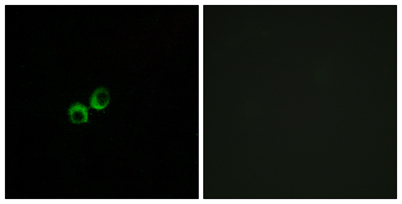
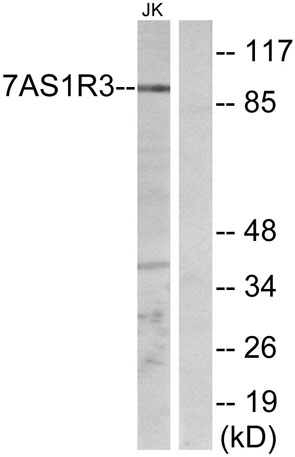
| Applications | WB;IF;ELISA |
| Other name | TAS1R3; T1R3; TR3; Taste receptor type 1 member 3; Sweet taste receptor T1R3 |
| Size | 50μL |
| Unit price ($) | 148 |
| Human gene ID | 83756 |
| Human Swiss-Prot | Q7RTX0 |
| Source | Rabbit |
| Isotype | IgG |
| Target | T1R3 |
| Fields | >>Taste transduction;>>Carbohydrate digestion and absorption |
| Gene name | TAS1R3 |
| Protein name | Taste receptor type 1 member 3 |
| Human gene link | View Human Gene |
| Human Swiss link | View Human Swiss-Prot |
| Mouse gene ID | |
| Mouse gene link | |
| Mouse Swiss-Prot | Q925D8 |
| Mouse Swiss link | View Mouse Swiss-Prot |
| Rat gene ID | |
| Rat gene link | |
| Rat Swiss-Prot | |
| Rat Swiss link | |
| Immunogen | The antiserum was produced against synthesized peptide derived from human TAS1R3. AA range:326-375 |
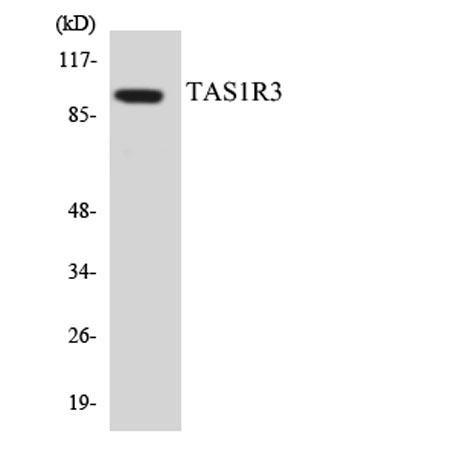
| Specificity | T1R3 Polyclonal Antibody detects endogenous levels of T1R3 protein. |
| Formulation | Liquid in PBS containing 50% glycerol, 0.5% BSA and 0.02% sodium azide. |
| Clonality | Polyclonal |
| Dilution | Western Blot: 1/500 - 1/2000. Immunofluorescence: 1/200 - 1/1000. ELISA: 1/10000. Not yet tested in other applications. |
| Purification | The antibody was affinity-purified from rabbit antiserum by affinity-chromatography using epitope-specific immunogen. |
| Concentration | 1 mg/ml |
| Storage stability | -20°C/1 year |
| Molecular Weight (Da) | |
| Observed band (KD) | 93kD |
| Background | The protein encoded by this gene is a G-protein coupled receptor involved in taste responses. The encoded protein can form a heterodimeric receptor with TAS1R1 to elicit the umami taste response, or it can bind with TAS1R2 to form a receptor for the sweet taste response. [provided by RefSeq, Nov 2015], |
| Function | function:Putative taste receptor. TAS1R1/TAS1R3 responds to the umami taste stimulus (the taste of monosodium glutamate). TAS1R2/TAS1R3 recognizes diverse natural and synthetic sweeteners. TAS1R3 is essential for the recognition and response to the disaccharide trehalose (By similarity). Sequence differences within and between species can significantly influence the selectivity and specificity of taste responses.,online information:The taste experience -Issue 55 of February 2005,similarity:Belongs to the G-protein coupled receptor 3 family. TAS1R subfamily.,subunit:Forms homodimers or heterodimers with TAS1R1 and TAS1R2., |
| Subcellular location | Cell membrane; Multi-pass membrane protein. |
| Expression |

Use collapsible tabs for more detailed information that will help customers make a purchasing decision.
Ex: Shipping and return policies, size guides, and other common questions.