 Français
 English

| ELK.No | ES7752 |
| Product name | EF-G2 rabbit pAb |
| Reactivity | Human;Rat;Mouse; |
| Applications | WB;IHC;IF;ELISA |
| Other name | GFM2; EFG2; MSTP027; Ribosome-releasing factor 2; mitochondrial; RRF2mt; Elongation factor G 2, mitochondrial; EF-G2mt; mEF-G 2; Elongation factor G2; hEFG2 |
| Size | 50μL |
| Unit price ($) | 148 |
| Human gene ID | 84340 |
| Human Swiss-Prot | Q969S9 |
| Source | Rabbit |
| Isotype | IgG |
| Target | EF-G2 |
| Fields | |
| Gene name | GFM2 |
| Protein name | Ribosome-releasing factor 2 mitochondrial |
| Human gene link | View Human Gene |
| Human Swiss link | View Human Swiss-Prot |
| Mouse gene ID | |
| Mouse gene link | |
| Mouse Swiss-Prot | Q8R2Q4 |
| Mouse Swiss link | View Mouse Swiss-Prot |
| Rat gene ID | |
| Rat gene link | |
| Rat Swiss-Prot | |
| Rat Swiss link | |
| Immunogen | The antiserum was produced against synthesized peptide derived from human GFM2. AA range:441-490 |
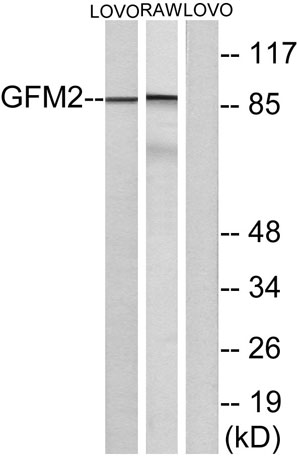
| Specificity | EF-G2 Polyclonal Antibody detects endogenous levels of EF-G2 protein. |
| Formulation | Liquid in PBS containing 50% glycerol, 0.5% BSA and 0.02% sodium azide. |
| Clonality | Polyclonal |
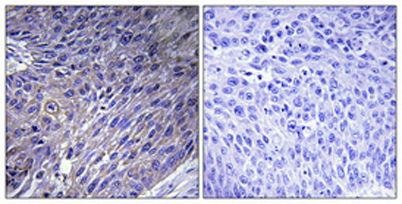
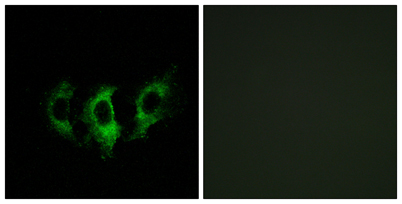
| Dilution | Western Blot: 1/500 - 1/2000. Immunohistochemistry: 1/100 - 1/300. Immunofluorescence: 1/200 - 1/1000. ELISA: 1/20000. Not yet tested in other applications. |
| Purification | The antibody was affinity-purified from rabbit antiserum by affinity-chromatography using epitope-specific immunogen. |
| Concentration | 1 mg/ml |
| Storage stability | -20°C/1 year |
| Molecular Weight (Da) | |
| Observed band (KD) | 87kD |
| Background | Eukaryotes contain two protein translational systems, one in the cytoplasm and one in the mitochondria. Mitochondrial translation is crucial for maintaining mitochondrial function and mutations in this system lead to a breakdown in the respiratory chain-oxidative phosphorylation system and to impaired maintenance of mitochondrial DNA. This gene encodes one of the mitochondrial translation elongation factors, which is a GTPase that plays a role at the termination of mitochondrial translation by mediating the disassembly of ribosomes from messenger RNA . Its role in the regulation of normal mitochondrial function and in disease states attributed to mitochondrial dysfunction is not known. Alternative splicing results in multiple transcript variants encoding distinct isoforms. [provided by RefSeq, Jul 2013], |
| Function | translation, mitochondrion organization, cellular component disassembly, mitochondrial translation, ribosome disassembly, macromolecular complex disassembly, ribonucleoprotein complex disassembly, cellular macromolecular complex subunit organization, cellular macromolecular complex disassembly, macromolecular complex subunit organization, |
| Subcellular location | Mitochondrion . |
| Expression | Widely expressed. |

Use collapsible tabs for more detailed information that will help customers make a purchasing decision.
Ex: Shipping and return policies, size guides, and other common questions.