 Français
 English
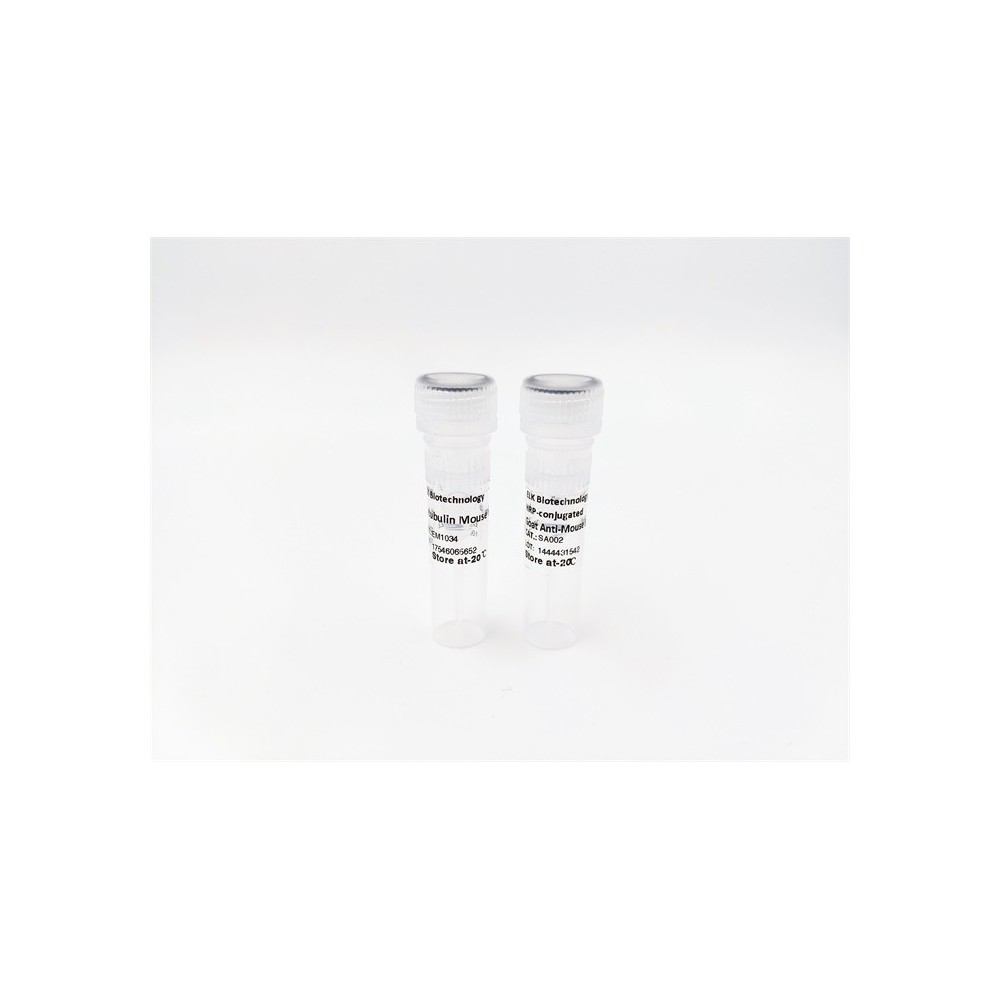
CaSR (phospho Thr888) rabbit pAb
AO-06-ES7763-100

| ELK.No | ES7763 |
| Product name | CaSR (phospho Thr888) rabbit pAb |
| Reactivity | Human;Mouse;Rat |
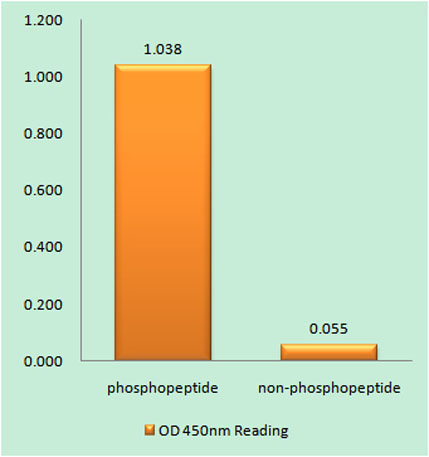
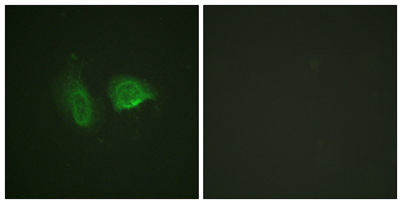
| Applications | WB;IF;ELISA |
| Other name | CASR; GPRC2A; PCAR1; Extracellular calcium-sensing receptor; CaSR; Parathyroid cell calcium-sensing receptor; PCaR1 |
| Size | 100μL |
| Unit price ($) | 248 |
| Human gene ID | 846 |
| Human Swiss-Prot | P41180 |
| Source | Rabbit |
| Isotype | IgG |
| Target | CaSR |
| Fields | >>NOD-like receptor signaling pathway;>>Parathyroid hormone synthesis, secretion and action |
| Gene name | CASR |
| Protein name | Extracellular calcium-sensing receptor |
| Human gene link | View Human Gene |
| Human Swiss link | View Human Swiss-Prot |
| Mouse gene ID | 12374 |
| Mouse gene link | View Mouse Gene |
| Mouse Swiss-Prot | Q9QY96 |
| Mouse Swiss link | View Mouse Swiss-Prot |
| Rat gene ID | 24247 |
| Rat gene link | View Rat Gene |
| Rat Swiss-Prot | P48442 |
| Rat Swiss link | View Rat Swiss-Prot |
| Immunogen | The antiserum was produced against synthesized peptide derived from human Calcium Sensing Receptor around the phosphorylation site of Thr888. AA range:854-903 |
| Specificity | Phospho-CaSR (T888) Polyclonal Antibody detects endogenous levels of CaSR protein only when phosphorylated at T888. |
| Formulation | Liquid in PBS containing 50% glycerol, 0.5% BSA and 0.02% sodium azide. |
| Clonality | Polyclonal |
| Dilution | Western Blot: 1/500 - 1/2000. Immunofluorescence: 1/200 - 1/1000. ELISA: 1/40000. Not yet tested in other applications. |
| Purification | The antibody was affinity-purified from rabbit antiserum by affinity-chromatography using epitope-specific immunogen. |
| Concentration | 1 mg/ml |
| Storage stability | -20°C/1 year |
| Molecular Weight (Da) | |
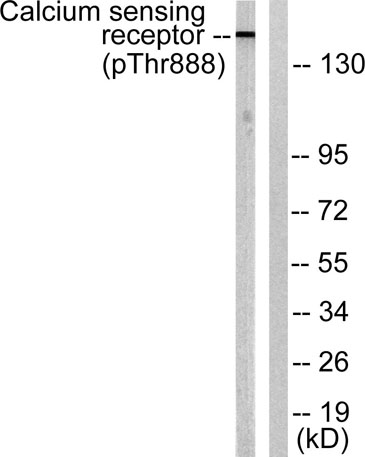
| Observed band (KD) | 140kD |
| Background | The protein encoded by this gene is a G protein-coupled receptor that is expressed in the parathyroid hormone (PTH)-producing chief cells of the parathyroid gland, and the cells lining the kidney tubule. It senses small changes in circulating calcium concentration and couples this information to intracellular signaling pathways that modify PTH secretion or renal cation handling, thus this protein plays an essential role in maintaining mineral ion homeostasis. Mutations in this gene cause familial hypocalciuric hypercalcemia, familial, isolated hypoparathyroidism, and neonatal severe primary hyperparathyroidism. [provided by RefSeq, Jul 2008], |
| Function | disease:Defects in CASR are the cause of autosomal dominant hypoparathyroidism (FIH) [MIM:146200]. FIH is characterized by hypocalcemia and hyperphosphatemia due to inadequate secretion of parathyroid hormone. Symptoms are seizures, tetany and cramps.,disease:Defects in CASR are the cause of familial hypocalciuric hypercalcemia type 1 (FHH) [MIM:145980]; in which the receptor has reduced activity. FHH is characterized by altered calcium homeostasis. Affected individuals exhibit mild or modest hypercalcemia, relative hypocalciuria, and inappropriately normal PTH levels.,disease:Defects in CASR are the cause of neonatal severe primary hyperparathyroidism (NSHPT) [MIM:239200]; in which the receptor has reduced activity. NSHPT is a rare autosomal recessive life-threatening disorder characterized by very high serum calcium concentrations, skeletal demineralization, and parathyroid hyperplasia |
| Subcellular location | Cell membrane ; Multi-pass membrane protein . |
| Expression | Expressed in the temporal lobe, frontal lobe, parietal lobe, hippocampus, and cerebellum. Also found in kidney, lung, liver, heart, skeletal muscle, placenta. |

Use collapsible tabs for more detailed information that will help customers make a purchasing decision.
Ex: Shipping and return policies, size guides, and other common questions.