 Français
 English
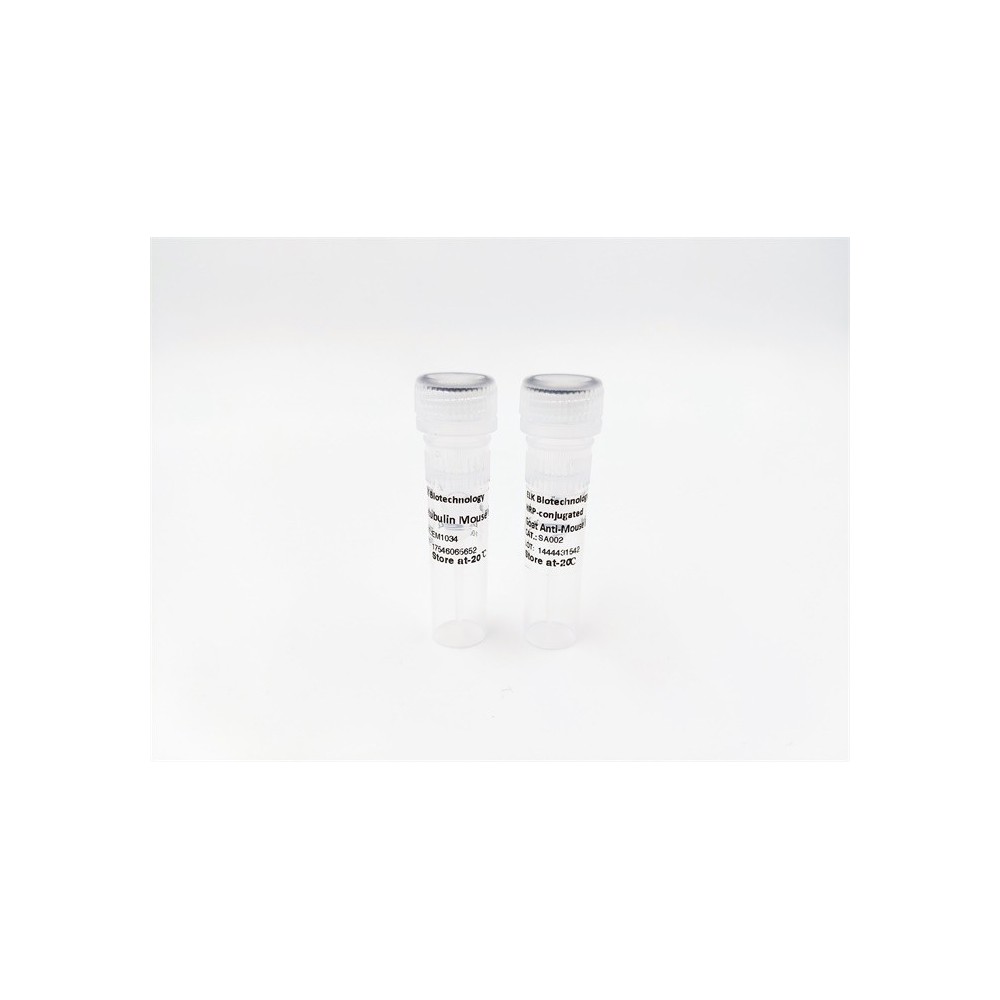

| ELK.No | ES7867 |
| Product name | SNX3 rabbit pAb |
| Reactivity | Human;Mouse;Rat |
| Applications | WB;ELISA;IHC |
| Other name | SNX3; Sorting nexin-3; Protein SDP3 |
| Size | 50μL |
| Unit price ($) | 148 |
| Human gene ID | 8724 |
| Human Swiss-Prot | O60493 |
| Source | Rabbit |
| Isotype | IgG |
| Target | SNX3 |
| Fields | >>Endocytosis |
| Gene name | SNX3 |
| Protein name | Sorting nexin-3 |
| Human gene link | View Human Gene |
| Human Swiss link | View Human Swiss-Prot |
| Mouse gene ID | |
| Mouse gene link | |
| Mouse Swiss-Prot | O70492 |
| Mouse Swiss link | View Mouse Swiss-Prot |
| Rat gene ID | 684097 |
| Rat gene link | View Rat Gene |
| Rat Swiss-Prot | Q5U211 |
| Rat Swiss link | View Rat Swiss-Prot |
| Immunogen | The antiserum was produced against synthesized peptide derived from human SNX3. AA range:91-140 |
| Specificity | SNX3 Polyclonal Antibody detects endogenous levels of SNX3 protein. |
| Formulation | Liquid in PBS containing 50% glycerol, 0.5% BSA and 0.02% sodium azide. |
| Clonality | Polyclonal |
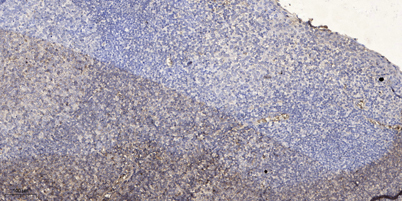
| Dilution | WB 1:500-2000;IHC-p 1:50-300; ELISA 2000-20000 |
| Purification | The antibody was affinity-purified from rabbit antiserum by affinity-chromatography using epitope-specific immunogen. |
| Concentration | 1 mg/ml |
| Storage stability | -20°C/1 year |
| Molecular Weight (Da) | |
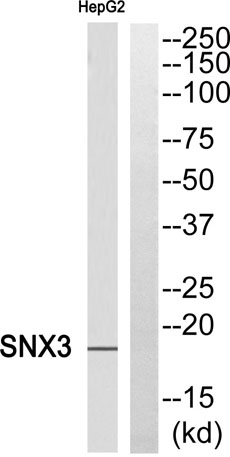
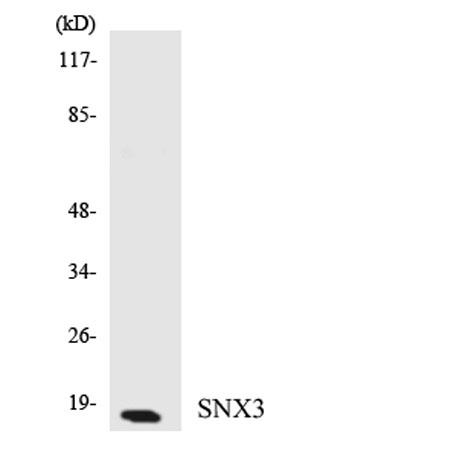
| Observed band (KD) | 18kD |
| Background | This gene encodes a member of the sorting nexin family. Members of this family contain a phox (PX) domain, which is a phosphoinositide binding domain, and are involved in intracellular trafficking. This protein does not contain a coiled coil region, like most family members. This protein interacts with phosphatidylinositol-3-phosphate, and is involved in protein trafficking. A pseudogene of this gene is present on the sex chromosomes. Alternative splicing results in multiple transcript variants encoding distinct isoforms. [provided by RefSeq, Jul 2014], |
| Function | disease:A chromosomal aberration disrupting SNX3 may be a cause of microphthalmia syndromic type 8 (MCOPS8) [MIM:601349]. Translocation t(6;13)(q21;q12). Microphthalmia is a clinically heterogeneous disorder of eye formation, ranging from small size of a single eye to complete bilateral absence of ocular tissues (anophthalmia). In many cases, microphthalmia/anophthalmia occurs in association with syndromes that include non-ocular abnormalities. MCOPS8 is a very rare congenital syndrome characterized by microcephaly, microphthalmia, ectrodactyly of the lower limbs and prognathism. Intellectual deficit has been reported.,function:May be involved in several stages of intracellular trafficking.,similarity:Belongs to the sorting nexin family.,similarity:Contains 1 PX (phox homology) domain., |
| Subcellular location | Early endosome . Cytoplasmic vesicle, phagosome . Colocalizes to clathrin-coated endosomal vesicles morphologically distinct from retromer-decorated non-branched endosomal tubule structures (PubMed:21725319) Colocalizes with EEA1 on nascent phagosomes in dendritic cells but competes with EEA1 for binding to phagosomal membrane (PubMed:23237080). In the case of Salmonella enterica infection localizes to Salmonella-containing vacuoles (SCVs) from which SNX3-containing tubules form 30-60 min after infection (PubMed:20482551). . |
| Expression | Brain,Colon,Epithelium,Pancreas,Platelet,Skin, |

Use collapsible tabs for more detailed information that will help customers make a purchasing decision.
Ex: Shipping and return policies, size guides, and other common questions.