 Français
 English

| ELK.No | ES8371 |
| Product name | TASK-1 rabbit pAb |
| Reactivity | Human;Mouse;Rat |
| Applications | WB;ELISA |
| Other name | KCNK3; TASK; TASK1; Potassium channel subfamily K member 3; Acid-sensitive potassium channel protein TASK-1; TWIK-related acid-sensitive K(+) channel 1; Two pore potassium channel KT3.1; Two pore K(+) channel KT3.1 |
| Size | 50μL |
| Unit price ($) | 148 |
| Human gene ID | 3777 |
| Human Swiss-Prot | O14649 |
| Source | Rabbit |
| Isotype | IgG |
| Target | TASK-1 |
| Fields | >>Aldosterone synthesis and secretion;>>Cortisol synthesis and secretion;>>Cushing syndrome |
| Gene name | KCNK3 |
| Protein name | Potassium channel subfamily K member 3 |
| Human gene link | View Human Gene |
| Human Swiss link | View Human Swiss-Prot |
| Mouse gene ID | 16527 |
| Mouse gene link | View Mouse Gene |
| Mouse Swiss-Prot | O35111 |
| Mouse Swiss link | View Mouse Swiss-Prot |
| Rat gene ID | 29553 |
| Rat gene link | View Rat Gene |
| Rat Swiss-Prot | O54912 |
| Rat Swiss link | View Rat Swiss-Prot |
| Immunogen | The antiserum was produced against synthesized peptide derived from human TASK-1. AA range:47-96 |
| Specificity | TASK-1 Polyclonal Antibody detects endogenous levels of TASK-1 protein. |
| Formulation | Liquid in PBS containing 50% glycerol, 0.5% BSA and 0.02% sodium azide. |
| Clonality | Polyclonal |
| Dilution | Western Blot: 1/500 - 1/2000. ELISA: 1/10000. Not yet tested in other applications. |
| Purification | The antibody was affinity-purified from rabbit antiserum by affinity-chromatography using epitope-specific immunogen. |
| Concentration | 1 mg/ml |
| Storage stability | -20°C/1 year |
| Molecular Weight (Da) | |
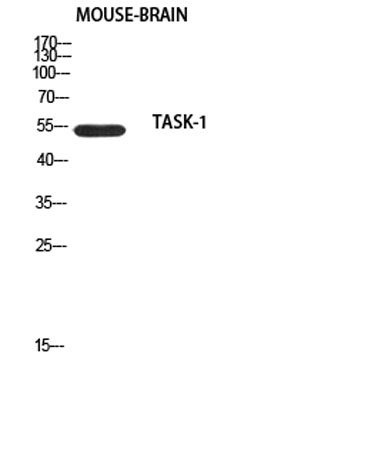
| Observed band (KD) | 53kD |
| Background | This gene encodes a member of the superfamily of potassium channel proteins that contain two pore-forming P domains. The encoded protein is an outwardly rectifying channel that is sensitive to changes in extracellular pH and is inhibited by extracellular acidification. Also referred to as an acid-sensitive potassium channel, it is activated by the anesthetics halothane and isoflurane. Although three transcripts are detected in northern blots, there is currently no sequence available to confirm transcript variants for this gene. [provided by RefSeq, Aug 2008], |
| Function | function:pH-dependent, voltage-insensitive, background potassium channel protein. Rectification direction results from potassium ion concentration on either side of the membrane. Acts as an outward rectifier when external potassium concentration is low. When external potassium concentration is high, current is inward.,miscellaneous:Inhibited by external acidification. Activated by halothane and isoflurane.,similarity:Belongs to the two pore domain potassium channel (TC 1.A.1.8) family.,tissue specificity:Widespread expression in adult. Strongest expression in pancreas and placenta. Lower expression in brain, lung, prostate, heart, kidney, uterus, small intestine and colon., |
| Subcellular location | Cell membrane ; Multi-pass membrane protein . |
| Expression | Widespread expression in adult. Strongest expression in pancreas and placenta. Lower expression in brain, lung, prostate, heart, kidney, uterus, small intestine and colon. |


Use collapsible tabs for more detailed information that will help customers make a purchasing decision.
Ex: Shipping and return policies, size guides, and other common questions.