 Français
 English

| ELK.No | ES8373 |
| Product name | Karyopherin α2 rabbit pAb |
| Reactivity | Human;Mouse;Rat |
| Applications | WB;IHC;IF;ELISA |
| Other name | KPNA2; RCH1; SRP1; Importin subunit alpha-2; Karyopherin subunit alpha-2; RAG cohort protein 1; SRP1-alpha |
| Size | 100μL |
| Unit price ($) | 248 |
| Human gene ID | 3838 |
| Human Swiss-Prot | P52292 |
| Source | Rabbit |
| Isotype | IgG |
| Target | Karyopherin α2 |
| Fields | >>Nucleocytoplasmic transport;>>Influenza A;>>Chemical carcinogenesis - receptor activation |
| Gene name | KPNA2 |
| Protein name | Importin subunit alpha-2 |
| Human gene link | View Human Gene |
| Human Swiss link | View Human Swiss-Prot |
| Mouse gene ID | 16647 |
| Mouse gene link | View Mouse Gene |
| Mouse Swiss-Prot | P52293 |
| Mouse Swiss link | View Mouse Swiss-Prot |
| Rat gene ID | |
| Rat gene link | |
| Rat Swiss-Prot | |
| Rat Swiss link | |
| Immunogen | Synthesized peptide derived from the N-terminal region of human Karyopherin α2. |
| Specificity | Karyopherin α2 Polyclonal Antibody detects endogenous levels of Karyopherin α2 protein. |
| Formulation | Liquid in PBS containing 50% glycerol, 0.5% BSA and 0.02% sodium azide. |
| Clonality | Polyclonal |
| Dilution | IHC-p: 100-300.Western Blot: 1/500 - 1/2000. ELISA: 1/10000. Not yet tested in other applications. |
| Purification | The antibody was affinity-purified from rabbit antiserum by affinity-chromatography using epitope-specific immunogen. |
| Concentration | 1 mg/ml |
| Storage stability | -20°C/1 year |
| Molecular Weight (Da) | |
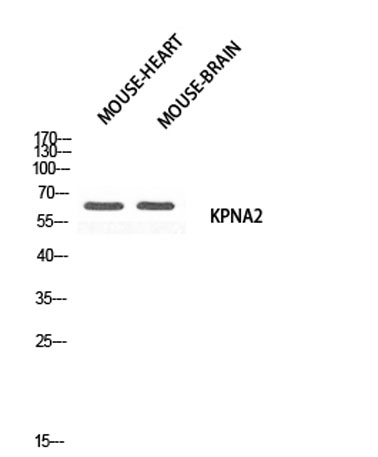
| Observed band (KD) | 60kD |
| Background | The import of proteins into the nucleus is a process that involves at least 2 steps. The first is an energy-independent docking of the protein to the nuclear envelope and the second is an energy-dependent translocation through the nuclear pore complex. Imported proteins require a nuclear localization sequence (NLS) which generally consists of a short region of basic amino acids or 2 such regions spaced about 10 amino acids apart. Proteins involved in the first step of nuclear import have been identified in different systems. These include the Xenopus protein importin and its yeast homolog, SRP1 (a suppressor of certain temperature-sensitive mutations of RNA polymerase I in Saccharomyces cerevisiae), which bind to the NLS. KPNA2 protein interacts with the NLSs of DNA helicase Q1 and SV40 T antigen and may be involved in the nuclear transport of proteins. KPNA2 also may play a role in V(D)J re |
| Function | domain:Consists of an N-terminal hydrophilic region, a hydrophobic central region composed of 10 repeats, and a short hydrophilic C-terminus. The N-terminal hydrophilic region contains the importin beta binding domain (IBB domain), which is sufficient for binding importin beta and essential for nuclear protein import.,domain:The IBB domain is thought to act as an intrasteric autoregulatory sequence by interacting with the internal autoinhibitory NLS. Binding of KPNB1 probably overlaps the internal NLS and contributes to a high affinity for cytoplasmic NLS-containing cargo substrates. After dissociation of the importin/substrate complex in the nucleus the internal autohibitory NLS contributes to a low affinity for nuclear NLS-containing proteins.,domain:The major and minor NLS binding sites are mainly involved in recognition of simple or bipartite NLS motifs. Structurally located within i |
| Subcellular location | Cytoplasm . Nucleus .; Endoplasmic reticulum membrane. Golgi apparatus membrane . (Microbial infection) Retained in ER/Golgi membranes upon interaction with SARS-COV virus ORF6 protein. . |
| Expression | Expressed ubiquitously. |



Use collapsible tabs for more detailed information that will help customers make a purchasing decision.
Ex: Shipping and return policies, size guides, and other common questions.