 Français
 English
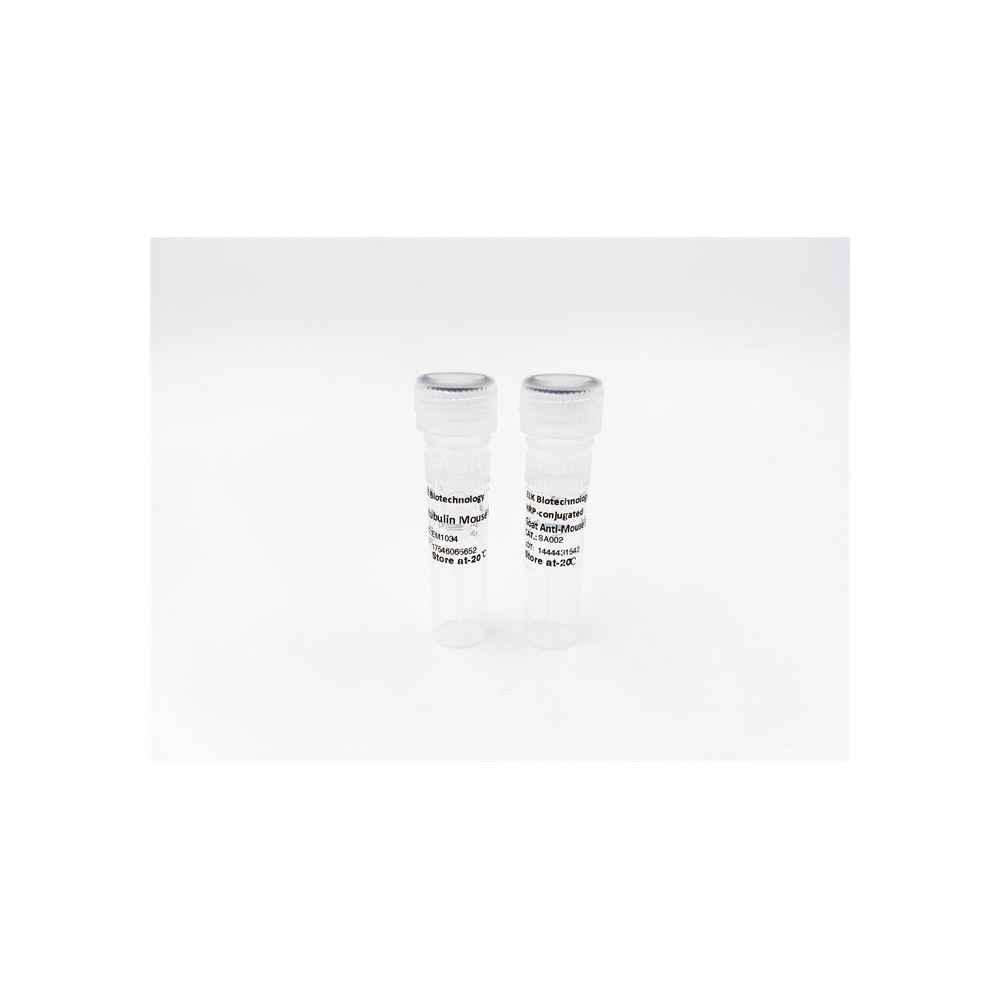
TAL1/2 (Acetyl Lys221/Acetyl Lys222/Acetyl Lys36/Acetyl Lys37) rabbit pAb
AO-06-ES8436-100

| ELK.No | ES8436 |
| Product name | TAL1/2 (Acetyl Lys221/Acetyl Lys222/Acetyl Lys36/Acetyl Lys37) rabbit pAb |
| Reactivity | Human;Mouse;Rat |
| Applications | WB;ELISA |
| Other name | TAL1; BHLHA17; SCL; TCL5; T-cell acute lymphocytic leukemia protein 1; TAL-1; Class A basic helix-loop-helix protein 17; bHLHa17; Stem cell protein; T-cell leukemia/lymphoma protein 5; TAL2; BHLHA19; T-cell acute lymphocytic leukemia protein 2; TAL-2; Class A basic helix-loop-helix protein 19; bHLHa19 |
| Size | 100μL |
| Unit price ($) | 248 |
| Human gene ID | 6886 |
| Human Swiss-Prot | P17542 |
| Source | Rabbit |
| Isotype | IgG |
| Target | TAL1/2 |
| Fields | |
| Gene name | TAL1/TAL2 |
| Protein name | T-cell acute lymphocytic leukemia protein 1 homolog/T-cell acute lymphocytic leukemia protein 2 |
| Human gene link | View Human Gene |
| Human Swiss link | View Human Swiss-Prot |
| Mouse gene ID | 21349 |
| Mouse gene link | View Mouse Gene |
| Mouse Swiss-Prot | P22091 |
| Mouse Swiss link | View Mouse Swiss-Prot |
| Rat gene ID | |
| Rat gene link | |
| Rat Swiss-Prot | |
| Rat Swiss link | |
| Immunogen | Synthesized acetyl-peptide derived from human TAL1/2 around the acetylation site of K221. |
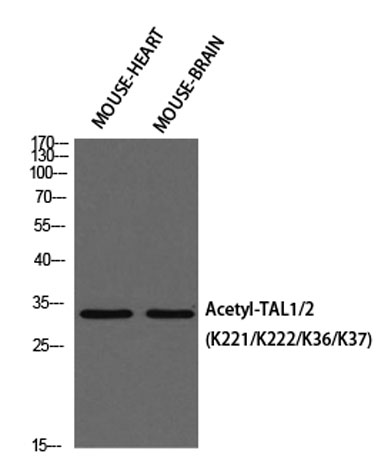
| Specificity | Acetyl-TAL1/2 (K221/K222/K36/K37) Polyclonal Antibody detects endogenous levels of TAL1/2 around the acetylation site of K221 protein. |
| Formulation | Liquid in PBS containing 50% glycerol, 0.5% BSA and 0.02% sodium azide. |
| Clonality | Polyclonal |
| Dilution | Western Blot: 1/500 - 1/2000. ELISA: 1/10000. Not yet tested in other applications. |
| Purification | The antibody was affinity-purified from rabbit antiserum by affinity-chromatography using epitope-specific immunogen. |
| Concentration | 1 mg/ml |
| Storage stability | -20°C/1 year |
| Molecular Weight (Da) | |
| Observed band (KD) | 45kD |
| Background | alternative products:The splicing pattern is cell-lineage dependent,disease:A chromosomal aberration involving TAL1 may be a cause of some T-cell acute lymphoblastic leukemias (T-ALL). Translocation t(1;14)(p32;q11) with T-cell receptor alpha chain (TCRA) genes.,domain:The helix-loop-helix domain is necessary and sufficient for the interaction with DRG1.,function:Implicated in the genesis of hemopoietic malignancies. It may play an important role in hemopoietic differentiation. Serves as a positive regulator of erythroid differentiation.,PTM:Phosphorylated on serine residues. Phosphorylation of Ser-122 is strongly stimulated by hypoxia.,PTM:Ubiquitinated; subsequent to hypoxia-dependent phosphorylation of Ser-122, ubiquitination targets the protein for rapid degradation via the ubiquitin system. This process may be characteristic for microvascular endothelial cells, since it could not be observed in large vessel endothelial cells.,similarity:Contains 1 basic helix-loop-helix (bHLH) domain.,subunit:Efficient DNA binding requires dimerization with another bHLH protein. Forms heterodimers with TCF3. Binds to the LIM domain containing protein LMO2 and to DRG1. Can assemble in a complex with LDB1 and LMO2. Component of a TAL-1 complex composed at least of CBFA2T3, LDB1, TAL1 and TCF3.,tissue specificity:Leukemic stem cell., |
| Function | alternative products:The splicing pattern is cell-lineage dependent,disease:A chromosomal aberration involving TAL1 may be a cause of some T-cell acute lymphoblastic leukemias (T-ALL). Translocation t(1;14)(p32;q11) with T-cell receptor alpha chain (TCRA) genes.,domain:The helix-loop-helix domain is necessary and sufficient for the interaction with DRG1.,function:Implicated in the genesis of hemopoietic malignancies. It may play an important role in hemopoietic differentiation. Serves as a positive regulator of erythroid differentiation.,PTM:Phosphorylated on serine residues. Phosphorylation of Ser-122 is strongly stimulated by hypoxia.,PTM:Ubiquitinated; subsequent to hypoxia-dependent phosphorylation of Ser-122, ubiquitination targets the protein for rapid degradation via the ubiquitin system. This process may be characteristic for microvascular endothelial cells, since it could not be |
| Subcellular location | Nucleus . |
| Expression | Leukemic stem cell. |

Use collapsible tabs for more detailed information that will help customers make a purchasing decision.
Ex: Shipping and return policies, size guides, and other common questions.