 Français
 English

| ELK.No | ES8440 |
| Product name | AChRα9 rabbit pAb |
| Reactivity | Human;Mouse;Rat |
| Applications | WB;ELISA |
| Other name | Neuronal acetylcholine receptor subunit alpha-9 (Nicotinic acetylcholine receptor subunit alpha-9) (NACHR alpha-9) |
| Size | 100μL |
| Unit price ($) | 248 |
| Human gene ID | 55584 |
| Human Swiss-Prot | Q9UGM1 |
| Source | Rabbit |
| Isotype | IgG |
| Target | AChRα9 |
| Fields | >>Neuroactive ligand-receptor interaction;>>Chemical carcinogenesis - receptor activation |
| Gene name | CHRNA9 |
| Protein name | cholinergic receptor, nicotinic, alpha 9 |
| Human gene link | View Human Gene |
| Human Swiss link | View Human Swiss-Prot |
| Mouse gene ID | |
| Mouse gene link | |
| Mouse Swiss-Prot | |
| Mouse Swiss link | |
| Rat gene ID | |
| Rat gene link | |
| Rat Swiss-Prot | P43144 |
| Rat Swiss link | View Rat Swiss-Prot |
| Immunogen | The antiserum was produced against synthesized peptide derived from the N-terminal region of human CHRNA9. AA range:50-100 |
| Specificity | AChRα9 Polyclonal Antibody detects endogenous levels of cholinergic receptor, nicotinic, alpha 9 |
| Formulation | Liquid in PBS containing 50% glycerol, 0.5% BSA and 0.02% sodium azide. |
| Clonality | Polyclonal |
| Dilution | Western Blot: 1/500 - 1/2000. ELISA: 1/10000. Not yet tested in other applications. |
| Purification | The antibody was affinity-purified from rabbit antiserum by affinity-chromatography using epitope-specific immunogen. |
| Concentration | 1 mg/ml |
| Storage stability | -20°C/1 year |
| Molecular Weight (Da) | |
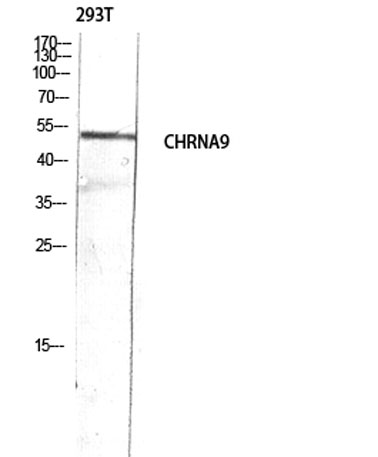
| Observed band (KD) | 55kD |
| Background | This gene is a member of the ligand-gated ionic channel family and nicotinic acetylcholine receptor gene superfamily. It encodes a plasma membrane protein that forms homo- or hetero-oligomeric divalent cation channels. This protein is involved in cochlea hair cell development and is also expressed in the outer hair cells (OHCs) of the adult cochlea. [provided by RefSeq, Feb 2012], |
| Function | function:Ionotropic receptor with a probable role in the modulation of auditory stimuli. Agonist binding may induce an extensive change in conformation that affects all subunits and leads to opening of an ion-conducting channel across the plasma membrane. The channel is permeable to a range of divalent cations including calcium, the influx of which may activate a potassium current which hyperpolarizes the cell membrane. In the ear, this may lead to a reduction in basilar membrane motion, altering the activity of auditory nerve fibers and reducing the range of dynamic hearing. This may protect against acoustic trauma. May also regulate keratinocyte adhesion.,miscellaneous:The hetero-oligomeric receptor composed of CHRNA9 and CHRNA10 has an atypical pharmacological profile, binding several non-nicotinic ligands including strychnine (a glycine receptor antagonist) and atropine (a muscarinic |
| Subcellular location | Cell junction, synapse, postsynaptic cell membrane ; Multi-pass membrane protein . Cell membrane ; Multi-pass membrane protein . |
| Expression | Expressed in cochlea, keratinocytes, pituitary gland, B-cells and T-cells. |

Use collapsible tabs for more detailed information that will help customers make a purchasing decision.
Ex: Shipping and return policies, size guides, and other common questions.