 Français
 English

| ELK.No | ES8608 |
| Product name | Tcl1 rabbit pAb |
| Reactivity | Human;Rat;Mouse; |
| Applications | WB;ELISA |
| Other name | T-cell leukemia/lymphoma protein 1A (Oncogene TCL-1) (Oncogene TCL1) (Protein p14 TCL1) |
| Size | 100μL |
| Unit price ($) | 248 |
| Human gene ID | 8115 |
| Human Swiss-Prot | P56279 |
| Source | Rabbit |
| Isotype | IgG |
| Target | Tcl1 |
| Fields | >>PI3K-Akt signaling pathway |
| Gene name | TCL1A TCL1 |
| Protein name | T-cell leukemia/lymphoma protein 1A (Oncogene TCL-1) (Oncogene TCL1) (Protein p14 TCL1) |
| Human gene link | View Human Gene |
| Human Swiss link | View Human Swiss-Prot |
| Mouse gene ID | 21432 |
| Mouse gene link | |
| Mouse Swiss-Prot | P56280 |
| Mouse Swiss link | View Mouse Swiss-Prot |
| Rat gene ID | |
| Rat gene link | |
| Rat Swiss-Prot | |
| Rat Swiss link | |
| Immunogen | Synthetic peptide from human protein at AA range: 30-110 |
| Specificity | The antibody detects endogenous Tcl1 |
| Formulation | Liquid in PBS containing 50% glycerol, 0.5% BSA and 0.02% sodium azide. |
| Clonality | Polyclonal |
| Dilution | WB 1:500-2000, ELISA 1:10000-20000 |
| Purification | The antibody was affinity-purified from rabbit antiserum by affinity-chromatography using epitope-specific immunogen. |
| Concentration | 1 mg/ml |
| Storage stability | -20°C/1 year |
| Molecular Weight (Da) | |
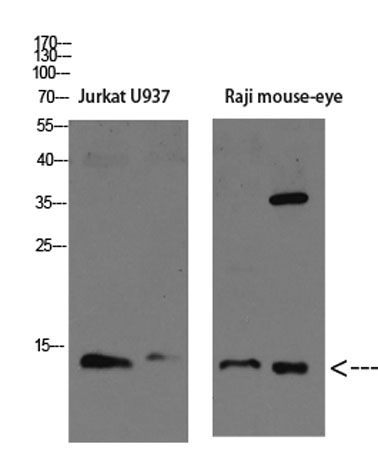
| Observed band (KD) | 13kD |
| Background | Overexpression of the TCL1 gene in humans has been implicated in the development of mature T cell leukemia, in which chromosomal rearrangements bring the TCL1 gene in close proximity to the T-cell antigen receptor (TCR)-alpha (MIM 186880) or TCR-beta (MIM 186930) regulatory elements (summarized by Virgilio et al., 1998 [PubMed 9520462]). In normal T cells TCL1 is expressed in CD4-/CD8- cells, but not in cells at later stages of differentiation. TCL1 functions as a coactivator of the cell survival kinase AKT (MIM 164730) (Laine et al., 2000 [PubMed 10983986]).[supplied by OMIM, Jul 2010], |
| Function | disease:Chromosomal aberrations activating TCL1A are found in chronic T-cell leukemias (T-CLL). Translocation t(14;14)(q11;q32); translocation t(7;14)(q35;q32); inversion inv(14)(q11;q32) that involves the T-cell receptor alpha/delta locuses.,function:Enhances the phosphorylation and activation of AKT1, AKT2 and AKT3. Promotes nuclear translocation of AKT1. Enhances cell proliferation, stabilizes mitochondrial membrane potential and promotes cell survival.,similarity:Belongs to the TCL1 family.,subcellular location:Microsomal fraction.,subunit:Homodimer. Interacts with AKT1, AKT2 and AKT3 (via PH domain). Interacts with PNPT1; the interaction has no effect on PNPT1 exonuclease activity.,tissue specificity:Restricted in the T-cell lineage to immature thymocytes and activated peripheral lymphocytes. Preferentially expressed early in T- and B-lymphocyte differentiation., |
| Subcellular location | Cytoplasm . Nucleus . Microsome . Endoplasmic reticulum . Microsomal fraction. |
| Expression | Restricted in the T-cell lineage to immature thymocytes and activated peripheral lymphocytes. Preferentially expressed early in T- and B-lymphocyte differentiation. |

Use collapsible tabs for more detailed information that will help customers make a purchasing decision.
Ex: Shipping and return policies, size guides, and other common questions.