 Français
 English
Ku-70 (Acetyl Lys317) rabbit pAb
AO-06-ES8631-100

| ELK.No | ES8631 |
| Product name | Ku-70 (Acetyl Lys317) rabbit pAb |
| Reactivity | Human;Rat;Mouse |
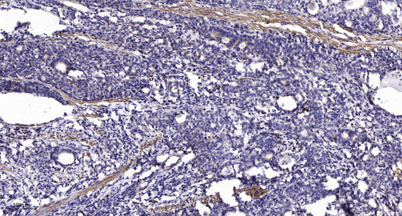
| Applications | WB;ELISA;IHC |
| Other name | X-ray repair cross-complementing protein 6 (EC 3.6.4.-) (EC 4.2.99.-) (5'-deoxyribose-5-phosphate lyase Ku70) (5'-dRP lyase Ku70) (70 kDa subunit of Ku antigen) (ATP-dependent DNA helicase 2 subunit 1) (ATP-dependent DNA helicase II 70 kDa subunit) (CTC box-binding factor 75 kDa subunit) (CTC75) (CTCBF) (DNA repair protein XRCC6) (Lupus Ku autoantigen protein p70) (Ku70) (Thyroid-lupus autoantigen) (TLAA) (X-ray repair complementing defective repair in Chinese hamster cells 6) |
| Size | 100μL |
| Unit price ($) | 248 |
| Human gene ID | 2547 |
| Human Swiss-Prot | P12956 |
| Source | Rabbit |
| Isotype | IgG |
| Target | Ku70/XRCC6 |
| Fields | >>Non-homologous end-joining |
| Gene name | XRCC6 G22P1 |
| Protein name | X-ray repair cross-complementing protein 6 (EC 3.6.4.-) (EC 4.2.99.-) (5'-deoxyribose-5-phosphate lyase Ku70) (5'-dRP lyase Ku70) (70 kDa subunit of Ku antigen) (ATP-dependent DNA helicase 2 subunit 1 |
| Human gene link | View Human Gene |
| Human Swiss link | View Human Swiss-Prot |
| Mouse gene ID | |
| Mouse gene link | |
| Mouse Swiss-Prot | P23475 |
| Mouse Swiss link | View Mouse Swiss-Prot |
| Rat gene ID | |
| Rat gene link | |
| Rat Swiss-Prot | |
| Rat Swiss link | |
| Immunogen | Synthetic Acetyl peptide from human protein at AA range: 317 |
| Specificity | The antibody detects endogenous Ku-70 when Acetyl occurs at Lys317 |
| Formulation | Liquid in PBS containing 50% glycerol, 0.5% BSA and 0.02% sodium azide. |
| Clonality | Polyclonal |
| Dilution | WB 1:500-2000;IHC-p 1:50-300; ELISA 2000-20000 |
| Purification | The antibody was affinity-purified from rabbit antiserum by affinity-chromatography using epitope-specific immunogen. |
| Concentration | 1 mg/ml |
| Storage stability | -20°C/1 year |
| Molecular Weight (Da) | |
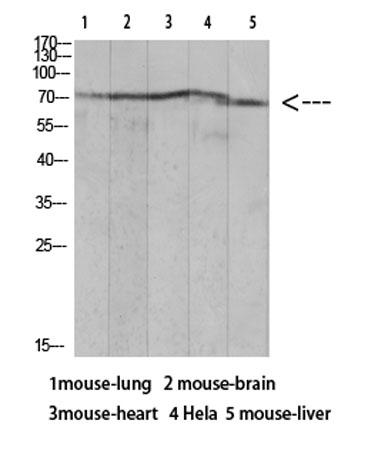
| Observed band (KD) | 69kD |
| Background | The p70/p80 autoantigen is a nuclear complex consisting of two subunits with molecular masses of approximately 70 and 80 kDa. The complex functions as a single-stranded DNA-dependent ATP-dependent helicase. The complex may be involved in the repair of nonhomologous DNA ends such as that required for double-strand break repair, transposition, and V(D)J recombination. High levels of autoantibodies to p70 and p80 have been found in some patients with systemic lupus erythematosus. [provided by RefSeq, Jul 2008], |
| Function | developmental stage:Expression does not increase during promyelocyte differentiation.,disease:Individuals with systemic lupus erythematosus (SLE) and related disorders produce extremely large amounts of autoantibodies to p70 and p86. Existence of a major autoantigenic epitope or epitopes on the C-terminal 190 amino acids of p70 containing the leucine repeat. The majority of autoantibodies to p70 in most sera from patients with SLE seem to be reactive with this region.,function:Single stranded DNA-dependent ATP-dependent helicase. Has a role in chromosome translocation. The DNA helicase II complex binds preferentially to fork-like ends of double-stranded DNA in a cell cycle-dependent manner. It works in the 3'-5' direction. Binding to DNA may be mediated by p70. Involved in DNA nonhomologous end joining (NHEJ) required for double-strand break repair and V(D)J recombination. The Ku p70/p86 |
| Subcellular location | Nucleus . Chromosome . |
| Expression | Brain,Cervix carcinoma,Epithelium,Heart,Hepatocyte,Kidney,Liver,Lun |

Use collapsible tabs for more detailed information that will help customers make a purchasing decision.
Ex: Shipping and return policies, size guides, and other common questions.