 Français
 English
Histone H3 (Tri-Methyl-K10) rabbit pAb
AO-06-ES8632-50

| ELK.No | ES8632 |
| Product name | Histone H3 (Tri-Methyl-K10) rabbit pAb |
| Reactivity | Human;Rat;Mouse |
| Applications | WB;ELISA |
| Other name | H3K10ME3; HIST1H3A; H3FA; HIST1H3B; H3FL; HIST1H3C; H3FC; HIST1H3D; H3FB; HIST1H3E; H3FD; HIST1H3F; H3FI; HIST1H3G; H3FH; HIST1H3H; H3FK; HIST1H3I; H3FF; HIST1H3J; H3FJ; Histone H3.1; Histone H3/a; Histone H3/b; Histone H3/c; Histone H3/d; Histone H3/f; Histone H3/h; Histone H3/i; Histone H3/j; Histone H3/k; Histone H3/l; HIST2H3A; HIST2H3C; H3F2; H3FM; HIST2H3D; Histone H3.2; Histone H3/m; Histone H3/o; H3F3A; H3.3A; H3F3; PP781; H3F3B; H3.3B; Histone H3.3 |
| Size | 50μL |
| Unit price ($) | 148 |
| Human gene ID | 8350 |
| Human Swiss-Prot | P68431/Q71DI3/P84243/Q6NXT2 |
| Source | Rabbit |
| Isotype | IgG |
| Target | Histone H3 |
| Fields | >>Neutrophil extracellular trap formation;>>Alcoholism;>>Shigellosis;>>Transcriptional misregulation in cancer;>>Systemic lupus erythematosus |
| Gene name | Histone H3 |
| Protein name | Histone H3 |
| Human gene link | View Human Gene |
| Human Swiss link | View Human Swiss-Prot |
| Mouse gene ID | |
| Mouse gene link | |
| Mouse Swiss-Prot | |
| Mouse Swiss link | |
| Rat gene ID | |
| Rat gene link | |
| Rat Swiss-Prot | |
| Rat Swiss link | |
| Immunogen | Synthetic Tri-Methyl peptide from human protein at AA range: 10 |
| Specificity | The antibody detects endogenous Tri-Methyl-Histone H3 (K10) |
| Formulation | Liquid in PBS containing 50% glycerol, 0.5% BSA and 0.02% sodium azide. |
| Clonality | Polyclonal |
| Dilution | WB 1:500-2000, ELISA 1:10000-20000 |
| Purification | The antibody was affinity-purified from rabbit antiserum by affinity-chromatography using epitope-specific immunogen. |
| Concentration | 1 mg/ml |
| Storage stability | -20°C/1 year |
| Molecular Weight (Da) | |
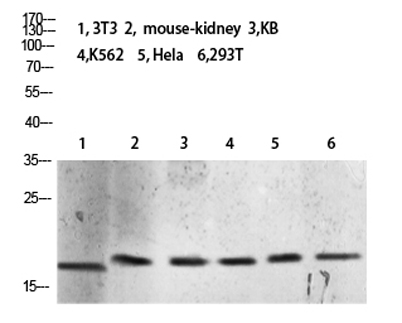
| Observed band (KD) | 15kD |
| Background | Histones are basic nuclear proteins that are responsible for the nucleosome structure of the chromosomal fiber in eukaryotes. This structure consists of approximately 146 bp of DNA wrapped around a nucleosome, an octamer composed of pairs of each of the four core histones (H2A, H2B, H3, and H4). The chromatin fiber is further compacted through the interaction of a linker histone, H1, with the DNA between the nucleosomes to form higher order chromatin structures. This gene is intronless and encodes a replication-dependent histone that is a member of the histone H3 family. Transcripts from this gene lack polyA tails; instead, they contain a palindromic termination element. This gene is found in the large histone gene cluster on chromosome 6p22-p21.3. [provided by RefSeq, Aug 2015], |
| Function | caution:Was originally (PubMed:2587222) thought to originate from mouse.,developmental stage:Expressed during S phase, then expression strongly decreases as cell division slows down during the process of differentiation.,function:Core component of nucleosome. Nucleosomes wrap and compact DNA into chromatin, limiting DNA accessibility to the cellular machineries which require DNA as a template. Histones thereby play a central role in transcription regulation, DNA repair, DNA replication and chromosomal stability. DNA accessibility is regulated via a complex set of post-translational modifications of histones, also called histone code, and nucleosome remodeling.,mass spectrometry:Monoisotopic with N-acetylserine PubMed:16457589,miscellaneous:This histone is only present in mammals and is enriched in acetylation of Lys-15 and dimethylation of Lys-10 (H3K9me2).,PTM:Acetylation is generally l |
| Subcellular location | Nucleus. Chromosome. |
| Expression | Blood,Epithelium,Kidney,Lung,Ovary,Spleen,Uterus, |

Use collapsible tabs for more detailed information that will help customers make a purchasing decision.
Ex: Shipping and return policies, size guides, and other common questions.