 Français
 English

| ELK.No | ES8917 |
| Product name | Granzyme B rabbit pAb |
| Reactivity | Human;Mouse;Rat |
| Applications | WB;IHC;IF;ELISA |
| Other name | Granzyme B (EC 3.4.21.79;C11;CTLA-1;Cathepsin G-like 1;CTSGL1;Cytotoxic T-lymphocyte proteinase 2;Lymphocyte protease;Fragmentin-2;Granzyme-2;Human lymphocyte protein;HLP;SECT;T-cell serine protease 1-3E) |
| Size | 100μL |
| Unit price ($) | 248 |
| Human gene ID | 3002 |
| Human Swiss-Prot | P10144 |
| Source | Rabbit |
| Isotype | IgG |
| Target | Granzyme B |
| Fields | >>Apoptosis;>>Natural killer cell mediated cytotoxicity;>>Type I diabetes mellitus;>>Transcriptional misregulation in cancer;>>Autoimmune thyroid disease;>>Allograft rejection;>>Graft-versus-host disease |
| Gene name | GZMB CGL1 CSPB CTLA1 GRB |
| Protein name | Granzyme B (EC 3.4.21.79) (C11) (CTLA-1) (Cathepsin G-like 1) (CTSGL1) (Cytotoxic T-lymphocyte proteinase 2) (Lymphocyte protease) (Fragmentin-2) (Granzyme-2) (Human lymphocyte protein) (HLP) (SECT) ( |
| Human gene link | View Human Gene |
| Human Swiss link | View Human Swiss-Prot |
| Mouse gene ID | 14939 |
| Mouse gene link | |
| Mouse Swiss-Prot | P04187 |
| Mouse Swiss link | View Mouse Swiss-Prot |
| Rat gene ID | 100361468 |
| Rat gene link | |
| Rat Swiss-Prot | P18291 |
| Rat Swiss link | View Rat Swiss-Prot |
| Immunogen | Synthesized peptide derived from human Granzyme B Polyclonal AA range: 81-130 |
| Specificity | This antibody detects endogenous levels of Granzyme B. |
| Formulation | Liquid in PBS containing 50% glycerol, 0.5% BSA and 0.02% sodium azide. |
| Clonality | Polyclonal |
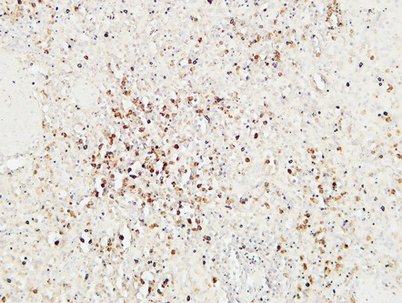
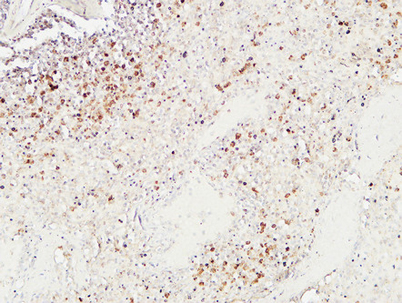
| Dilution | IHC-p: 100-300.WB 1:500-2000, ELISA 1:10000-20000 |
| Purification | The antibody was affinity-purified from rabbit antiserum by affinity-chromatography using epitope-specific immunogen. |
| Concentration | 1 mg/ml |
| Storage stability | -20°C/1 year |
| Molecular Weight (Da) | |
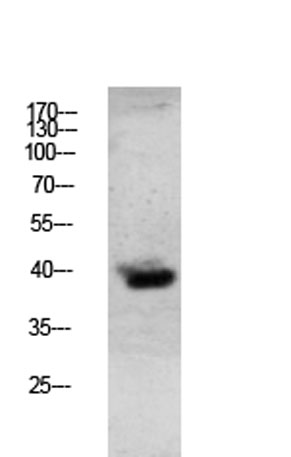
| Observed band (KD) | 38kD |
| Background | This gene encodes a member of the granzyme subfamily of proteins, part of the peptidase S1 family of serine proteases. The encoded preproprotein is secreted by natural killer (NK) cells and cytotoxic T lymphocytes (CTLs) and proteolytically processed to generate the active protease, which induces target cell apoptosis. This protein also processes cytokines and degrades extracellular matrix proteins, and these roles are implicated in chronic inflammation and wound healing. Expression of this gene may be elevated in human patients with cardiac fibrosis. [provided by RefSeq, Sep 2016], |
| Function | catalytic activity:Preferential cleavage: -Asp-|-Xaa- >> -Asn-|-Xaa- > -Met-|-Xaa-, -Ser-|-Xaa-.,function:This enzyme is necessary for target cell lysis in cell-mediated immune responses. It cleaves after Asp. Seems to be linked to an activation cascade of caspases (aspartate-specific cysteine proteases) responsible for apoptosis execution. Cleaves caspase-3, -7, -9 and 10 to give rise to active enzymes mediating apoptosis.,induction:By staphylococcal enterotoxin A (SEA) in peripheral blood leukocytes.,similarity:Belongs to the peptidase S1 family.,similarity:Belongs to the peptidase S1 family. Granzyme subfamily.,similarity:Contains 1 peptidase S1 domain.,subcellular location:Cytoplasmic granules of cytolytic T-lymphocytes and natural killer cells., |
| Subcellular location | Secreted . Cytolytic granule . Delivered into the target cell by perforin (PubMed:20038786). . |
| Expression | Breast carcinoma,Large granular lymphocyte leukemia,Pancreas, |

Use collapsible tabs for more detailed information that will help customers make a purchasing decision.
Ex: Shipping and return policies, size guides, and other common questions.