 Français
 English
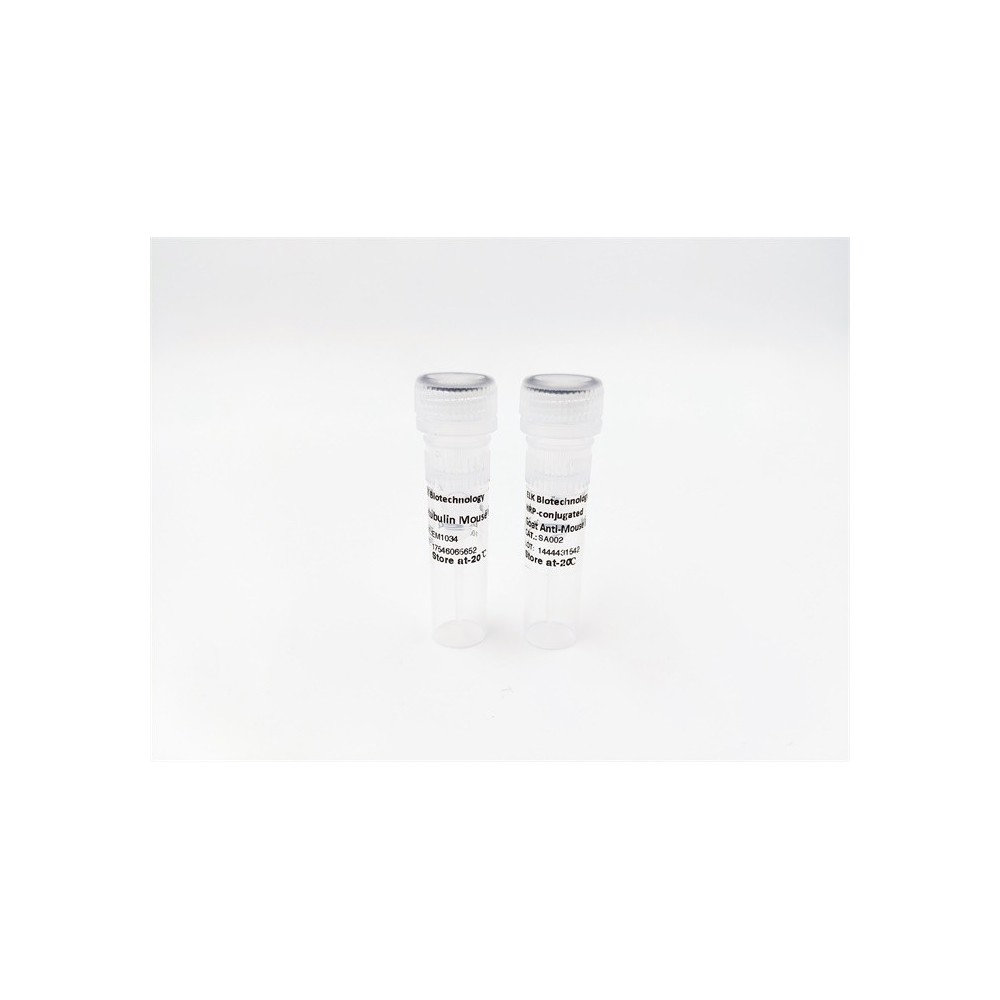

| ELK.No | ES9042 |
| Product name | EFNB2 rabbit pAb |
| Reactivity | Human;Mouse |
| Applications | WB;ELISA |
| Other name | |
| Size | 100μL |
| Unit price ($) | 248 |
| Human gene ID | 1948 |
| Human Swiss-Prot | P52799 |
| Source | Rabbit |
| Isotype | IgG |
| Target | EFNB2 |
| Fields | >>Axon guidance |
| Gene name | EFNB2 EPLG5 HTKL LERK5 |
| Protein name | Ephrin-B2 (EPH-related receptor tyrosine kinase ligand 5) (LERK-5) (HTK ligand) (HTK-L) |
| Human gene link | |
| Human Swiss link | View Human Swiss-Prot |
| Mouse gene ID | |
| Mouse gene link | |
| Mouse Swiss-Prot | P52800 |
| Mouse Swiss link | View Mouse Swiss-Prot |
| Rat gene ID | |
| Rat gene link | |
| Rat Swiss-Prot | |
| Rat Swiss link | |
| Immunogen | Synthesized peptide derived from human protein . at AA range: 210-290 |
| Specificity | EFNB2 Polyclonal Antibody detects endogenous levels of protein. |
| Formulation | Liquid in PBS containing 50% glycerol, and 0.02% sodium azide. |
| Clonality | Polyclonal |
| Dilution | WB 1:500-2000 ELISA 1:5000-20000 |
| Purification | The antibody was affinity-purified from rabbit antiserum by affinity-chromatography using epitope-specific immunogen. |
| Concentration | 1 mg/ml |
| Storage stability | -20°C/1 year |
| Molecular Weight (Da) | |
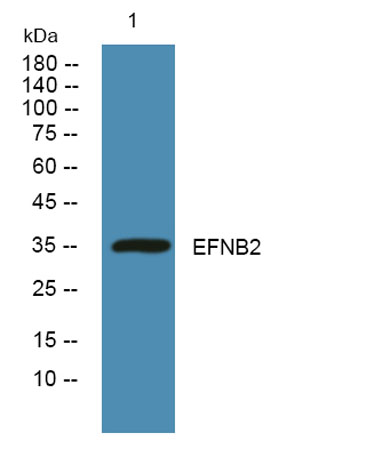
| Observed band (KD) | 36kD |
| Background | This gene encodes a member of the ephrin (EPH) family. The ephrins and EPH-related receptors comprise the largest subfamily of receptor protein-tyrosine kinases and have been implicated in mediating developmental events, especially in the nervous system and in erythropoiesis. Based on their structures and sequence relationships, ephrins are divided into the ephrin-A (EFNA) class, which are anchored to the membrane by a glycosylphosphatidylinositol linkage, and the ephrin-B (EFNB) class, which are transmembrane proteins. This gene encodes an EFNB class ephrin which binds to the EPHB4 and EPHA3 receptors. [provided by RefSeq, Jul 2008], |
| Function | function:Binds to the receptor tyrosine kinases EPHB4 and EPHA3. May play a role in constraining the orientation of longitudinally projecting axons.,PTM:Inducible phosphorylation of tyrosine residues in the cytoplasmic domain.,similarity:Belongs to the ephrin family.,subunit:Interacts with PDZRN3 (By similarity). Binds to the receptor tyrosine kinases EPHB4 and EPHA3. Binds to Nipah virus G protein.,tissue specificity:Lung and kidney., |
| Subcellular location | Cell membrane ; Single-pass type I membrane protein . Cell junction, adherens junction . |
| Expression | Lung and kidney. |

Use collapsible tabs for more detailed information that will help customers make a purchasing decision.
Ex: Shipping and return policies, size guides, and other common questions.