 Français
 English

| ELK.No | ES9064 |
| Product name | PCBP1 rabbit pAb |
| Reactivity | Human;Mouse |
| Applications | WB;ELISA |
| Other name | |
| Size | 50μL |
| Unit price ($) | 148 |
| Human gene ID | 5093 |
| Human Swiss-Prot | Q15365 |
| Source | Rabbit |
| Isotype | IgG |
| Target | PCBP1 |
| Fields | >>Spliceosome;>>Ferroptosis |
| Gene name | PCBP1 |
| Protein name | Poly(rC)-binding protein 1 (Alpha-CP1) (Heterogeneous nuclear ribonucleoprotein E1) (hnRNP E1) (Nucleic acid-binding protein SUB2.3) |
| Human gene link | |
| Human Swiss link | View Human Swiss-Prot |
| Mouse gene ID | |
| Mouse gene link | |
| Mouse Swiss-Prot | P60335 |
| Mouse Swiss link | View Mouse Swiss-Prot |
| Rat gene ID | |
| Rat gene link | |
| Rat Swiss-Prot | |
| Rat Swiss link | |
| Immunogen | Synthesized peptide derived from human protein . at AA range: 30-110 |
| Specificity | PCBP1 Polyclonal Antibody detects endogenous levels of protein. |
| Formulation | Liquid in PBS containing 50% glycerol, and 0.02% sodium azide. |
| Clonality | Polyclonal |
| Dilution | WB 1:500-2000 ELISA 1:5000-20000 |
| Purification | The antibody was affinity-purified from rabbit antiserum by affinity-chromatography using epitope-specific immunogen. |
| Concentration | 1 mg/ml |
| Storage stability | -20°C/1 year |
| Molecular Weight (Da) | |
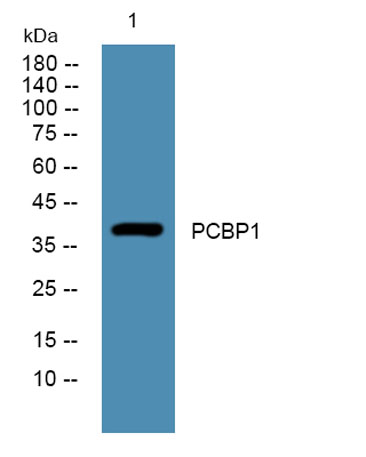
| Observed band (KD) | 39kD |
| Background | This intronless gene is thought to have been generated by retrotransposition of a fully processed PCBP-2 mRNA. This gene and PCBP-2 have paralogues (PCBP3 and PCBP4) which are thought to have arisen as a result of duplication events of entire genes. The protein encoded by this gene appears to be multifunctional. It along with PCBP-2 and hnRNPK corresponds to the major cellular poly(rC)-binding protein. It contains three K-homologous (KH) domains which may be involved in RNA binding. This encoded protein together with PCBP-2 also functions as translational coactivators of poliovirus RNA via a sequence-specific interaction with stem-loop IV of the IRES and promote poliovirus RNA replication by binding to its 5'-terminal cloverleaf structure. It has also been implicated in translational control of the 15-lipoxygenase mRNA, human Papillomavirus type 16 L2 mRNA, and hepatitis A virus RNA. Th |
| Function | function:Single-stranded nucleic acid binding protein that binds preferentially to oligo dC.,PTM:Phosphorylated; lowers poly(rC)-binding activity.,similarity:Contains 3 KH domains.,subcellular location:Loosely bound in the nucleus. May shuttle between the nucleus and the cytoplasm.,tissue specificity:Abundantly expressed in skeletal muscle, thymus and peripheral blood leucocytes while a lower expression is observed in prostate, spleen, testis, ovary, small intestine, heart, liver, adrenal and thyroid glands., |
| Subcellular location | Nucleus. Cytoplasm. Loosely bound in the nucleus. May shuttle between the nucleus and the cytoplasm. |
| Expression | Abundantly expressed in skeletal muscle, thymus and peripheral blood leukocytes while a lower expression is observed in prostate, spleen, testis, ovary, small intestine, heart, liver, adrenal and thyroid glands. |

Use collapsible tabs for more detailed information that will help customers make a purchasing decision.
Ex: Shipping and return policies, size guides, and other common questions.