 Français
 English
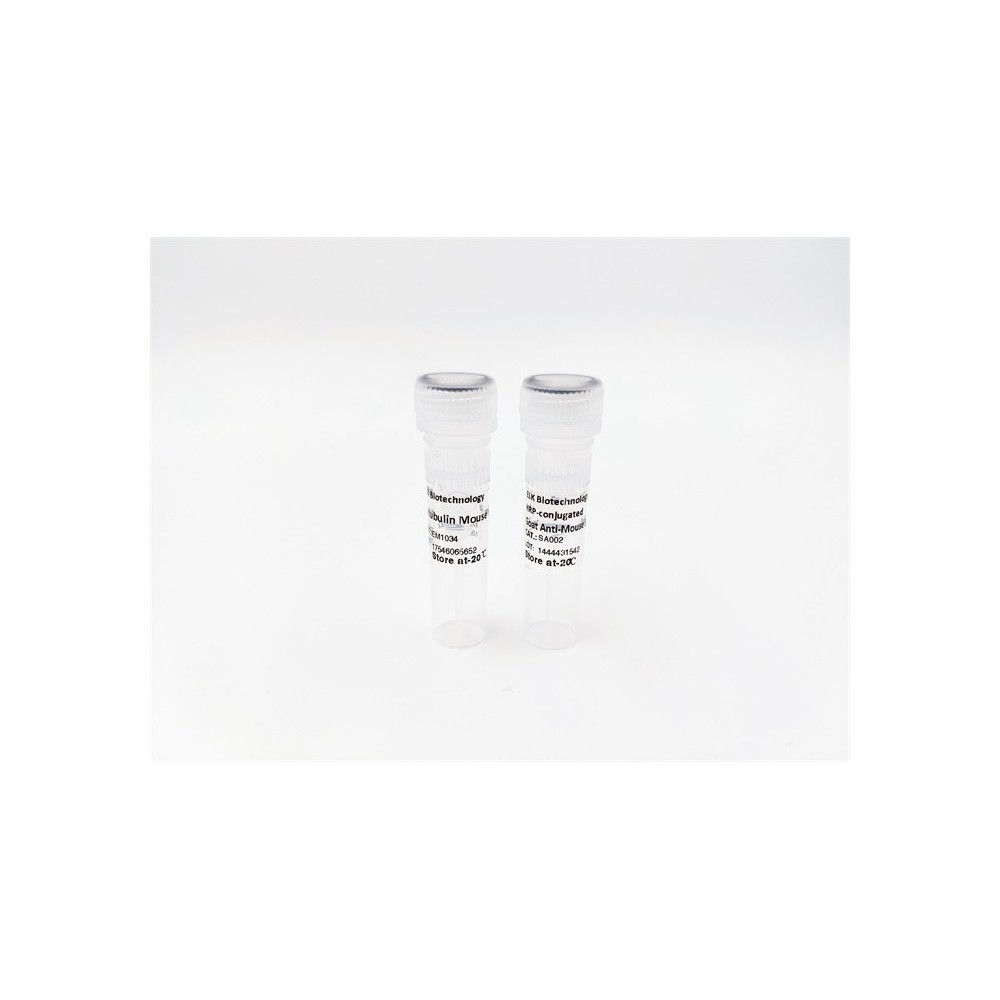

| ELK.No | ES9122 |
| Product name | ARRS rabbit pAb |
| Reactivity | Human;Rat;Mouse; |
| Applications | WB;ELISA |
| Other name | |
| Size | 100μL |
| Unit price ($) | 248 |
| Human gene ID | 6295 |
| Human Swiss-Prot | P10523 |
| Source | Rabbit |
| Isotype | IgG |
| Target | ARRS |
| Fields | >>Phototransduction |
| Gene name | SAG |
| Protein name | S-arrestin (48 kDa protein) (Retinal S-antigen) (S-AG) (Rod photoreceptor arrestin) |
| Human gene link | |
| Human Swiss link | View Human Swiss-Prot |
| Mouse gene ID | |
| Mouse gene link | |
| Mouse Swiss-Prot | P20443 |
| Mouse Swiss link | View Mouse Swiss-Prot |
| Rat gene ID | |
| Rat gene link | |
| Rat Swiss-Prot | P15887 |
| Rat Swiss link | View Rat Swiss-Prot |
| Immunogen | Synthesized peptide derived from human protein . at AA range: 210-290 |
| Specificity | ARRS Polyclonal Antibody detects endogenous levels of protein. |
| Formulation | Liquid in PBS containing 50% glycerol, and 0.02% sodium azide. |
| Clonality | Polyclonal |
| Dilution | WB 1:500-2000 ELISA 1:5000-20000 |
| Purification | The antibody was affinity-purified from rabbit antiserum by affinity-chromatography using epitope-specific immunogen. |
| Concentration | 1 mg/ml |
| Storage stability | -20°C/1 year |
| Molecular Weight (Da) | |
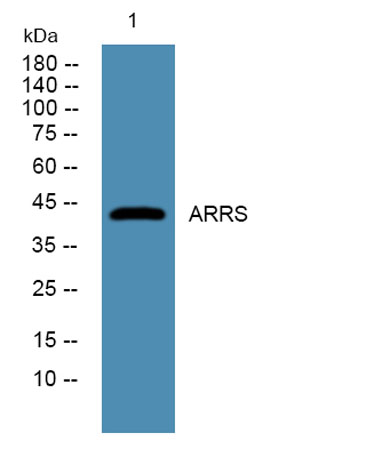
| Observed band (KD) | 44kD |
| Background | Members of arrestin/beta-arrestin protein family are thought to participate in agonist-mediated desensitization of G-protein-coupled receptors and cause specific dampening of cellular responses to stimuli such as hormones, neurotransmitters, or sensory signals. S-arrestin, also known as S-antigen, is a major soluble photoreceptor protein that is involved in desensitization of the photoactivated transduction cascade. It is expressed in the retina and the pineal gland and inhibits coupling of rhodopsin to transducin in vitro. Additionally, S-arrestin is highly antigenic, and is capable of inducing experimental autoimmune uveoretinitis. Mutations in this gene have been associated with Oguchi disease, a rare autosomal recessive form of night blindness. [provided by RefSeq, Jul 2008], |
| Function | disease:Defects in SAG are a cause of congenital stationary night blindness Oguchi type (CSNBO) [MIM:258100]; also known as Oguchi disease. Congenital stationary night blindness is a non-progressive retinal disorder characterized by impaired night vision. CSNBO is an autosomal recessive form associated with fundus discoloration and abnormally slow dark adaptation.,disease:S-antigen induces autoimmune uveitis.,function:Arrestin is one of the major proteins of the ros (retinal rod outer segments); it binds to photoactivated-phosphorylated rhodopsin, thereby apparently preventing the transducin-mediated activation of phosphodiesterase.,miscellaneous:Arrestin binds calcium.,online information:Retina International's Scientific Newsletter,similarity:Belongs to the arrestin family.,tissue specificity:Retina and pineal gland., |
| Subcellular location | Cell projection, cilium, photoreceptor outer segment . Membrane ; Peripheral membrane protein . Highly expressed in photoreceptor outer segments in light-exposed retina. Evenly distributed throughout rod photoreceptor cells in dark-adapted retina (By similarity). Predominantly dectected at the proximal region of photoreceptor outer segments, near disk membranes (PubMed:3720866). . |
| Expression | Detected in retina, in the proximal portion of the outer segment of rod photoreceptor cells (at protein level). |

Use collapsible tabs for more detailed information that will help customers make a purchasing decision.
Ex: Shipping and return policies, size guides, and other common questions.