 Français
 English
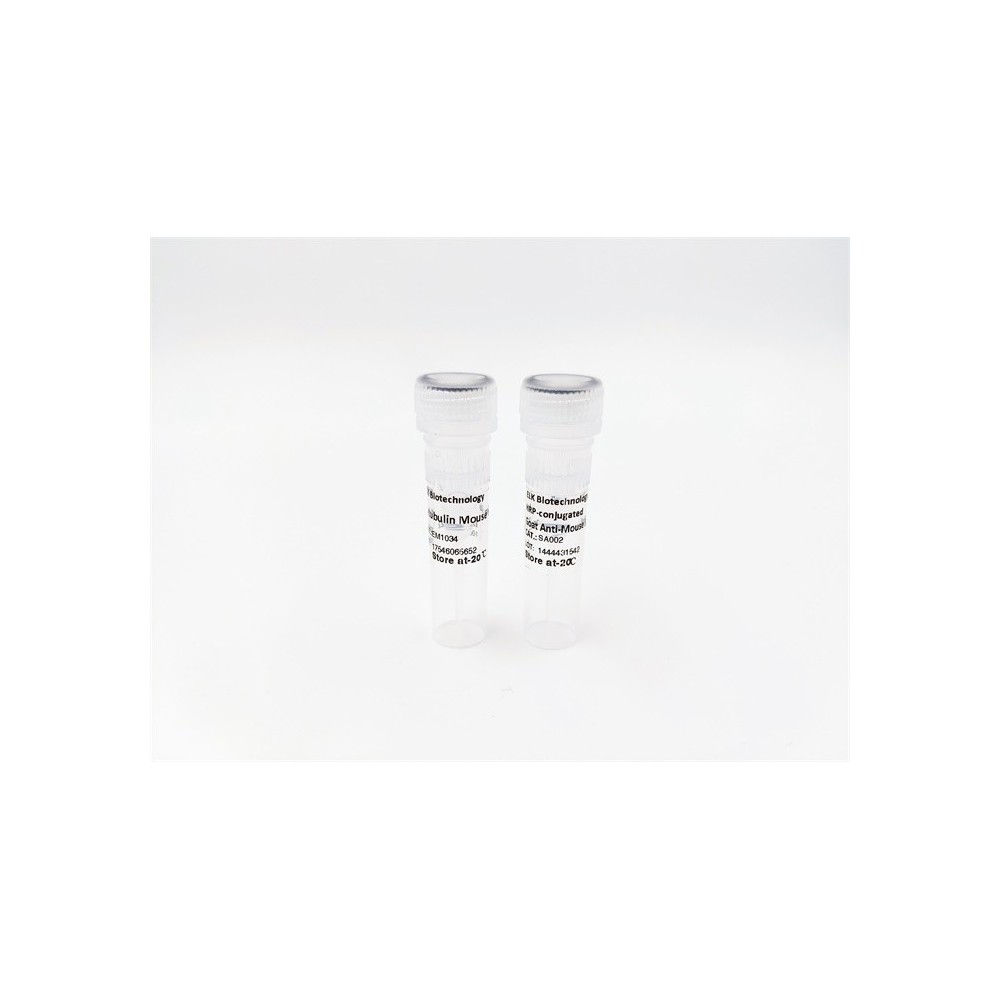

| ELK.No | ES9177 |
| Product name | INGR2 rabbit pAb |
| Reactivity | Human;Rat;Mouse; |
| Applications | WB;ELISA |
| Other name | |
| Size | 100μL |
| Unit price ($) | 248 |
| Human gene ID | 3460 |
| Human Swiss-Prot | P38484 |
| Source | Rabbit |
| Isotype | IgG |
| Target | INGR2 |
| Fields | >>Cytokine-cytokine receptor interaction;>>HIF-1 signaling pathway;>>Necroptosis;>>Osteoclast differentiation;>>JAK-STAT signaling pathway;>>Natural killer cell mediated cytotoxicity;>>Th1 and Th2 cell differentiation;>>Th17 cell differentiation;>>Leishmaniasis;>>Chagas disease;>>Toxoplasmosis;>>Tuberculosis;>>Influenza A;>>Herpes simplex virus 1 infection;>>Pathways in cancer;>>PD-L1 expression and PD-1 checkpoint pathway in cancer;>>Inflammatory bowel disease |
| Gene name | IFNGR2 IFNGT1 |
| Protein name | Interferon gamma receptor 2 (IFN-gamma receptor 2) (IFN-gamma-R2) (Interferon gamma receptor accessory factor 1) (AF-1) (Interferon gamma transducer 1) |
| Human gene link | |
| Human Swiss link | View Human Swiss-Prot |
| Mouse gene ID | |
| Mouse gene link | |
| Mouse Swiss-Prot | |
| Mouse Swiss link | |
| Rat gene ID | |
| Rat gene link | |
| Rat Swiss-Prot | |
| Rat Swiss link | |
| Immunogen | Synthesized peptide derived from human protein . at AA range: 250-330 |
| Specificity | INGR2 Polyclonal Antibody detects endogenous levels of protein. |
| Formulation | Liquid in PBS containing 50% glycerol, and 0.02% sodium azide. |
| Clonality | Polyclonal |
| Dilution | WB 1:500-2000 ELISA 1:5000-20000 |
| Purification | The antibody was affinity-purified from rabbit antiserum by affinity-chromatography using epitope-specific immunogen. |
| Concentration | 1 mg/ml |
| Storage stability | -20°C/1 year |
| Molecular Weight (Da) | |
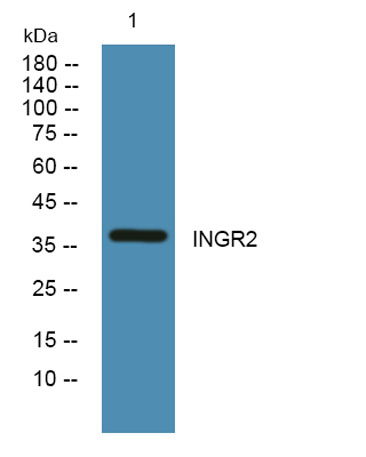
| Observed band (KD) | 37kD |
| Background | This gene (IFNGR2) encodes the non-ligand-binding beta chain of the gamma interferon receptor. Human interferon-gamma receptor is a heterodimer of IFNGR1 and IFNGR2. Defects in IFNGR2 are a cause of mendelian susceptibility to mycobacterial disease (MSMD), also known as familial disseminated atypical mycobacterial infection. MSMD is a genetically heterogeneous disease with autosomal recessive, autosomal dominant or X-linked inheritance. [provided by RefSeq, Jul 2008], |
| Function | disease:Defects in IFNGR2 are a cause of mendelian susceptibility to mycobacterial disease (MSMD) [MIM:209950]; also known as familial disseminated atypical mycobacterial infection. This rare condition confers predisposition to illness caused by moderately virulent mycobacterial species, such as Bacillus Calmette-Guerin (BCG) vaccine and environmental non-tuberculous mycobacteria, and by the more virulent Mycobacterium tuberculosis. Other microorganisms rarely cause severe clinical disease in individuals with susceptibility to mycobacterial infections, with the exception of Salmonella which infects less than 50% of these individuals. The pathogenic mechanism underlying MSMD is the impairment of interferon-gamma mediated immunity, whose severity determines the clinical outcome. Some patients die of overwhelming mycobacterial disease with lepromatous-like lesions in early childhood, wherea |
| Subcellular location | Cell membrane ; Single-pass type I membrane protein . Cytoplasmic vesicle membrane ; Single-pass type I membrane protein . Golgi apparatus membrane ; Single-pass type I membrane protein . Endoplasmic reticulum membrane ; Single-pass type I membrane protein . Cytoplasm . Has low cell surface expression and high cytoplasmic expression in T cells. The bias towards cytoplasmic expression may be due to ligand-independent receptor internalization and recycling. . |
| Expression | Expressed in T-cells (at protein level). |

Use collapsible tabs for more detailed information that will help customers make a purchasing decision.
Ex: Shipping and return policies, size guides, and other common questions.