 Français
 English

| ELK.No | ES9248 |
| Product name | CIDEA rabbit pAb |
| Reactivity | Human;Rat;Mouse; |
| Applications | WB;ELISA |
| Other name | |
| Size | 100μL |
| Unit price ($) | 248 |
| Human gene ID | 1149 |
| Human Swiss-Prot | O60543 |
| Source | Rabbit |
| Isotype | IgG |
| Target | CIDEA |
| Fields | |
| Gene name | CIDEA |
| Protein name | Cell death activator CIDE-A (Cell death-inducing DFFA-like effector A) |
| Human gene link | |
| Human Swiss link | View Human Swiss-Prot |
| Mouse gene ID | |
| Mouse gene link | |
| Mouse Swiss-Prot | O70302 |
| Mouse Swiss link | View Mouse Swiss-Prot |
| Rat gene ID | |
| Rat gene link | |
| Rat Swiss-Prot | |
| Rat Swiss link | |
| Immunogen | Synthesized peptide derived from human protein . at AA range: 140-220 |
| Specificity | CIDEA Polyclonal Antibody detects endogenous levels of protein. |
| Formulation | Liquid in PBS containing 50% glycerol, and 0.02% sodium azide. |
| Clonality | Polyclonal |
| Dilution | WB 1:500-2000 ELISA 1:5000-20000 |
| Purification | The antibody was affinity-purified from rabbit antiserum by affinity-chromatography using epitope-specific immunogen. |
| Concentration | 1 mg/ml |
| Storage stability | -20°C/1 year |
| Molecular Weight (Da) | |
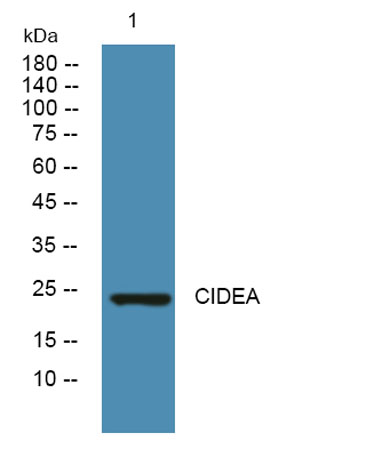
| Observed band (KD) | 24kD |
| Background | cell death-inducing DFFA-like effector a(CIDEA) Homo sapiens This gene encodes the homolog of the mouse protein Cidea that has been shown to activate apoptosis. This activation of apoptosis is inhibited by the DNA fragmentation factor DFF45 but not by caspase inhibitors. Mice that lack functional Cidea have higher metabolic rates, higher lipolysis in brown adipose tissue and higher core body temperatures when subjected to cold. These mice are also resistant to diet-induced obesity and diabetes. This suggests that in mice this gene product plays a role in thermogenesis and lipolysis. Alternatively spliced transcripts have been identified. [provided by RefSeq, Aug 2010], |
| Function | function:Activates apoptosis.,similarity:Contains 1 CIDE-N domain.,subunit:Inhibited by DFFB., |
| Subcellular location | Lipid droplet . Nucleus . Enriched at lipid droplet contact sites. Has been shown to localize to mitochondria, where it could interact with UCP1 and hence inhibit UCP1 uncoupling activity (By similarity). These data could not be confirmed (PubMed:18509062). . |
| Expression | Expressed in omental and subcutaneous adipose tissue (at protein level). |

Use collapsible tabs for more detailed information that will help customers make a purchasing decision.
Ex: Shipping and return policies, size guides, and other common questions.