 Français
 English

| ELK.No | ES9372 |
| Product name | ADHX rabbit pAb |
| Reactivity | Human;Mouse;Rat |
| Applications | WB;ELISA |
| Other name | |
| Size | 100μL |
| Unit price ($) | 248 |
| Human gene ID | 128 |
| Human Swiss-Prot | P11766 |
| Source | Rabbit |
| Isotype | IgG |
| Target | ADHX |
| Fields | >>Glycolysis / Gluconeogenesis;>>Fatty acid degradation;>>Tyrosine metabolism;>>Pyruvate metabolism;>>Retinol metabolism;>>Metabolism of xenobiotics by cytochrome P450;>>Drug metabolism - cytochrome P450;>>Metabolic pathways;>>Carbon metabolism;>>Alcoholic liver disease |
| Gene name | ADH5 ADHX FDH |
| Protein name | Alcohol dehydrogenase class-3 (EC 1.1.1.1) (Alcohol dehydrogenase 5) (Alcohol dehydrogenase class chi chain) (Alcohol dehydrogenase class-III) (Glutathione-dependent formaldehyde dehydrogenase) (FALDH |
| Human gene link | |
| Human Swiss link | View Human Swiss-Prot |
| Mouse gene ID | |
| Mouse gene link | |
| Mouse Swiss-Prot | P28474 |
| Mouse Swiss link | View Mouse Swiss-Prot |
| Rat gene ID | |
| Rat gene link | |
| Rat Swiss-Prot | P12711 |
| Rat Swiss link | View Rat Swiss-Prot |
| Immunogen | Synthesized peptide derived from human protein . at AA range: 280-360 |
| Specificity | ADHX Polyclonal Antibody detects endogenous levels of protein. |
| Formulation | Liquid in PBS containing 50% glycerol, and 0.02% sodium azide. |
| Clonality | Polyclonal |
| Dilution | WB 1:500-2000 ELISA 1:5000-20000 |
| Purification | The antibody was affinity-purified from rabbit antiserum by affinity-chromatography using epitope-specific immunogen. |
| Concentration | 1 mg/ml |
| Storage stability | -20°C/1 year |
| Molecular Weight (Da) | |
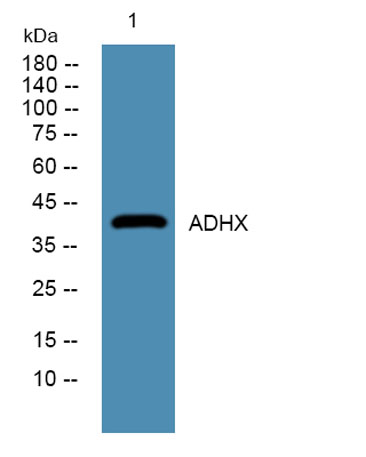
| Observed band (KD) | 41kD |
| Background | This gene encodes a member of the alcohol dehydrogenase family. Members of this family metabolize a wide variety of substrates, including ethanol, retinol, other aliphatic alcohols, hydroxysteroids, and lipid peroxidation products. The encoded protein forms a homodimer. It has virtually no activity for ethanol oxidation, but exhibits high activity for oxidation of long-chain primary alcohols and for oxidation of S-hydroxymethyl-glutathione, a spontaneous adduct between formaldehyde and glutathione. This enzyme is an important component of cellular metabolism for the elimination of formaldehyde, a potent irritant and sensitizing agent that causes lacrymation, rhinitis, pharyngitis, and contact dermatitis. The human genome contains several non-transcribed pseudogenes related to this gene. [provided by RefSeq, Oct 2008], |
| Function | catalytic activity:An alcohol + NAD(+) = an aldehyde or ketone + NADH.,catalytic activity:S-(hydroxymethyl)glutathione + NAD(P)(+) = S-formylglutathione + NAD(P)H.,cofactor:Binds 2 zinc ions per subunit.,cofactor:Zinc.,function:Class-III ADH is remarkably ineffective in oxidizing ethanol, but it readily catalyzes the oxidation of long-chain primary alcohols and the oxidation of S-(hydroxymethyl) glutathione.,miscellaneous:There are 7 different ADH's isozymes in human: three belongs to class-I: alpha, beta, and gamma, one to class-II: pi, one to class-III: chi, one to class-IV: ADH7 and one to class-V: ADH6.,similarity:Belongs to the zinc-containing alcohol dehydrogenase family. Class-III subfamily.,subunit:Homodimer., |
| Subcellular location | Cytoplasm . |
| Expression | Amygdala,B-cell,Liver,Skin, |

Use collapsible tabs for more detailed information that will help customers make a purchasing decision.
Ex: Shipping and return policies, size guides, and other common questions.