 Français
 English

| ELK.No | ES9646 |
| Product name | NEIL2 rabbit pAb |
| Reactivity | Human;Mouse |
| Applications | WB;ELISA |
| Other name | |
| Size | 50μL |
| Unit price ($) | 148 |
| Human gene ID | 252969 |
| Human Swiss-Prot | Q969S2 |
| Source | Rabbit |
| Isotype | IgG |
| Target | NEIL2 |
| Fields | >>Base excision repair |
| Gene name | NEIL2 |
| Protein name | Endonuclease 8-like 2 (EC 3.2.2.-) (EC 4.2.99.18) (DNA glycosylase/AP lyase Neil2) (DNA-(apurinic or apyrimidinic site) lyase Neil2) (Endonuclease VIII-like 2) (Nei homolog 2) (NEH2) (Nei-like protein |
| Human gene link | |
| Human Swiss link | View Human Swiss-Prot |
| Mouse gene ID | |
| Mouse gene link | |
| Mouse Swiss-Prot | Q6R2P8 |
| Mouse Swiss link | View Mouse Swiss-Prot |
| Rat gene ID | |
| Rat gene link | |
| Rat Swiss-Prot | |
| Rat Swiss link | |
| Immunogen | Synthesized peptide derived from part region of human protein |
| Specificity | NEIL2 Polyclonal Antibody detects endogenous levels of protein. |
| Formulation | Liquid in PBS containing 50% glycerol, and 0.02% sodium azide. |
| Clonality | Polyclonal |
| Dilution | WB 1:500-2000 ELISA 1:5000-20000 |
| Purification | The antibody was affinity-purified from rabbit antiserum by affinity-chromatography using epitope-specific immunogen. |
| Concentration | 1 mg/ml |
| Storage stability | -20°C/1 year |
| Molecular Weight (Da) | |
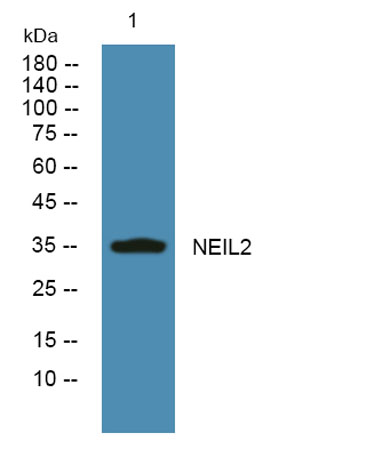
| Observed band (KD) | 36kD |
| Background | NEIL2 belongs to a class of DNA glycosylases homologous to the bacterial Fpg/Nei family. These glycosylases initiate the first step in base excision repair by cleaving bases damaged by reactive oxygen species and introducing a DNA strand break via the associated lyase reaction (Bandaru et al., 2002 [PubMed 12509226])[supplied by OMIM, Mar 2008], |
| Function | catalytic activity:Removes damaged bases from DNA, leaving an abasic site.,catalytic activity:The C-O-P bond 3' to the apurinic or apyrimidinic site in DNA is broken by a beta-elimination reaction, leaving a 3'-terminal unsaturated sugar and a product with a terminal 5'-phosphate.,domain:The zinc-finger domain is important for DNA binding.,enzyme regulation:Acetylation of Lys-50 leads to loss of DNA nicking activity. Acetylation of Lys-154 has no effect.,function:Involved in base excision repair of DNA damaged by oxidation or by mutagenic agents. Has DNA glycosylase activity towards 5-hydroxyuracil and other oxidized derivatives of cytosine with a preference for mismatched double stranded DNA (DNA bubbles). Has low or no DNA glycosylase activity towards thymine glycol, 2-hydroxyadenine, hypoxanthine and 8-oxoguanine. Has AP (apurinic/apyrimidinic) lyase activity and introduces nicks in t |
| Subcellular location | Nucleus . |
| Expression | Detected in testis, skeletal muscle, heart, brain, placenta, lung, pancreas, kidney and liver. |

Use collapsible tabs for more detailed information that will help customers make a purchasing decision.
Ex: Shipping and return policies, size guides, and other common questions.
