 Français
 English

| ELK.No | ES9676 |
| Product name | HPGDS rabbit pAb |
| Reactivity | Human;Rat;Mouse; |
| Applications | WB;ELISA |
| Other name | |
| Size | 50μL |
| Unit price ($) | 148 |
| Human gene ID | 27306 |
| Human Swiss-Prot | O60760 |
| Source | Rabbit |
| Isotype | IgG |
| Target | HPGDS |
| Fields | >>Glutathione metabolism;>>Arachidonic acid metabolism;>>Metabolism of xenobiotics by cytochrome P450;>>Drug metabolism - cytochrome P450;>>Metabolic pathways;>>Chemical carcinogenesis - DNA adducts |
| Gene name | HPGDS GSTS PGDS PTGDS2 |
| Protein name | Hematopoietic prostaglandin D synthase (H-PGDS) (EC 5.3.99.2) (GST class-sigma) (Glutathione S-transferase) (EC 2.5.1.18) (Glutathione-dependent PGD synthase) (Glutathione-requiring prostaglandin D sy |
| Human gene link | |
| Human Swiss link | View Human Swiss-Prot |
| Mouse gene ID | |
| Mouse gene link | |
| Mouse Swiss-Prot | Q9JHF7 |
| Mouse Swiss link | View Mouse Swiss-Prot |
| Rat gene ID | |
| Rat gene link | |
| Rat Swiss-Prot | O35543 |
| Rat Swiss link | View Rat Swiss-Prot |
| Immunogen | Synthesized peptide derived from part region of human protein |
| Specificity | HPGDS Polyclonal Antibody detects endogenous levels of protein. |
| Formulation | Liquid in PBS containing 50% glycerol, and 0.02% sodium azide. |
| Clonality | Polyclonal |
| Dilution | WB 1:500-2000 ELISA 1:5000-20000 |
| Purification | The antibody was affinity-purified from rabbit antiserum by affinity-chromatography using epitope-specific immunogen. |
| Concentration | 1 mg/ml |
| Storage stability | -20°C/1 year |
| Molecular Weight (Da) | |
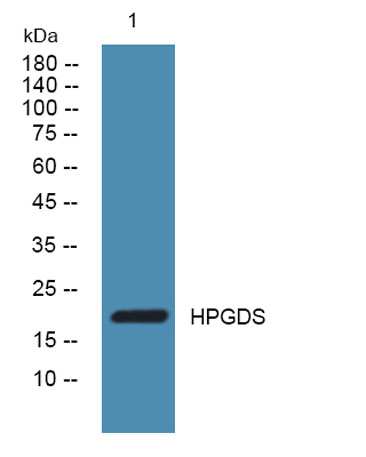
| Observed band (KD) | 21kD |
| Background | Prostaglandin-D synthase is a sigma class glutathione-S-transferase family member. The enzyme catalyzes the conversion of PGH2 to PGD2 and plays a role in the production of prostanoids in the immune system and mast cells. The presence of this enzyme can be used to identify the differentiation stage of human megakaryocytes. [provided by RefSeq, Jul 2008], |
| Function | catalytic activity:(5Z,13E,15S)-9-alpha,11-alpha-epidioxy-15-hydroxyprosta-5,13-dienoate = (5Z,13E,15S)-9-alpha,15-dihydroxy-11-oxoprosta-5,13-dienoate.,developmental stage:Expression in the amniotic fluid increases dramatically during weeks 12 to 25 of pregnancy. Levels decrease slowly after 25 weeks.,function:Catalyzes the conversion of PGH2 to PGD2, a prostaglandin involved in smooth muscle contraction/relaxation and a potent inhibitor of platelet aggregation. Involved in a variety of CNS functions, such as sedation, NREM sleep and PGE2-induced allodynia, and may have an anti-apoptotic role in oligodendrocytes. Binds small non-substrate lipophilic molecules, including biliverdin, bilirubin, retinal, retinoic acid and thyroid hormone, and may act as a scavenger for harmful hydrophopic molecules and as a secretory retinoid and thyroid hormone transporter. Possibly involved in developmen |
| Subcellular location | Cytoplasm . |
| Expression | Expressed in a number of megakaryocytic cell lines but not in platelets. Highly expressed in adipose tissue, macrophages and placenta. Also expressed at lower levels in lung, heart, lymph nodes, appendix, bone marrow and fetal liver. |

Use collapsible tabs for more detailed information that will help customers make a purchasing decision.
Ex: Shipping and return policies, size guides, and other common questions.
