 Français
 English

| ELK.No | ES9684 |
| Product name | GCH1 rabbit pAb |
| Reactivity | Human;Mouse;Rat |
| Applications | WB;ELISA |
| Other name | |
| Size | 50μL |
| Unit price ($) | 148 |
| Human gene ID | 2643 |
| Human Swiss-Prot | P30793 |
| Source | Rabbit |
| Isotype | IgG |
| Target | GCH1 |
| Fields | >>Folate biosynthesis;>>Metabolic pathways;>>Biosynthesis of cofactors |
| Gene name | GCH1 DYT5 GCH |
| Protein name | GTP cyclohydrolase 1 (EC 3.5.4.16) (GTP cyclohydrolase I) (GTP-CH-I) |
| Human gene link | |
| Human Swiss link | View Human Swiss-Prot |
| Mouse gene ID | |
| Mouse gene link | |
| Mouse Swiss-Prot | Q05915 |
| Mouse Swiss link | View Mouse Swiss-Prot |
| Rat gene ID | |
| Rat gene link | |
| Rat Swiss-Prot | P22288 |
| Rat Swiss link | View Rat Swiss-Prot |
| Immunogen | Synthesized peptide derived from part region of human protein |
| Specificity | GCH1 Polyclonal Antibody detects endogenous levels of protein. |
| Formulation | Liquid in PBS containing 50% glycerol, and 0.02% sodium azide. |
| Clonality | Polyclonal |
| Dilution | WB 1:500-2000 ELISA 1:5000-20000 |
| Purification | The antibody was affinity-purified from rabbit antiserum by affinity-chromatography using epitope-specific immunogen. |
| Concentration | 1 mg/ml |
| Storage stability | -20°C/1 year |
| Molecular Weight (Da) | |
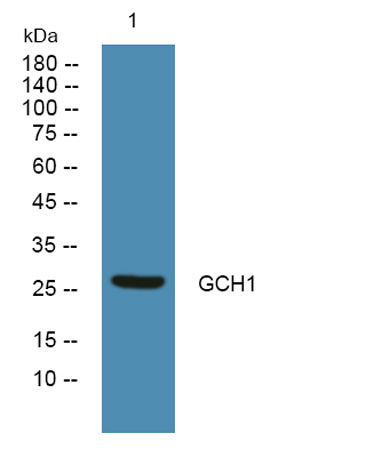
| Observed band (KD) | 27kD |
| Background | This gene encodes a member of the GTP cyclohydrolase family. The encoded protein is the first and rate-limiting enzyme in tetrahydrobiopterin (BH4) biosynthesis, catalyzing the conversion of GTP into 7,8-dihydroneopterin triphosphate. BH4 is an essential cofactor required by aromatic amino acid hydroxylases as well as nitric oxide synthases. Mutations in this gene are associated with malignant hyperphenylalaninemia and dopa-responsive dystonia. Several alternatively spliced transcript variants encoding different isoforms have been described; however, not all variants give rise to a functional enzyme. [provided by RefSeq, Jul 2008], |
| Function | catalytic activity:GTP + H(2)O = formate + 2-amino-4-hydroxy-6-(erythro-1,2,3-trihydroxypropyl)-dihydropteridine triphosphate.,disease:Defects in GCH1 are the cause of dystonia type 5 (DYT5) [MIM:128230]; also known as progressive dystonia with diurnal fluctuation, autosomal dominant Segawa syndrome or dystonia-parkinsonism with diurnal fluctuation. DYT5 is a DOPA-responsive dystonia. Dystonia is defined by the presence of sustained involuntary muscle contractions, often leading to abnormal postures. DYT5 typically presents in childhood with walking problems due to dystonia of the lower limbs and worsening of the dystonia towards the evening. It is characterized by postural and motor disturbances showing marked diurnal fluctuation. Torsion of the trunk is unusual. Symptoms are alleviated after sleep and aggravated by fatigue and excercise. There is a favorable response to L-DOPA without |
| Subcellular location | Cytoplasm . Nucleus . |
| Expression | In epidermis, expressed predominantly in basal undifferentiated keratinocytes and in some but not all melanocytes (at protein level). |

Use collapsible tabs for more detailed information that will help customers make a purchasing decision.
Ex: Shipping and return policies, size guides, and other common questions.
