 Français
 English

| ELK.No | ES9733 |
| Product name | HXD13 rabbit pAb |
| Reactivity | Human;Mouse |
| Applications | WB;ELISA |
| Other name | |
| Size | 100μL |
| Unit price ($) | 248 |
| Human gene ID | 3239 |
| Human Swiss-Prot | P35453 |
| Source | Rabbit |
| Isotype | IgG |
| Target | HXD13 |
| Fields | |
| Gene name | HOXD13 HOX4I |
| Protein name | Homeobox protein Hox-D13 (Homeobox protein Hox-4I) |
| Human gene link | |
| Human Swiss link | View Human Swiss-Prot |
| Mouse gene ID | |
| Mouse gene link | |
| Mouse Swiss-Prot | P70217 |
| Mouse Swiss link | View Mouse Swiss-Prot |
| Rat gene ID | |
| Rat gene link | |
| Rat Swiss-Prot | |
| Rat Swiss link | |
| Immunogen | Synthesized peptide derived from part region of human protein |
| Specificity | HXD13 Polyclonal Antibody detects endogenous levels of protein. |
| Formulation | Liquid in PBS containing 50% glycerol, and 0.02% sodium azide. |
| Clonality | Polyclonal |
| Dilution | WB 1:500-2000 ELISA 1:5000-20000 |
| Purification | The antibody was affinity-purified from rabbit antiserum by affinity-chromatography using epitope-specific immunogen. |
| Concentration | 1 mg/ml |
| Storage stability | -20°C/1 year |
| Molecular Weight (Da) | |
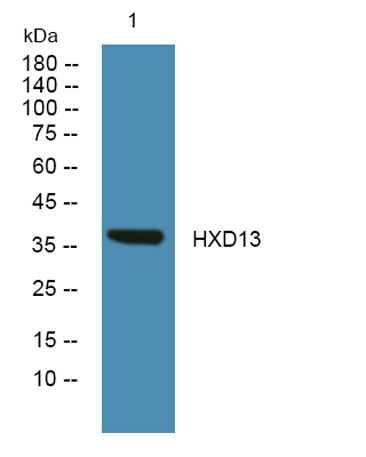
| Observed band (KD) | 37kD |
| Background | This gene belongs to the homeobox family of genes. The homeobox genes encode a highly conserved family of transcription factors that play an important role in morphogenesis in all multicellular organisms. Mammals possess four similar homeobox gene clusters, HOXA, HOXB, HOXC and HOXD, located on different chromosomes, consisting of 9 to 11 genes arranged in tandem. This gene is one of several homeobox HOXD genes located in a cluster on chromosome 2. Deletions that remove the entire HOXD gene cluster or the 5' end of this cluster have been associated with severe limb and genital abnormalities. Mutations in this particular gene cause synpolydactyly. [provided by RefSeq, Jul 2008], |
| Function | caution:It is uncertain whether Met-1 or Met-9 is the initiator.,disease:Defects in HOXD13 are the cause of brachydactyly type D (BDD) [MIM:113200]. BDD is characterized by short and broad terminal phalanges of the thumbs and big toes. Inheritance is autosomal dominant.,disease:Defects in HOXD13 are the cause of brachydactyly type E (BDE) [MIM:113300]. BDE is characterized by shortening of the fingers mainly in the metacarpals and metatarsals. Inheritance is autosomal dominant.,disease:Defects in HOXD13 are the cause of brachydactyly-syndactyly syndrome (BDSD) [MIM:610713]. Most of affected individuals exhibit generalized shortening of the hands and feet, broad and short distal phalanges of the thumbs, and cutaneous syndactyly of toes 2 and 3. The limb phenotypes observed in this syndrome overlap those of brachydactyly types A4, D, E and syndactyly type 1.,disease:Defects in HOXD13 are t |
| Subcellular location | Nucleus . |
| Expression |

Use collapsible tabs for more detailed information that will help customers make a purchasing decision.
Ex: Shipping and return policies, size guides, and other common questions.
