Français
 English



Product Information
|
Protein full name |
Plasminogen activator inhibitor 2, macrophage |
|
Synonyms |
PAI-2, Serpin B2, Serpinb2, Pai2, Planh2, Monocyte Arginine-serpin, Urokinase inhibitor |
|
Uniprot ID |
P12388 |
|
Immunogen |
Recombinant protein corresponding to Mouse SerpinB2/PAI-2 |
|
Isotype |
IgG |
|
Predicted MW./Observed MW. |
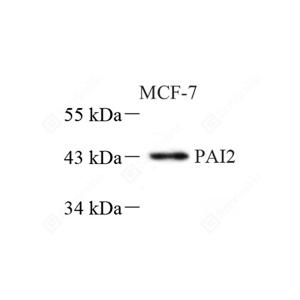
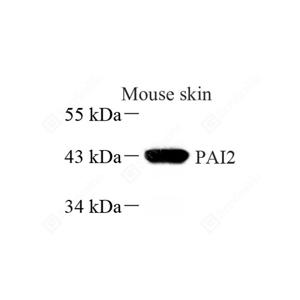
46 kDa / 42 kDa |
|
Purity |
Affinity purification |
|
Subcellular location |
Cytoplasm, Secreted |
Applications
| Applications | Species | Dilution | Positive Tissue |
| WB | Human, Mouse | 1: 500-1: 1000 | skin |
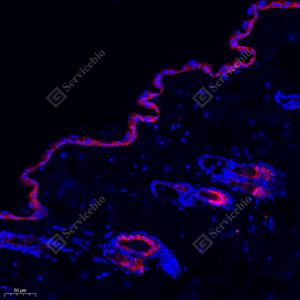
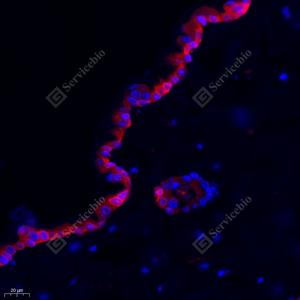
| IHC/IF | Human, Mouse, Rat | 1: 600-1: 1200 | Hodgkin's lymphoma, skin |
Background
SerpinB2 is a serine proteinase inhibitor of the ovalbumin like B clade of serpins. It was first discovered in the placenta, and given the name PAI-2 because of the ability to inhibit urokinase plasminogen activator (u-PA) at low micromolar efficiency. SerpinB2 also inhibits tissue plasminogen activator (t-PA), but with micromolar efficiency, and PAI-1 is much more efficient that SerpinB2 on both forms of plasminogen activator. The structure of PAI-2 is not terribly similar to PAI-1, however, which is an E clade serpin.
Images
|
|
WB analysis of SerpinB2/PAI-2(GB112219). Sample: Protein treated by RIPA Lysis Buffer (G2002). Blocking buffer: 3% Nonfat dry milk (GC310001) in TBST, RT, 1h. Primary antibody: 1: 1000, 4℃ overnight. Secondary antibody: HRP conjugated Goat Anti-Rabbit lgG (H+L) (GB23303), 1: 5000, RT, 1h. |
|
|
WB analysis of SerpinB2/PAI-2(GB112219). Sample: Protein treated by RIPA Lysis Buffer (G2002). Blocking buffer: 3% Nonfat dry milk (GC310001) in TBST, RT, 1h. Primary antibody: 1: 1000, 4℃ overnight. Secondary antibody: HRP conjugated Goat Anti-Rabbit lgG (H+L) (GB23303), 1: 5000, RT, 1h. |
|
|
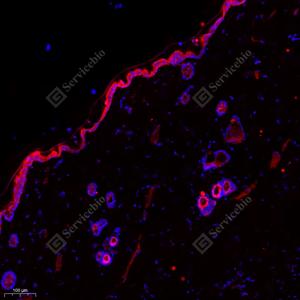
IF analysis of SerpinB2/PAI-2(GB112219)red. Sample: Mouse skin, 4% PFA (G1101) 12-24h. Antigen retrieval: Tris-EDTA buffer (pH 9.0) (G1203), 98℃, 20min. Blocking buffer: 3% BSA (GC305010) in PBS, RT, 30min. Primary antibody: 1: 600, 4℃ overnight. Secondary antibody: Cy3 conjugated Goat Anti-Rabbit IgG (H+L) (GB21303), 1: 300, RT, 1h. |
|
|
IF analysis of SerpinB2/PAI-2(GB112219)red. Sample: Mouse skin, 4% PFA (G1101) 12-24h. Antigen retrieval: Tris-EDTA buffer (pH 9.0) (G1203), 98℃, 20min. Blocking buffer: 3% BSA (GC305010) in PBS, RT, 30min. Primary antibody: 1: 600, 4℃ overnight. Secondary antibody: Cy3 conjugated Goat Anti-Rabbit IgG (H+L) (GB21303), 1: 300, RT, 1h. |
|
|
IF analysis of SerpinB2/PAI-2(GB112219)red. Sample: Rat skin, 4% PFA (G1101) 12-24h. Antigen retrieval: Tris-EDTA buffer (pH 9.0) (G1203), 98℃, 20min. Blocking buffer: 3% BSA (GC305010) in PBS, RT, 30min. Primary antibody: 1: 600, 4℃ overnight. Secondary antibody: Cy3 conjugated Goat Anti-Rabbit IgG (H+L) (GB21303), 1: 300, RT, 1h. |
|
|
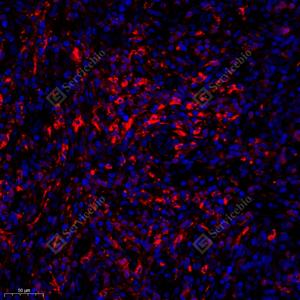
IF analysis of SerpinB2/PAI-2(GB112219)red. Sample: Human Hodgkin's lymphoma, 4% PFA (G1101) 12-24h. Antigen retrieval: Tris-EDTA buffer (pH 9.0) (G1203), 98℃, 20min. Blocking buffer: 3% BSA (GC305010) in PBS, RT, 30min. Primary antibody: 1: 600, 4℃ overnight. Secondary antibody: Cy3 conjugated Goat Anti-Rabbit IgG (H+L) (GB21303), 1: 300, RT, 1h. |
Storage
| Storage | Store at -20℃ for one year. Avoid repeated freeze/thaw cycles. |
| Storage Buffer | PBS with 0.15% ProClin300, 100 μg/mL BSA and 50% glycerol. |
NOTE:
1.This product is intended for research only.
2.This product is recommended to dilute with the Primary Antibody Dilution Buffer (G2025).
Use collapsible tabs for more detailed information that will help customers make a purchasing decision.
Ex: Shipping and return policies, size guides, and other common questions.