Français
 English



Product Information
|
Protein full name |
Hematopoietic progenitor cell antigen CD34 |
|
Synonyms |
CD34, HPCA1, Mucosialin, Cluster designation 34, cluster of differentiation 34, CD34 antigen, CD34 molecule |
|
Uniprot ID |
Q64314 |
|
Immunogen |
Recombinant protein corresponding to Mouse CD34 |
|
Isotype |
IgG |
|
Predicted MW./Observed MW. |
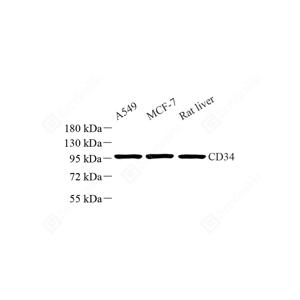
41 kDa / 110 kDa |
|
Purity |
Affinity purification |
Applications
| Applications | Species | Dilution | Positive Tissue |
| WB | Human, Mouse, Rat | 1: 500-1: 800 | liver |
Background
CD34 is a 105- to 120-kDa glycophosphoprotein expressed on the majority of hematopoietic stem/progenitor cells, bone marrow stromal cells, capillary endothelial cells, embryonic fibroblasts, and some nerve tissue. CD34 is a commonly used marker for identifying human hematopoietic stem/progenitor cells and mediates cell adhesion and lymphocyte homing by binding L-selectin and E-selectin ligands. CD34 is also one of the best negative selection markers for characterizing and/or isolating human MSCs from bone marrow and other sources.
Images
|
|
WB analysis of CD34(GB11013). Sample: Protein treated by RIPA Lysis Buffer (G2002). Blocking buffer: 3% Nonfat dry milk (GC310001) in TBST, RT, 1h. Primary antibody: 1: 500, 4℃ overnight. Secondary antibody: HRP conjugated Goat Anti-Rabbit lgG (H+L) (GB23303), 1: 5000, RT, 1h. |
Storage
| Storage | Store at -20℃ for one year. Avoid repeated freeze/thaw cycles. |
| Storage Buffer | PBS with 0.15% ProClin300, 100 μg/mL BSA and 50% glycerol. |
NOTE:
1.This product is intended for research only.
2.This product is recommended to dilute with the Primary Antibody Dilution Buffer (G2025).
Use collapsible tabs for more detailed information that will help customers make a purchasing decision.
Ex: Shipping and return policies, size guides, and other common questions.