Product Information
Protein full name | Nuclear factor NF-kappa-B p105 subunit |
Synonyms | DNA binding factor KBF1, EBP 1, KBF1, NF kappa B, NFKB p105, NFKB p50, NFKB1, NFKB1,p105, NFKB1,p105,p50, nfkb1a, NF-κB, NF-κB 1, p105, p50 |
Uniprot ID | P25799 |
Immunogen | KLH conjugated Synthetic peptide corresponding to Mouse NFkBp105 |
Isotype | IgG |
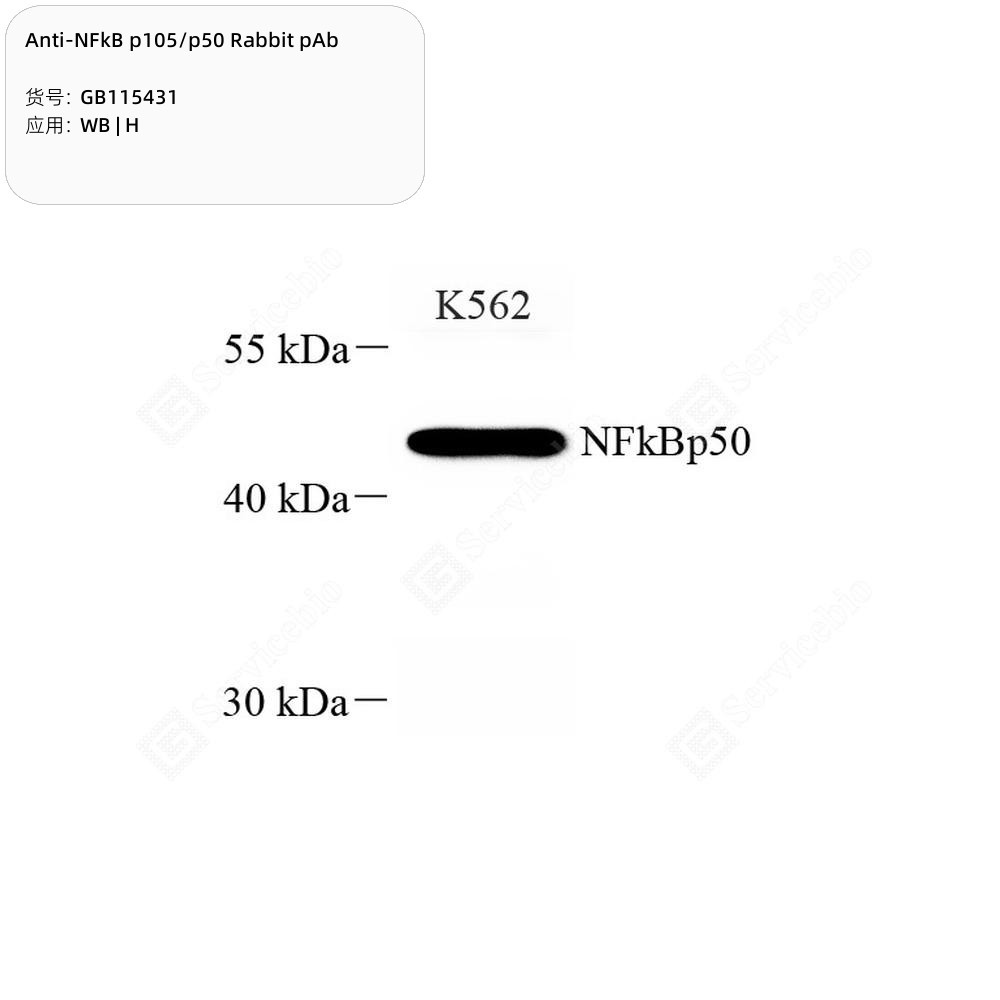
Predicted MW./Observed MW. | 105/84/98/40/65/56/44 kDa / 44 kDa |
Purity | Affinity purification |
Applications
| Applications | Species | Dilution | Positive Tissue |
| WB | Human | 1: 300-1: 800 | K562 |
Background
NF-kappa-B is a pleiotropic transcription factor present in almost all cell types and is the endpoint of a series of signal transduction events that are initiated by a vast array of stimuli related to many biological processes such as inflammation, immunity, differentiation, cell growth, tumorigenesis and apoptosis. NF-kappa-B is a homo- or heterodimeric complex formed by the Rel-like domain-containing proteins RELA/p65, RELB, NFKB1/p105, NFKB1/p50, REL and NFKB2/p52 and the heterodimeric p65-p50 complex appears to be most abundant one. The dimers bind at kappa-B sites in the DNA of their target genes and the individual dimers have distinct preferences for different kappa-B sites that they can bind with distinguishable affinity and specificity. Different dimer combinations act as transcriptional activators or repressors, respectively. NF-kappa-B is controlled by various mechanisms of post-translational modification and subcellular compartmentalization as well as by interactions with other cofactors or corepressors. NF-kappa-B complexes are held in the cytoplasm in an inactive state complexed with members of the NF-kappa-B inhibitor (I-kappa-B) family. In a conventional activation pathway, I-kappa-B is phosphorylated by I-kappa-B kinases (IKKs) in response to different activators, subsequently degraded thus liberating the active NF-kappa-B complex which translocates to the nucleus. NF-kappa-B heterodimeric p65-p50 and RelB-p50 complexes are transcriptional activators. The NF-kappa-B p50-p50 homodimer is a transcriptional repressor, but can act as a transcriptional activator when associated with BCL3. NFKB1 appears to have dual functions such as cytoplasmic retention of attached NF-kappa-B proteins by p105 and generation of p50 by a cotranslational processing. The proteasome-mediated process ensures the production of both p50 and p105 and preserves their independent function, although processing of NFKB1/p105 also appears to occur post-translationally. p50 binds to the kappa-B consensus sequence 5'-GGRNNYYCC-3', located in the enhancer region of genes involved in immune response and acute phase reactions. Plays a role in the regulation of apoptosis. Isoform 5, isoform 6 and isoform 7 act as inhibitors of transactivation of p50 NF-kappa-B subunit, probably by sequestering it in the cytoplasm. Isoform 3 (p98) (but not p84 or p105) acts as a transactivator of NF-kappa-B-regulated gene expression. In a complex with MAP3K8, NFKB1/p105 represses MAP3K8-induced MAPK signaling; active MAP3K8 is released by proteasome-dependent degradation of NFKB1/p105.
Images
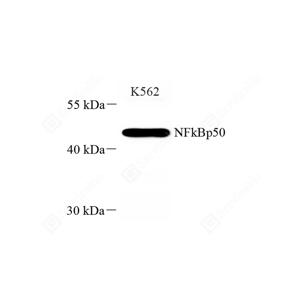
| WB analysis of NFkB p105/p50(GB115431).
Sample: Protein treated by RIPA Lysis Buffer (G2002).
Blocking buffer: 3% Nonfat dry milk (GC310001) in TBST, RT, 1h.
Primary antibody: 1: 800, 4°C overnight.
Secondary antibody: HRP conjugated Goat Anti-Rabbit lgG (H+L) (GB23303), 1: 5000, RT, 1h. |
Storage
| Storage | Store at -20°C for one year. Avoid repeated freeze/thaw cycles. |
| Storage Buffer | PBS with 0.15% ProClin300, 100 µg/mL BSA and 50% glycerol. |
NOTE:
1.This product is intended for research only.
2.This product is recommended to dilute with the Primary Antibody Dilution Buffer (G2025).
Datasheet: Download datasheet 1

 Français
 English