Français
 English


Product Information | |||||
Protein full name | Microtubule-associated protein tau | ||||
Synonyms | MAPTL, MTBT1, TAU, MAPT, p-TAU | ||||
Immunogen | Recombinant protein corresponding to Human Phospho-Tau(S202/T205) | ||||
Uniprot ID | P10636 | ||||
Isotype | IgG, κ | ||||
Clone Number | SB372 | ||||
Purity | Affinity purification | ||||
Subcellular location | Cytoplasm, Cell membrane | ||||
Predicted MW. / Observed MW. | 79 kDa / 50-80 kDa | ||||
Applications | Species | Dilution | Positive Tissue | ||
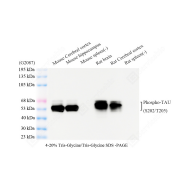
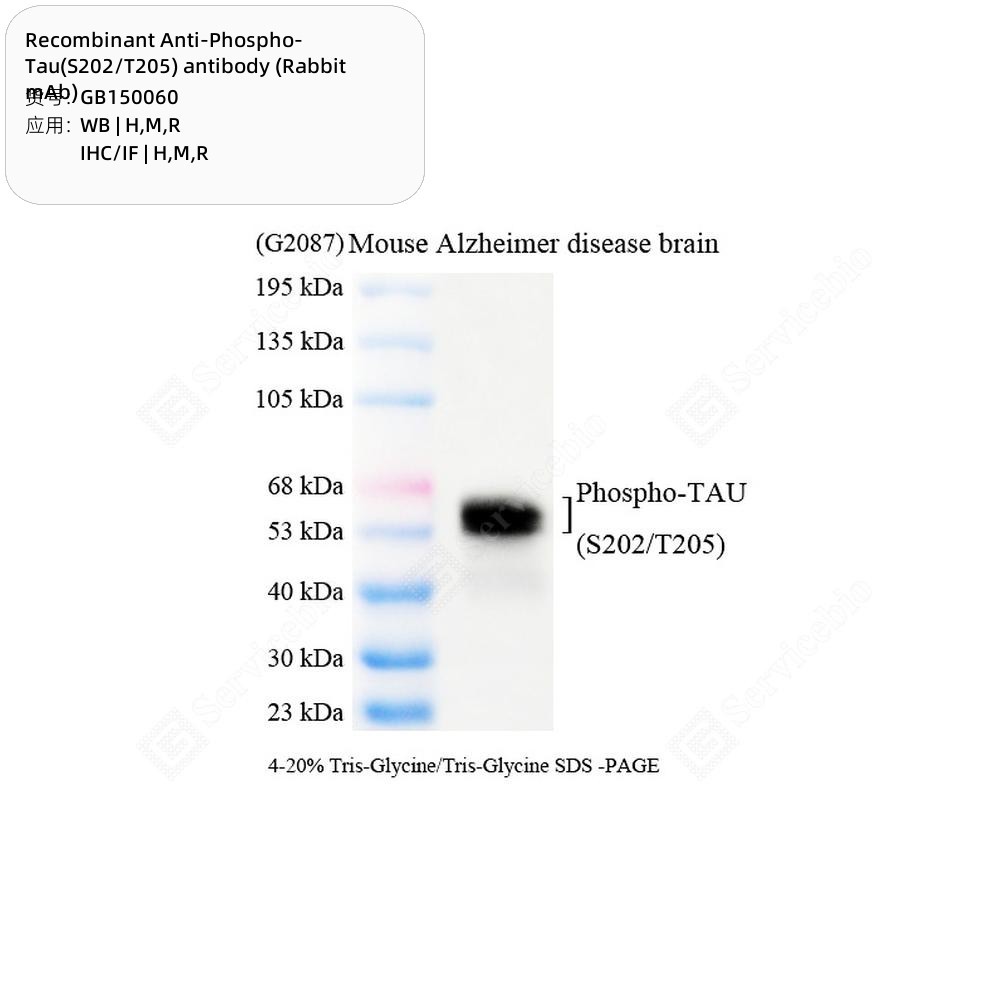
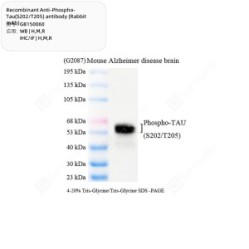
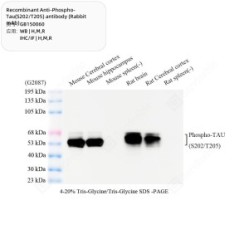
WB | Human, Mouse, Rat | 1: 1000-1: 2000 | Cerebral cortex, brain, Alzheimerdiseasebrain | ||
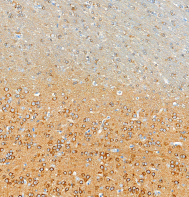
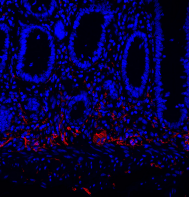
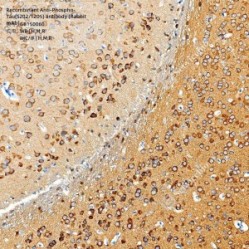
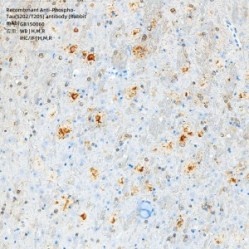
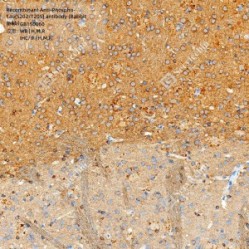
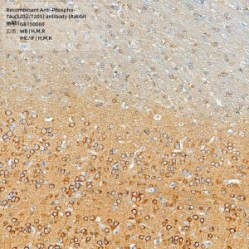
IHC/IF | Human, Mouse, Rat | 1: 150-1: 500 | colon, brain, Alzheimer's brain | ||
Storage | |||||
Storage | Store at -20℃ for one year. Avoid repeated freeze/thaw cycles. | ||||
Storage Buffer | PBS with 0.15% ProClin300, 100 μg/mL BSA and 50% glycerol. | ||||
background | |||||
Promotes microtubule assembly and stability, and might be involved in the establishment and maintenance of neuronal polarity.The C-terminus binds axonal microtubules while the N-terminus binds neural plasma membrane components, suggesting that tau functions as a linker protein between both.Axonal polarity is predetermined by TAU/MAPT localization (in the neuronal cell) in the domain of the cell body defined by the centrosome. The short isoforms allow plasticity of the cytoskeleton whereas the longer isoforms may preferentially play a role in its stabilization. | |||||
Images | |||||
|
|
| |||
WB analysis of Phospho-Tau(S202/Y205)(GB150060). | IHC analysis of Phospho-Tau(S202/Y205)(GB150060). | IF analysis of Phospho-Tau(S202/Y205)(GB150060)red. | |||
For Research Use Only!
Use collapsible tabs for more detailed information that will help customers make a purchasing decision.
Ex: Shipping and return policies, size guides, and other common questions.